Pyotr Semyenov – Tianshansky
Just outside Balykchi is a statue of the Russian explorer Pyotr Petrovich Semyenov leading his packhorse. He was awarded the honorary title TienShansky by the Tsar in 1906, some 50 years after his expeditions, in recognition of his achievements.
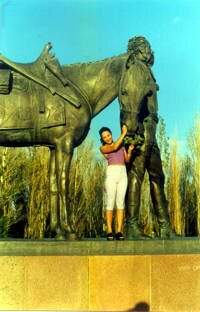
Born in 1827, in the village of Urusovo in the Leningrad region of Russia, Semyenov graduated from Petersburg University in 1848 and was elected a member of the Russian Geographical Society in 1849 which was then the fourth most important in the world after those in London, Paris and Berlin. In 1873, he became a vice-president of the society and later, as President, was the inspiration and “soul” of many of the journeys of exploration which the society organized.
His importance went beyond that of being an explorer. He played a significant role in the ending of serfdom in 1861, was the initiator and organizer of the first General Population Census of the Russian Empire as well as an influential voice for the expansionist policy of the Russian Empire into Central Asia.
Popular amongst his contemporaries, he was regarded a sympathetic and wise counsellor.
He was a great collector … particularly of natural specimens and paintings.
As a highly cultured professional soldier – he was well versed (and an inveterate collector of specimens), in zoology, botany mineralogy, ethnology, topography and art, (his collection of 719 Dutch and Flemish paintings was considered the second greatest in the world and is now in the Hermitage Museum).
His true passion in life, however, was for geography. At a young age, he translated the book “The Physical Geography of Asia” by the famous German geographer Karl Fitter from the original German into Russian and travelled to Italy, apparently climbing Mount Vesuvius seventeen times. (Like most geographers of the time, he thought that the Tien Shan Mountains were of volcanic origin).
But, as evidenced in his honorific title, Tienshansky, Peter Petrovich Semyenov is most widely known for his explorations into the “terra incognita” of the time – the Tien Shan.
In August 1856, he arrived in Almaty – known at that time by the name Vernoe – as a little known member of the Russian Geographical Society and with an armed group of Cossacks, he crossed the Kungei Ala Too mountain range over the San Tash Pass on camels and entered the Issyk Kul hollow from the East. He mapped the lake, which he described as “A blue emerald set in a frame of silvery mountains.” Later he approached the lake through Boom Gorge and discovered that the Chui River did not flow through the lake as everyone had previously assumed. He returned to Almaty and spent the winter studying the plant and rock samples that he had collected – many of which were later to be named after him.
He returned in 1857, as a renowned and famous scholar. This time he proceeded further into the Tien Shan Mountains at the head of a small army of 1500 men. He was particularly interested in discovering more about the peak of Khan Tengi – at that time thought to be the highest point of the Tien Shan, based on information gathered from Byzantine missionaries and ancient Chinese sources.
With him was Paul Kosharov, who graduated from the Petersburg Academy of Arts in 1851 and had been an art teacher in the Tomsk grammar school. They met in Semipalatinsk, (now in Kazakhstan) and Semyenov invited him to join the expedition to record the expedition into the unexplored ranges of the Tien Shan. From the outset Kosharov made picturesque sketches of the district, historical monuments, portraits of local residents, images of the life and clothes of the local people and maps showing the progress of the group. Much of his work is now preserved in a museum in St. Petersburg. His work has been hailed as “the first detailed ethnographic album, embodying monuments of Kirghiz culture and life.”
The expedition lasted some three months. From the shores of Lake Issyk Kul, where they were interested by the stories of ancient sunken cities and the artefacts washed up on the shore, they passed through the immense green valleys, where they found yet more previously unknown plants and flowers, and then up the track, which became steeper and steeper. It was bitterly cold, and the expedition encountered the corpses of natives and animal carcasses that had remained there where they had fallen, preserved by the icy air.
They ascended up to 4,200 meters into the upper reaches of the Naryn River. Then, instead of proceeding south, the expedition headed east towards the Chinese frontier and arrived in the highest area in the entire range. In July 1857, he crossed the Kok Jar mountain pass and counted at least thirty very high mountains covered with snow, all dominated by an extraordinary pyramid-shaped mountain. (Actually, he appears to have confused the two mountains – Peak Pobeda and Khan Tengri.) He also explored many of the region’s glaciers.
As a result of his journeys of exploration, he was able to show that the Tien Shan Mountains were not made up from young volcanic rock formations – as was generally thought at the time – but were, in fact, a very old mountain range.
His expeditions covered hundreds of kilometres, crossed 23 mountain passes, in three different ranges, identifying over 50 peaks, opened the glacial regions of the Eastern Tien Shan, explored the source of the Naryn river, corrected geographical errors such as the source of the Chu River and volcanic origin of the mountain range, described the natural zones and determined the height of the Snow line, discovered about 100 new species of animals and plants, made accurate maps of the region, collected much ethnographical information about the various lives, rights and responsibilities of the different layers of society – including the taxes paid by the Kyrgyz to their respective Chinese and Kokand overlords.
Kyrgyzstan is often referred to as the “Switzerland of Central Asia” and Tienshansky may have been the first to make the comparison – he wrote about Lake Issyk Kul: “The dark, blue surface of Issyk-Kul is as blue as the surface of Geneva Lake, but the large size of Issyk-Kul makes it grandiose, which cannot be said of Geneva Lake. The Issyk-Kul water beautifully reflects snow-covered Tien Shan peaks against the background of the dark blue, bright, cloudless Central Asian sky.”
He died in St Petersburg, of pneumonia in March, 1914.
An abridged translation of Semyenov’s account of his explorations can be found at:
www.iras.ucalgary.ca/~volk/sylvia/Semenov1.htm
http://graphics.tudelft.nl/~bart/natuur/kazachstan/semenov.html




 Bishkek