Alexander the Great
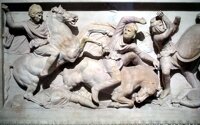
Some years ago, I visited Istanbul and while I was there I went to see all the usual sights such as the Saint Sofia Mosque and Topkapi Museum. As I was walking through the Tapkapi Museum I came across something which took me aback. There, in one of the rooms was a marble sarcophagus and the label clearly said that it belonged to Alexander the Great.
As it happens, today, (July 20th), is apparently Alexander’s birthday!
Now, there are several legends about Alexander the Great and his troops associated with different places around Kyrgyzstan, however, it’s an open question if he actually made it to the country, it is not at all clear how far into Central Asia he, himself, actually ventured.
According to some legends, for example, he is credited with founding the city of Osh … The name is said to come from his exclamation when he first saw the site … and in others he was at Lake Issyk Kul.
In the Spring of 329 BC his conquests had brought him to the banks of the River Oxus – the Amu Darya) which today forms the border between Afghanistan and Tajikistan. After defeating Darius, the king of Persia, he pursued the royal pretended Bessus across the Hindu Kush – and was nw faced with a new challenge: Bessus had burned all the wooden boats and so crossing the wide and fast flowing river seemed an impossible task. Alexander was undaunted. An creative “original thinker”, he was a marial genius. He gave orders to his troops that they should sew together the hides that they used for their tents into boat skins – and using these, the entire army had crossed the river five days after they first reached its shores. He continued the pursuit of Bessus – and finally suceeded in capturing him.
Alexander then turned his attention towards the capital of Sogdiana – Makaranda, which is now called Samarkand. Having conquered yet another capital, he moved on further North to the river Jaxartes (also known as the Syr Darya), where the Macedonian army was best upon by Scythian tribesmen. After they had been defeated Alexander founded a city on the site – which, like other cities which he established during his campaigns, was to be called Alexandria near the site of the present day city of Khojand in Tajikistan – near the Kyrgyz border. To distinguish it from the others it was called “Alexandria Eschate” – “Alexandria the Farthest”. As the name implies, this marked the furthest extent of his conquests into Central Asia.
His time in Central Asia, however, was not yet over. He was faced with what was probably the most stubborn resistance that he met in all his career - an 18 month long guerilla war with the Sogdians led by Spitamenes.
The insurgents occupied seven frontier towns. In response Alexander split his army into five smaller groups and within a couple of days, five of the towns had fallen once again into Macedonian hands and Alexander turned his attention to Cyrolis – modern Istaravshan near the Tajik-Uzbek border.
The city had been foundeed by Cyrus and efended by a high city wall. At first Alexander summoned his seige engines – but then, once again thinking “out of the box”, he devised a different, imaginative plan of action. Noticing that the stream which ran trough the town was dry – the streambed provided the oppotunity to crawl the wall, through the water channels. Alexander and some of his men entered the town this way and broke down the city gates to let the rest of the army in. During the ensuing battle the Sogdians retreated into a citadel -but, without a supply of water, were forced to surrender the following day.
Next he marched to relieve Marakanda which was being beseiged by Spitamenes. In the face of the approaching Macedonian army, the Sogdians fled to a mountain fortress – “The Sogdian Rock” – which was supposed to be impregnable. When he arrived Alexander was not put off by difficulties presented by the sheer sides of the rock on which the fortress sat. He also realised that the deep snow on the summit would not only make an assault difficult, but meant that the rebels had an ample supply of water that would enable them to sit out a lengthy siege. He offered the Sogdian rebels terms – but was greeted in reponse by laughter and jibes that he would need “soldiers with wings” to take the fortress. This served as a spur and strengthened his resolve. Amongst his troops he had about 300 soldiers who were experienced in rock climbing from previous expeditions. One night, he sent them up the steepest part of the sheer, rock, cliff face using small metal pegs and strong ropes made from flax. About 30 died by falling into the snow but the rest reached the top just as dawn was breaking. Alexander announced to the rebels that he had found his “soldiers with wings”and they were in possession of the summit – so the Sogdians might as well surrender. Imaging that theforce was much larger than the group they could see … they surrendered.
Roxanne – a Sogdian princess – was amongst the poeple holed up in the fortress – and Alexander took her to become his wife, and began to adopt local customs and dress and encouraged his troops to do likewise.
The exact location of this fortress is not known but the ancient chronicles indicate that it was in the Hissar Mountains.
Spitamenes was, however, still at large … and Alexander is said to have pursued him Eastwards to what is now known as Lake Alexander – near the Yaghnob Gorge. Alexander ordered the construction of a dam across the river – and threatened to release the waters and drown the villages below if Spitamenes was not delivered up. Although the ruse was successful, Spitamenes escaped and fled into the Makshevat Gorge where he and his handful of survivors, resolutely refusing to surrender, eventually died of starvation. Local lore identifies a desicated, partly mumified corpse, with Spitamenes.
Having finally subdued this far flung corner of his empire, Alexander turned South and headed for India … before his fellow Macedonians decided that they had had enough – and yearning for their homeland persuaded him that it was time to return to Macedonia.
So, although Alexander reached Central Asia – and we have accounts of his campaigns – it is not clear how far his travels extended into the country which is today called Kyrgyzstan. On the map, it is clear that the Batken region was within easy reach of the many places in this story – but Osh?, and Issyk Kul? Tha’t is not clear … there are no reliable accounts – and although archeologists sometimes discover coins or artifacts which exhibit a stong hellenic influence – they do not provide proof that Alexander himself was here.
.
Anyway, Happy Birthday Alexander!




 Bishkek