Tamerlane
It is not clear to me whether the great Mongol leader Tamerlane died on February 17th or the 18th, in 1405, I have seen both dates recorded in the literature. Whichever it was, I am sure that were plenty of people who were relieved by his passing – if only the envoys of the Chinese Ming Emperor that he was holding hostage at the time.
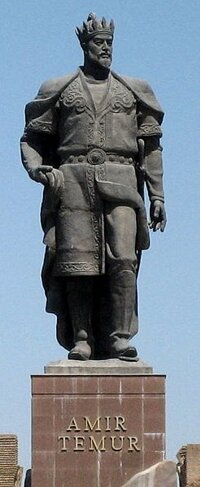
Photo: from Wikipedia
Timur (Tamerlane) was born almost seventy years before this, in 1336, (near Shakhrisabz in present day Uzbekistan), into a noble family of the “great Mogul’s” dynasty. According to this family tree, Timur and Genghis Khan shared a common ancestor, Buzanchar, which was quite important because, at that time anyone who would be a ruler claimed to be acting in the name and traditions of the great Khan. Although Timur couldn’t claim to be a direct descendant of Genghis he could, at least, claim to be a relative.
There is a story about how the young Timur was inspired by an ant, (reminiscent of the story of Robert the Bruch and the spider). He was sitting, watching the ant crawl up a blade of grass. The insect kept slipping and sliding back, but despite this it persisted and eventually succeeded in reaching the top. The young Timur apparently thought to himself: “If the ant managed to achieve its goal, then why can’t I?”
In his youth, Timur received little formal education, yet he knew several languages, (including Turkic and Persian), and in adulthood exhibited a range of knowledge. He particularly valued the practical sciences of medicine, astronomy, mathematics, and architecture.
There are no contemporary portraits of Timur which have survived to our time, but there are written records which give a description of him. The one by the Arabian scholar Ibn Arabshakh is probably the most thorough one. He wrote: “Timur was well built, tall, with wide forehead, big head, strong voice; his strength did not give way to his courage. He was a broad-shouldered man with high colour in his white face, with thin fingers, long hips, and strong muscles. He wore long beard; his right hand as well as his right leg were mutilated in battles. However, his look was rather tender.” Other writers tell us how, in his spare time, Timur would hunt or play chess, (in which, apparently, he was quite skilled).
According to the historian Shereph ad-din Ali Ezdi, he was “the scourge of his enemies, idol for his warriors and the father of his nations.” His enemies gave him the nickname ”Temur-lenk”, which in Persian meant the “Iron Lame”, and this was how he became known in the West.
From early in his youth, Timur served many of the local rulers. The time came, however, when he decided that he would fight for himself, and his own interests, alone. He started with the conquest and subjugation of Movarrounahr, his native homeland, which lay between the Amu-Darya and Syr-Darya rivers and was centered on Samarkand. Like the other lands in the region at this time, it suffered from disunity and internecine strife between the local rulers. In 1369 he defeated the last of these, (a former ally), Husein of Samarkand. Timur married Husein’s widow, Saray-mulk-Khanym, who was a descendant of Genghiz Khan. Saray-mulk-Khanym became his “senior wife” – his “Bibi-Khanym”.
Following the marriage, Timur assumed the title of ‘gurgan’, which he used on solemn occasions and engraved on coins.
It had taken him ten years to force the various emirs and beks to obey him and to become the absolute, undisputed ruler of Mejdurechye – the country between two rivers.
He began to carve out an empire for himself which stretched across Central Asia as far as the Crimea. He also launched campaigns into China and India, sacking Delhi in 1398. He entertained envoys from all over the known world – even from Spain. (Ruy Gonzales de Clavijo was the ambassador of the king of Spain to the court of Tamerlane and his written account provides a “snap-shot” view of Central Asia in 1405.)
His armies were as ruthless as those of Genghis Khan (so much so that some people often confuse the two) but whereas those of his predecessor engaged in acts of brutality to serve a purpose, his marauding armies seem to have done so simply for the sake of it. It is said that he once had a grisly pyramid built out of 70,000 human skulls. He is famed for plundering the vanquished cities and civilizations and carrying off treasures and artisans to enrich his capital at Samarkand and his birthplace, Shakhrisabz. Hence he is sometimes seen as a cultured man, but also as a “tyrant’s tyrant”.
He died in 1405 at Otrar, (in present day Kazakhstan and which, incidentally, was the starting point for the invasion led by Genghis Khan), whilst preparing an invasion of China. His wooden coffin is preserved in a museum in Samarkand. His family tree was engraved on a jade tombstone in his burial-vault, known as Gur-Emir, in Samarkand.
His legacy is a mixed one. He is remembered for his brutality and conquests, which he meticulously planned well in advance, making extensive use of propaganda – a feature of modern day warfare. He is also known as a supporter of the arts and many of the buildings he commissioned in Samarkand are still standing. He has been hailed by modern Uzbekistan as one of the founders of the nation. His statue, on horseback, has replaced that of Lenin in Tashkent and his image adorns the Sum, the national currency.
.
Technically, Tamerlane’s empire stretched only as far as Uzgen in Southern Kyrgyzstan. The rest of modern day Kyrgyzstan, (including Tokmok, Issyk Kul, and Naryn), lay in the Jagatai Khanate, which was allied with him. There are a few points of particular contact with the character who was the subject a play “in two parts” by Christopher Marlow and Edgar Allen Poe’s first published poem.
His campaigns in the region in order to prevent his TransOxiana empire from incursions by nomadic Mongols under the chieftain Qamar ad-Din, although not as well known as those against Persia, India or the Ottoman Turks, (perhaps because they were less dramatically successful), deserve greater recognition for the fact that they were conducted over difficult territory and against an elusive enemy. They took him through Talas and the valley of the Chui River into Issyk Kul and down through Naryn back to Ferghana and back to Samarkand. At one point Qamar ad-Din caught him in an ambush and by all accounts he managed to escape showing great personal courage, with his “lance, war club, sword and lasso”. Despite six expeditions between 1366 and 1392, Qamar ad-Din was not to be caught, eventually disappearing into the Altai in 1390 never to be heard of again.
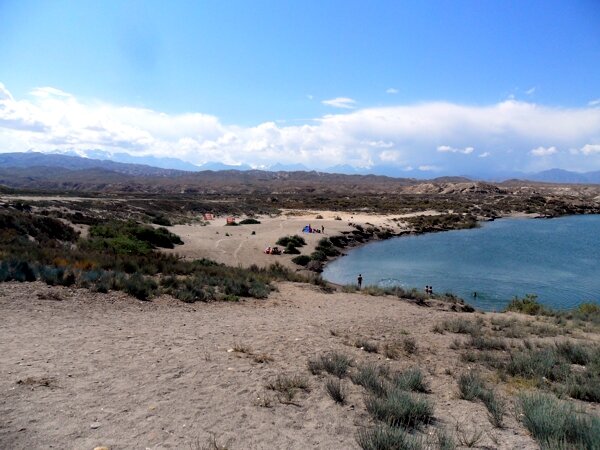
Lake Issyk Kul, in Kyrgyzstan, is said to have been used by Tamerlane as his “summer camp” and according to the medieval historian Ibn Arab Shakh, he built a small prison on an island on the lake for noble prisoners. As there are no islands to be found in the lake today, this could be a sign of the variations in the water level that have occurred over the years.
There is a particularly poignant site which is said to be connected to him at San Tash, (which translates as “counting stones”) at the Eastern end of the Karakara, (Black Crane), valley, just 20 kilometres short of the Kazakh border. The Russian explorer Semyenov tells a story that, according to legend, when Tamerlane was taking his army to attack the Chinese, he ordered that every soldier pick up a stone on the bank of Lake Issyk Kul and set it on the pass, which they did, creating a huge pile. On their return from the campaign, each survivor took away one stone and Tamerlane was able to count how many men he had lost in battle. So heavy were his losses that more stones were left than removed. The army had built its own memorial. There are, however, other, more prosaic, explanations offered, such as the stones are the remains of a stone lined Kurgan, or burial mound, that had been exposed by the elements and were then piled up.





 Bishkek