Planet Bishkek
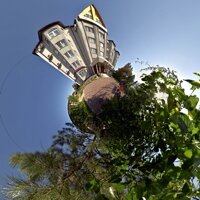
The Silk Road Lodge - our hotel in Bishkek
Some time ago I came across some fascinating images of famous places – and some not so famous, (for example, on Flickr, in the Daily Mail and the Daily Telegraph and also here), created by photographers who were making 3D Spherical panoramas, like Victor Rehemeyer’s which I’ve featured here and on our website www.see.kg. They were called Mini Planets.
The panoramas are made by taking a series of photographs from one spot and then special software is used to stitch them together … then, using another special program, it is possible to rotate the image to give a impression of standing in one spot, seeing what you could see if you were standing in place of the camera and were turning around.
Some of the panoramas give just a cylindrical view, but the spherical panoramas allow you look up and down as well as left and tight, so that it is possible to look up into the sky or down at the ground. This is especially useful when inside a building and want to look at a painted ceiling.
Here’s one of the main Ala Too Square in Bishkek:
It is also possible to turn them into film clips so that you don’t need to download the special program in order to get the full effect.
The individual photos can be stitched together in other ways in the same way that there are different projections for maps of the world, such as:
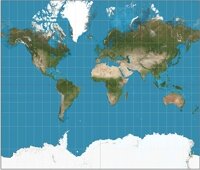
Mercator Projection
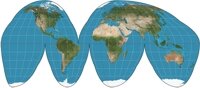
Goode Homolosine Projection

Mollweide Projection
For example, they can be stitched together like Mercator projection to give a flat screen image.
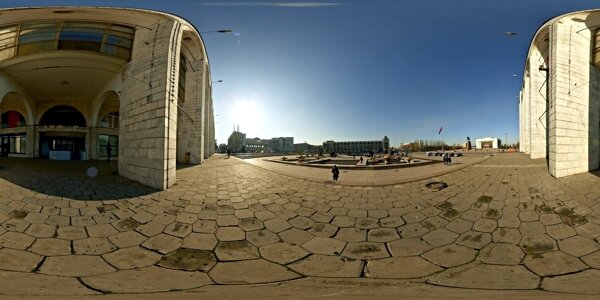
A view of Ala Too Square
You can see some more examples here. Sometimes they produce interesting results like in this photo of the Karmandjan Datka monument in Bishkek, which is actually a semicircle, and we got questions about how we managed to make it look so straight:
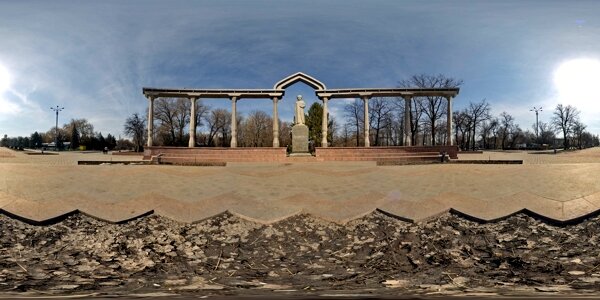
An unusual view of the Kurmandjan Datka monument
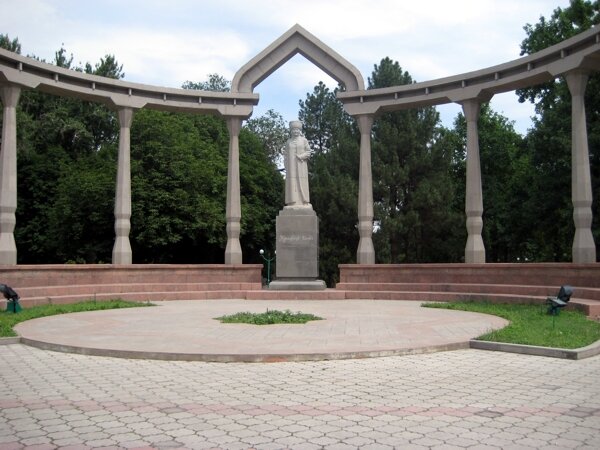
A more traditional view of the Kurmandjan Datka monument
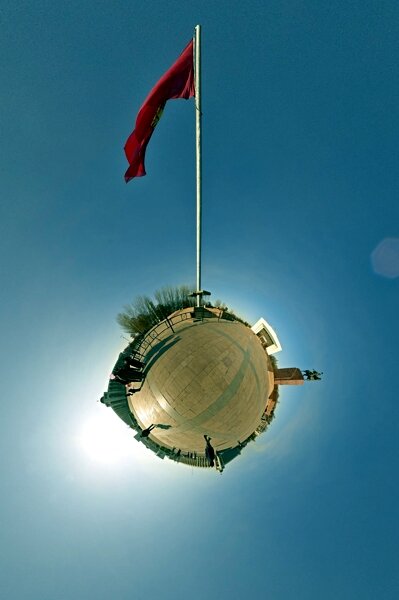
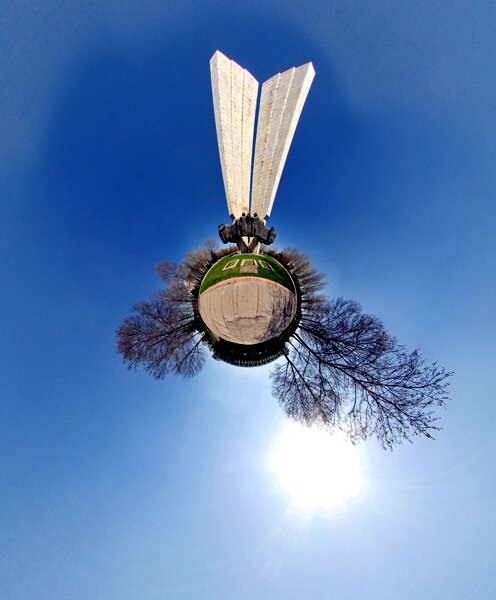
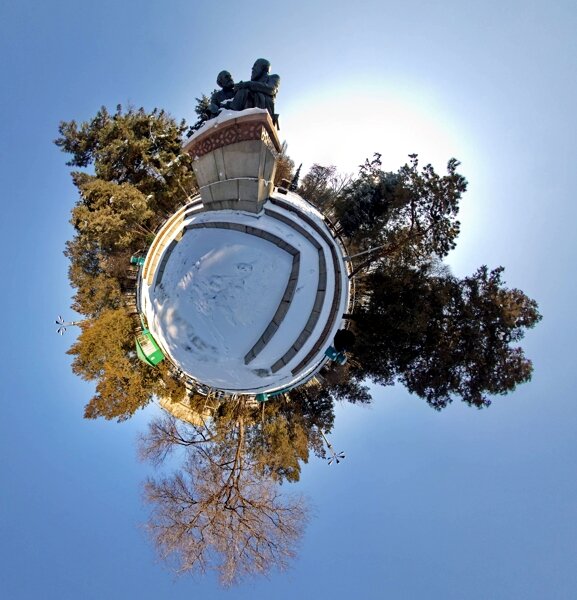
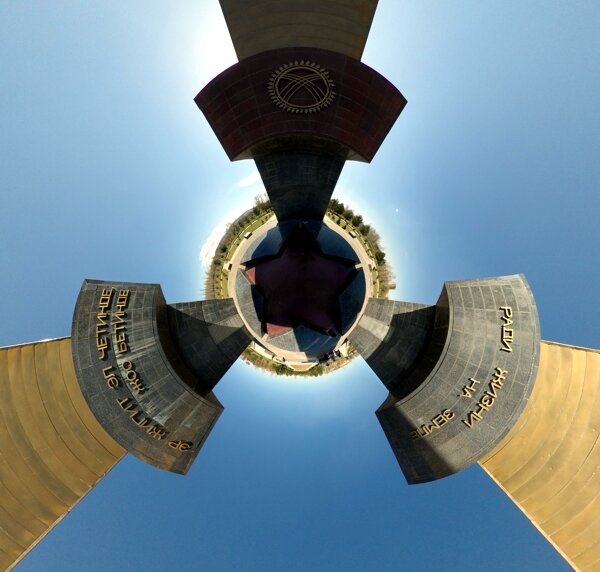
The Mini Planets are another feature produced by the software used for preparing the spherical panoramas – it’s called a Sterographic Projection, taking the 360 degree spherical panorama and presenting it as a flat image.
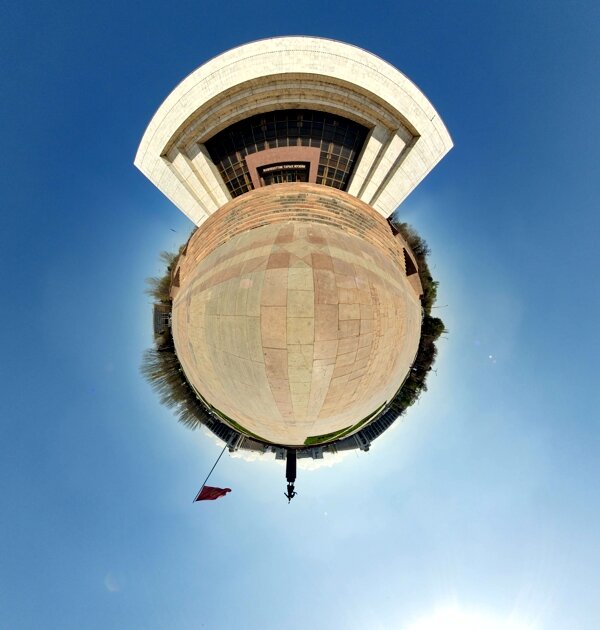
Ala Too Square from the steps of the History Museum, mith the statue of Manas and the State flagpole in the distance.
If you imagine yourself at the centre of the picture, then the central point represents the ground underneath you can see all the things around you with the sky at the edges of the photo.
Here’s another one:
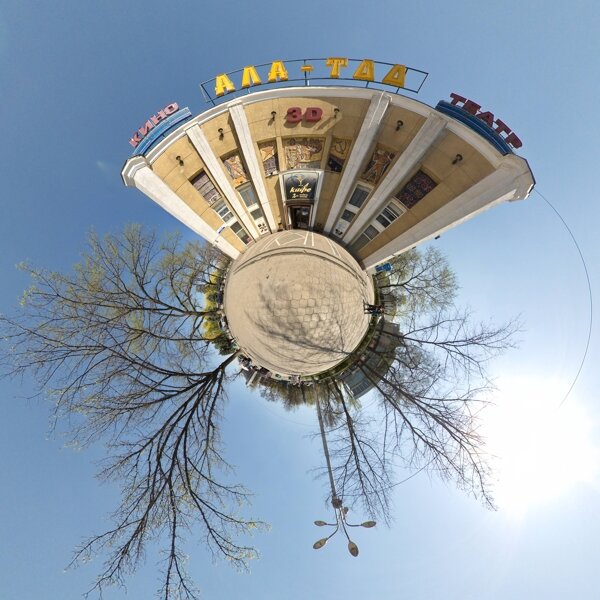
The entrance of the Ala Too Cinema, on Prospect Chui, (where it intersects with Erkindik), with its 1963 mosaics mixing traditional nomadic designs with Soviet symbols, including a cosmonaut.
For anyone interested in how they are actually made, there are quite a few sites which explain the process, and here is one of them.
They say that the camera never lies … and although it is possible to tidy the images up in Photoshop, (or some other photo editing package), especially to make sure that sky is blue, but in many ways it is more interesting to leave the pictures as they are – showing the uneven surfaces, potholes and the like – showing the place as it really is, “warts and all” – as Oliver Cromwell put it.
We’ve started an album, Planet Bishkek, on our Facebook page and will add another of Planet Kyrgyzstan pictures . We’ll add to them as we get some more.






We hope that you find them interesting.



 Bishkek