Chichkan – Mouse
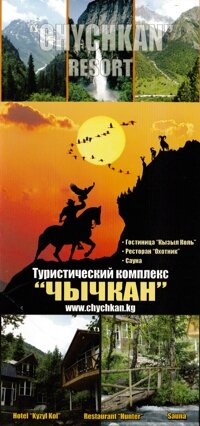
Flyer for the Chichkan resort
A few years ago I was asked by a friend where he could take his wife ind in-laws for a weekend away.
As it happens, he knows Kyrgyzstan quite well, (his wife is Kyrgyz), and he had already been to many places around Bishkek. He wanted to avoid the obvious places like Ala Archa, which they all knew very well and would be busy with people from Bishkek taking the chance for a picnic. He wanted, he said, somewhere “new” that he didn’t already know – and, more importantly, that the family wouldn’t know.
That ruled out most of the spots in the Kyrgyz Range to the South of the city … Ala Archa, Alamedin, Issyk Ata, Kegety and Shamsy to the East and the Belagorka valley to the West. So, it meant travelling a little further afield.
There were several options, each with their own attendant advantages and disadvantages, but after discussing it together I suggested three alternative choices to him …
- Chon Kemin to the East, where there is a comfortable guesthouse, where they could spend both nights and would have the chance to spend the whole day Saturday walking, horse riding, or even rafting (during the Summer months – it was Summer, so that was OK) …
- over the Too Ashu pass to the West, then along the Kekemeren Valley and along the Southern flank if the Kyrgyz range to Kochkor, and finally completing the circle and returning to Bishkek … stopping the first night in, for example, a homestay in Kyzyl Oi and the second night in Kochkor …
- over the Too Ashu pass to the West, then along the main Bishkek-Osh road to Chichkan where there is is a guesthouse, where they could spend both nights and would have the chance to spend the whole day Saturday walking, horse riding, or even hunting and fishing in the right season, (it wasn’t the right season and, anyway, he’s neither a hunter, nor a fisherman, so that was fairly academic).
He went back and talked it over with the family and they decided on the third option.
To be honest, that surprised me a little bit. Such a choice usually depends on balancing out different factors.
The main criterion was that the trip should be to “somewhere new, somewhere different“, to quote a former slogan for Kyrgyz Tourism. All three options fit the bill in this respect.
The main advantage of the second option was that it provided a circular route. The chief disadvantage, however, is that it involves a fair amount of traveling … which may suit some people, but means spending a lot of time sitting in a vehicle with limited time exploring the destination – which can be a problem, especially if there are children in the group, as there would be in this group. So that option was apparently ruled out, more or less, straight away.
The other two options, on the other hand, gave time based in a “center” … and the opportunity to explore the surrounding area … and undertake a variety of activities.
However, they both involved traveling “there and back” along the same route. The lack of a “turn off” along the route is often a “turn off” for travelers who want to see new places and feel that “doubling back” represents a waste of time and effort which could be better used to add places and experiences. On this occasion it wasn’t seen as a problem.
The variety of things to see and do is another factor that needed to be taken into account … Hunting and fishing weren’t an issue, and it seems that nobody was really keen on going horseriding, so it boiled down to the chance to go walking, take a picnic and perhaps exploring the neighbourhood. Both options offered these possibilities.
In the end, it was Chichkan that won the vote … I am not sure why but I think it was possibly simply because the road to Chon Kemin meant the road to Issyk Kul … and everyone knows that road quite well, whereas the road to Chichkan meant traveling to the other side of the Kyrgyz Range and crossing over two mountain passes which seemed to offer a greater variety of scenery.
They drove West from Bishkek along the main road that continues over the border and across Kazakh territory and eventually to Tashkent in Uzbekistan. Passing through conurbations of villages that seem to merge one with another, they eventually hit open countryside with arable farmland on either side of the road … in the wide Chui valley. Some of the villages were once populated by Dungans and the Chinese style roofs of their houses are visible from the road. When they got to the city of Kara Balta, they turned South and headed towards the imposing chain of the Kyrgyz Alatau mountains, the incline of the road rising gently at first until it entered the as the road enters then the gorge of the Kara Balta river. From the barrier at the foot of the gorge, the road meanders, crossing and then recrossing the river, rising steeply, at places hugging the hillside as it enters several switchback turns until finally it reaches the mouth of the Too Ashu tunnel, (at 3686m asl).
Emerging from the other side of the tunnel it descends to the lush Suusamyr plain … a high steppe plateau ringed by mountain peaks which provides the local shepherds with an abundance of green pastures for their flocks … and the horses. Having crossed the plain, the road passes the turning to the Otmok Pass and Talas before climbs steadily once more to the Ala Bel Pass. In many ways its appearance is deceptive … it doesn’t have the dramatic panoramas and although it is lower, (at 3184m asl) and wider than Too Ashu, in winter it can provide difficulties – especially in Winter.
Descending from Ala Bel the road enters the narrow Chichkan Gorge.
Actually, to be honest, according to the general transcription rules, that should probably be Chychkan … but when I first came here it was introduced to me as Chichkan … and, as they say, “old habits die hard.”
Chichkan (or Chychkan) is the Kyrgyz for “mouse” and the gorge is named after the river running through it. Why it is called that I have no idea … although some of Kyrgyzstan’s species of rodents mice are found in the area, there aren’t that many of them. It seems to me that there ought to be legend associated with it, but the best explanation I have come across is that the river is reminiscent of a mouse tail. Perhaps someone will tell me a better story after I have posted this postcard and, if so, I’ll put the explanation in a comment at the foot of the post.
The gorge is interesting for a number of reasons. It is, for example, Kyrgyzstan’s main source of marble.
The river flows through a narrow gorge flanked by steep cliffs, some coloured red. Lower down the cliffs recede from the river banks allowing fruit trees to grow beside the banks of the river. From there it flows into the Toktogul Reservoir just West of the town of Toktogul on the northern shore of the massive reservoir created by the construction of the Toktogul Dam across the Naryn River.
Some of the fruit is often on sale at the roadside stalls, as is some of the honey harvested in the surrounding hills, and fish caught in the river.
The valley contains the Chichkan Nature Reserve, (which was established in 1974).
Apparently, off the tributary Bala Chichkan, which joins the main river in the south of the valley, is the Ak Unkur cave, (White Cave), but I have never been there. Nor have I made it, (yet), to the two high mountain lakes (both at an altitude of over 3300 m), and one of them features a 60 m. waterfall.
There are several cafe’s and guesthouses in the valley … in fact, when I first got involved in tourism here, this was the main reason for many Western tourists visiting Chichkan, (although a lot of local, especially “officials”, were well aware of the facilities and the possibilities for rest and relaxation that they offered). The road conditions were not particularly good and it was a full day’s journey from Bishkek to Osh – a day sitting in a vehicle … a real “turn off”. So, most tour operators encouraged their tourists to break the journey here … it’s not exactly half way but close enough to make one long drive into two more or less easier days with time to linger and relax. The setting provided some good fresh air and the opportunity to relax in spectacular natural surroundings.
These days, with better road conditions, the tendency to “break the journey” isn’t as important … which means that people often zoom through instead of taking stopping to take “time out”. It’s their loss, but I do understand the problem of trying to fit as much as possible into a limited amount of time.
As it happens, we’ve recently heard of a new resort opening in the valley, with extensive facilities for holding meetings, seminars, etc., with a “hunter’s restaurant” and sauna. They have some yurts and even say they offer Kumyz lechebiye … a form of medical treatment involving drinking fermented mare’s milk.


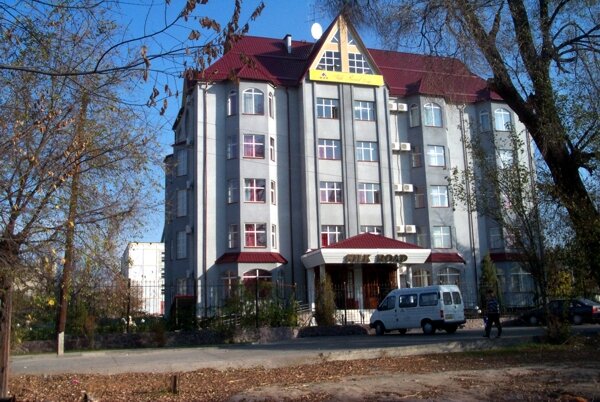


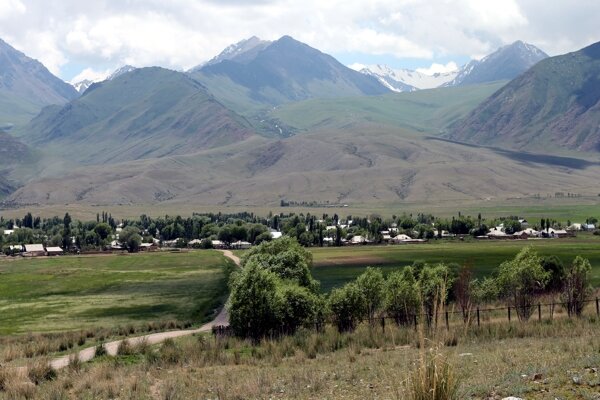
 Bishkek