Tuu Ashu
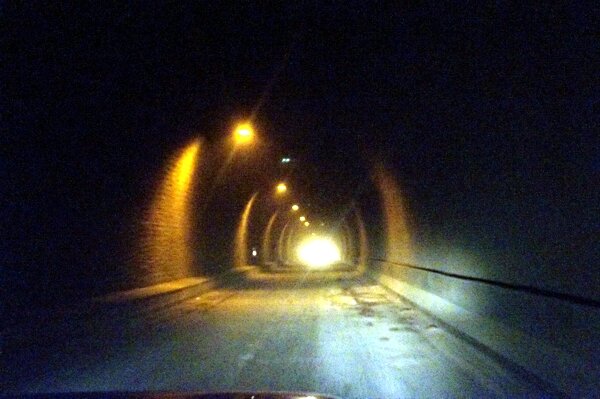
In the Tuu Ashu tunnel
Today marks the anniversary of the opening of the Channel Tunnel in 1994, connecting Britain with France and the rest of Europe – although it wasn’t until November 14th that rail services began to carry passengers.
Here in Kyrgyzstan we don’t have anything on that scale – a 50 kilometer long tunnel under the sea – but we do have one very important tunnel – the Tuu Ashu tunnel on the main Bishkek-Osh highway – sometimes written as Too Ashu.
In some respects, the two are similar – in that:
- they both connect two very different communities – in our case connecting the Northern and Southern halves of the country – avoiding the need of a long detour through Kazakhstan and Uzbekistan;
- they both play an important role in carrying goods and passenger traffic – although the original estimates for the European link are generally accepted as having been over optimistic – partly because there were already successful existing alternatives;
- since their construction it has faced a number of problems – in particular fires, (in 1996 and 2008 in the case of the Channel Tunnel and 2001 in Tuu Ashu);
There are some important differences as well:
- the Tuu Ashu tunnel is just 2600m long,
- at an altitude of 3125m above sea level – it actually passes underneath the Tuu Ashu pass which, at 3586m, used to be the easiest way to cross the Kyrgyz Range … the old road over the pass can still be seen from the apron area on the Northern side of the tunnel;
- it’s a road tunnel and not a railway one – with space only for single line traffic in each direction … at times it needs to close
The tunnel is about 120 kilometers from the downtown Bishkek and it takes about two and a half hours to get there. It was apparently built in 1961 by the same construction team responsible for the both the Leningrad and Moscow metros and is named after Kusein Kolbaev, after the first Minister of Transport.
Here’s a short clip, (just one minute – with a commentary in Russian), from a documentary about the construction of the tunnel:
Traffic through the tunnel is subject to strict controls. Buses aren’t allowed through the tunnel except with special permission – hence there still is no bus service connecting the Northern and Southern “capitals”, (Bishkek and Osh), although small minibuses and 4WD vehicles are allowed to pass.
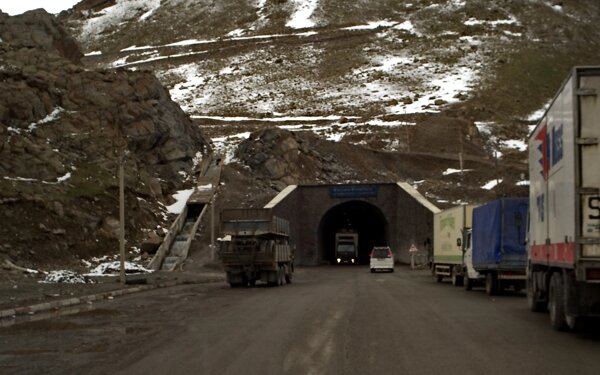
The entrance to the tunnel
There is often a long queue of traffic waiting to be let through the tunnel itself – on one occasion in 2012 there was reportedly some 6000 vehicles caught up in a traffic jam waiting their turn to go through … brought about by the snow. At this height it can be quite bleak with cool, if not cold, temperatures all year round – and rain is common.
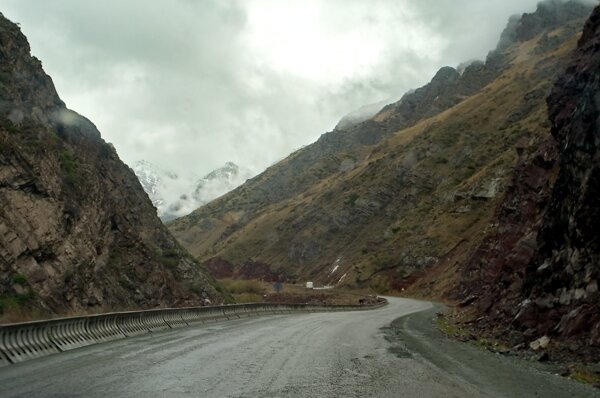
Climbing the gorge
On the Northern side it is approached from Kara Balta through toll gate and then climbs through a narrow gorge, the road going through many steep switchbacks which give spectacularly wonderful views back down the gorge. On the slopes above the road are snow traps to help prevent avalanches – one of the main causes of “emergency situations” here in Kyrgyzstan.
The incident in 2001 apparently resulted from a vehicle stopping in the tunnel … there is little ventilation, (it seems that Japan is prepared to help fund an improvement in the ventilation system), and fumes built up … a fire started and swiftly swept through the vehicles held up in the tunnel.
Although I have actually seen it … personally, I’m not sure that it is wise for cyclists to try and ride through the tunnel … it is not flat inside the tunnel and although coasting downhill might be OK – I thing the exertion of pedaling three kilometers uphill in a confined space with poor ventilation.
There is poor lighting inside the tunnel but emerging the other sides brings a fine view of the Suusamyr plain below, (the turn off to the village of Suusamyr – which lies some 15 kilometers off the main highway – is at the foot of “the long and winding road”).
A few kilometers down from the mouth of the tunnel is the Tuu Ashu ski base – with the longest ski run in the country.
After travelling across the Suusamyr plain, the road climbs to cross the Ala Bel pass (at 3184m – but the scenery isn’t as dramatic until you start descending through the gorge cut by the Chihckan river)


 Bishkek