Felix Derzhinsky and the Cheka
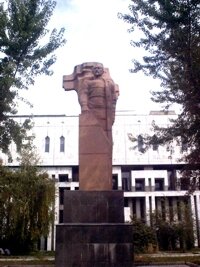
Felix Derzhinsky in Bishkek
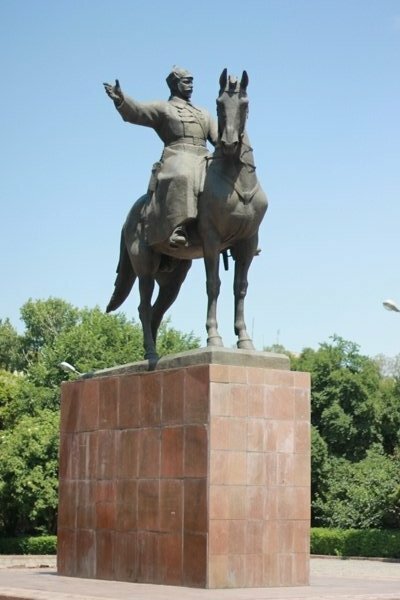
Tucked away behind the National Library, in a small square on the corner of Tynystanovna and Funze streets, there is an interesting, albeit anonymous monument. Anonymous, in that it bears no inscription to tell the passers by who the notable worthy is that is depicted rising out of the pink granite plinth.
The lack of an inscription, as with the location – the statue almost hidden away location, is probably because it’s a statue of Felix Derzhinsky – the famous, (some would say infamous), Polish-Russian socialist, contemporary of Lenin, Soviet statesman and a member of the early Soviet government … oh, yes, and founder of the infamous Cheka secret police … the forerunner of the KGB.
For the record: the Cheka was created by decree on 20th December, 1920.
The statue hasn’t always been here.
It was originally erected in 1984 at the foot of Erkindik, (where it meets the city’s Dubovny Park – Oak Park), which at that time was called Derzhinsky.
It was intended to be part of the redesign and reconstruction of the center of Bishkek, replacing a statue of Lenin, who was to have another erected in the main Ala Too Square. It stood there until 2004 when a new monumental complex of Kurmandjan Datka, the Queen of the Alai, now stands.
The Derzhinsky statue was the work of the major monumental artist Sydykov who is responsible for many other of the monuments which adorn the city center, including:
- Friendship Monument – 1974 – in the square between the White House and Ala Too Square
- The Monument to Labour – 1974 – a series of bronze plaques, originally mounted on a single plinth but now reassembled onto two which flank the statue of Lenin in the old Central Square
- Some of the busts in the Alley of Heroes – 1975 – on the central reservation of Molodaya Gvardia where it crosses Prospect Chui
- The Revolutionary Warriors – 1978 – depicting Salieva and flanking compositions in Revolution Square, at the junctions of Prospect Chui and Sovietskaya
- The Manas Sculptural Complex – 1982 – outside the Philharmonia
- Lenin – 1984 – originally placed in Ala Too Square but moved to Central Square on the Northern side of the Historical Museum in 1999
- the Victory monument – 1985 – in Park Pobeda, (Victory Park), depicting Mother waiting for her loved onmes to return from the front and one of the flanking compositions
- the Fathers of the nation – 1995 – on the Western side of the Philharmonia building – but the figures have long since disappeared from the striking T-shaped on which they stood
- the Ballerina Bibusara – 1997 – in the grounds outside the Hyatt,
- Erkindik – 1999 – the symbolic Kyrgyz “Statue of Liberty” which replaced Lenin in the main square, but was in turn replaced by the statue of Manas in 2012 … and is now tucked away in storage.
- Kojumkol – 2004 – outside the Sports Palace named after the Kyrgyz Giant Strongman. on Togolok Moldo
- Aikol Manas (Magnanimous Manas) – 2011 – in the main square where it replaced the statue of Erkindik
As far as I am aware, Felix Dezhinsky never visited Kyrgyzstan so the was not erected to commemorate a direct connection with Kyrgyzstan, but was intended to honour one of the monumental figures (pun intended) who helped to shape the Soviet Union.
He was born into a Polish noble family on 11th September, 1877, (although, on the Julian calendar it was only 30th August), and died on 20th July, 1926 – of heart failure.
In his youth, he considered becoming becoming a Jesuit priest before being converted to Marxism – and, in 1917, joining Lenin and the Bolsheviks.
He was a good student, fluent in four languages, (Polish, Russian, Yiddish and Latin), as well having some knowledge of French and Greek … but his revolutionary activities got in the way of his studies and he was expelled from his gymnasium just a couple of months before graduating. They were also to get him into further trouble – arrested several times, imprisoned and sent into “internal exile” in Siberia; several times – he escaped several times, too.
Before the 1917 revolutions he spent four and a half years in a notorious prison being manacled and regularly beaten by the guards. Released as a result of the February revolution, he threw himself once more into revolutionary politics and was responsible for the security of the Party headquarters at the time of the October Revolution.
Although he often opposed Lenin on policy issues, the latter recognized his abilities and appointed him to head an organization to defeat internal threats to the Revolution … an organization which became the Cheka – an abbreviation of the acronym of it’s title, the Vsyerossiyskoi Chezvychainoi Komissiy, (The All Russian Emergency Commission – BChK),
The Cheka grew in size, power and influence during the Civil War, partly as a response to the difficult and dangerous times and partly through Derzhinsky’s positioning and maneuvering. It established a reputation which mirrored Dezhinsky’s own – for using “drastic measures, for the ruthless pursuit of any perceived threat or counter revolutionary elements.
Note that “perceived” …
In addition to his role as Director of the Cheka, Derzhinsky also took on other roles; in the fight against Typhus, for example, and the construction of orphanages, (invoking shades of the Jesuit maxim: “give me a child until he is seven …”); being in charge of Internal Affairs from 1919 to 1923; organizing the embalming of Lenin and even serving as the Chairman of the Friends of Soviet Cinema.
Known for ruthlessness, fear, insecurity and ever present suspicion inspired by his “creation” – the Secret Police, he was still held in high regard in the former Soviet Union. As well as a host of monuments, (like this one in Bishkek), erected in his honour – streets, squares and schools … and no less than seven towns … were named after him.
In recent years, however, the activities of the Cheka, and its successor organizations, have come under the spotlight – especially the role it played in the Stalinist Purges – the repression of many innocent people … including the fathers of Soviet Kyrgyzstan. Perhaps that’s one of the reasons the monument is “hidden away” and anonymous.
There is some logic, however, behind its current location … it stands facing across the street the building of the Ministry of the Interior … a Ministry in Moscow that he headed for those crucial early years following the October Revolution.


 Bishkek