Toktogul Reservoir
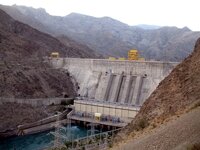
The Toktogul Dam
Reservoirs form an important part of the Kyrgyz landscape.
The most notable of Kyrgyzstan’s thirty odd reservoirs is the vast Toktogul reservoir.
The dam at the head of this man-made lake was constructed in 1974 in the Ketmen Tube valley, as one of a series across the Naryn River, (the Naryn-Syr Darya cascade – The current work on the Karambata I and II Hydroelectric power stations represent two more of the series).
The reservoir covers an area of 284 square kilometers, (being 65 km long and 12 km wide at its widest point), and has a volume of 19.5 cubic kilometres. The average depth is 69m, with a maximum depth of 120m. The level of the reservoir fluctuates by as much as 63 m.
The dam is a concrete gravity dam, (the force holding the dam in place against the push from the water is Earth’s gravity pulling down on the mass of the dam), which rises 215m above the river at the outlet and is almost 300m wide.
The power station has four 300MW turbines giving a total capacity of 1200MW. Although construction work apparently began as early as 1960, and the reservoir began to fill up upon completion of the dam in 1974, the power station was commissioned and began generation in 1978.
As well as being important for the generation of electricity, the Toktogul Reservoir is also an important resource in providing water for irrigation purposes downstream. It makes possible the long term regulation of the River Naryn’s water flow, increasing the dependable water supply available for irrigation and enabling a greater area of land to be watered.
The Toktogul Dam and Hydroelectric power station is featured on the 100 som banknote.
When the dam was built, the valley flooded and the reservoir created, some 26 local communities were displaced and the main Bishkek-Osh highway had to be rerouted. In addition, archaeological remains, including many burial mounds dating back as far as the eighth century were lost. Some of the discoveries made during the construction of the site, including Gold jewellery, is on display in the State Historical Museum in Bishkek.
To the north of the reservoir is the town of Toktogul, (named for it’s famous son – the akyn Toktogul Satilganov, 1884-1933, who is also buried in the town), and to the south there is Kara Kul which is a dormitory town for the workers at the main Toktogul power station. The southern reaches of the reservoir is in the form of a flooded canyon which is about 0.3-2 km wide – and can reach as much as 100 m deep. Elsewhere there are many shallow areas with abundant vegetation, which serves as a habitat for wildlife.
In January 2004, the Vecherniye Bishkek newspaper carried an interesting story about some Bishkek residents who went fishing in the reservoir. The men knew the area very well and the waters where they were was only about a meter deep. They felt the line snag on something and when they investigated they saw something grey, about 20 centimetres across. It looked like a snake – and when the line was eventually freed it was stripped of all the bait and catch that had been there. It was at this point that they remembered having been told by local people not to fish there as there was “a huge snake that can cut off something between your legs!”.
When he was asked what he thought it could possibly have been, one of the fishermen is reputed to have said: “I have never seen anything like it in my life. But I know one thing: I will not go fishing to Toktogul Reservoir anymore!”
The state of the Toktogul reservoir is very important to Kyrgyzstan and is regularly the subject of press reports. With a capacity of almost 20 billion cubic meters, during the year it fluctuates somewhere around the 16, 17, 18 billion mark but, at the moment, it is currently about 2 billion less than was stored at this time last year … AND it is expected to fall to about half full over the winter as water is drained off to power the generators, reaching about 10 billion cubic meters in April – which is pretty close to the minimum level when the power station would have to be shut down to prevent damage to the turbines. What’s more, current models suggest that there might not be a sufficient flow of water into the reservoir in 2013 in order to provide sufficient generating capacity for the following winter.






 Bishkek