The use of Coins in Jewellery
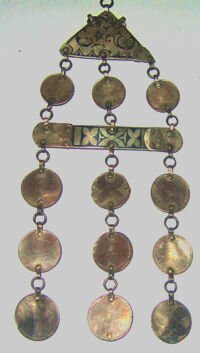
Coin pendant
The jewellery of ancient Central Asia often made use of coins …
It was thought that they had magical characteristics in that they were round, (which is a mark of the Sun, which was considered to bring good luck and success in everyday affairs), and that they were often made of silver (which, according to the belief of ancient peoples, drove away malicious forces).
Some coins were minted with a hole in the centre, and these would be strung together on a cord which was threaded through the hole. This was convenient both for storage, and for transporting money. A string of coins usually consisted of a hundred pieces, which the traveller slung over their shoulder. Not only was it difficult to lose an individual coin, the string could even provide a weapon in the case of an attack by robbers.
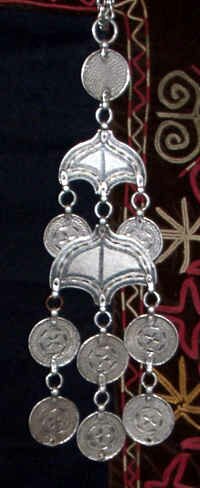
Coin pendant
Women, on the other hand, would often braid these coins in their hair. The coins would be hidden from curious eyes as it was the custom for women to wear a scarf or cap over the hair when in public. Coins with holes, however, tended to made from copper. Silver coins with holes were rare and very valuable, and usually had “ears” soldered onto them through which the hair would be threaded. The custom of braiding coins into the hair apparently led to a range of special ornaments that were also worn in this way.
One was the Chach Kap: a hat made of black velvet decorated with silver discs under which married women customarily wore their hair. In the northern districts of Kyrgyzstan in particular, a massive silver plate called an Arkalyk, with decorative patterns cut into it was used to adorn the cap.
A second was the Chach Ushtuk, (or Chach Monchok). These were strings of coral beads alternating with silver balls, threaded together on cords and with the strings connected by horizontal silver plates with patterns tempered into them. The threads were suspended from a triangular plate which served as a tumar, or charm. Similar to the Chach Ushtuk was the Cholpu. The plate at the top from which the fringe of threads hung was triangular – it may have been a single triangle but sometimes it consisted of a row of two or three, and below it there would be three or four chains of coins, connected together by silver rings. All the parts of the Cholpu would be highly embellished with patterns which may have been embossed, engraved or nielloed (filled with a black compound to enhance the pattern) and the plates could be inlaid with coral, a cornelian, turquoise or glass.
Another was the Chah Papik, and this was more commonly found in the southern regions of Kyrgyzstan and in Talas. It consisted of black laces surmounted by metal, cone-shaped, ornaments from which long brushes of black silk threads and strings of beads were suspended. The metal parts were usually decorated with patterns engraved and nielloed.
As with other forms of jewellery, these adornments were thought to protect the wearer from the influence of malicious spirits – in this case protecting the woman’s back, the front being protected by the Tumar amulet and the necklace. They tended to be very heavy and the weight helped to force the women to stand up straight.







 Bishkek