Traditional amulets – Tumar
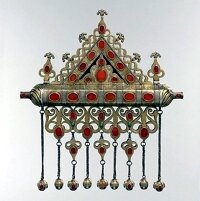
A Central Asian Tumar - part of the collection of the Metropolitan Museum of Art
In ancient times, the breast was considered a receptacle of the human soul, and should be protected with the greatest zeal and so amulets and talismans were hung over them, to be closer to heart – “the home of soul” – in order to protect the person from influence of malicious spirits.
Amulets are found in many different cultures … and they are a common feature amongst the peoples of Central Asia, where they are known as Tumar. The tumar served as a talisman. (In Arabic, apparently the word “talisman” means “a magic mark”.) They were thought to embody an energy which could bring good luck, riches, or happiness. This power was amplified, was stronger, if it was made from silver or gold.
In Kyrgyzstan, there are different types of amulet. Some were worn around the neck, others as a sort breast plate or brooch, whilst others were worn as a bracelet. Some were elaborately decorated jewellery. In Kyrgyzstan, however, there were also simple amulets made of material, even felt, and often took the form of a triangle.
For the record: The triangle is an ancient symbol found in numerous cultures where it is imbued with mystical connotations and significance. As “Dan Brown, in his book “The Da Vinci Code”, points out – from ancient times a triangle pointing upwards was a symbol of the masculine aspects of nature, of heavenly forces, or of fire, and when pointing down towards the earth it was symbol of the feminine aspects of nature, of water and dark forces. The “Star of David” united the two - as a graphic representation of the balance between the Terrestrial and the Divine, between the Earth and the Sky, Fire and Water, between man and woman.
It was also thought that the power of the amulet was also magnified by what it contained. (It was usually hollow with either a small door on one side, or a pin, which allowed it to be opened so that something could be placed inside it.) Some, for example, would contain soil from the owner’s homeland - there was a tradition that everyone should be buried in the native ground, but if the person died in a foreign land, then a part of their homeland remained with them.
Alternatively, the amulet could contain a “happy” stone – such as a cornelian – to bring success in any undertakings and love affairs. The talisman had the greatest force, however, when inside it was placed the “Holy Writ” (a scroll with sura, or verse, from the Koran).
Inscription, such as spells and symbols, would often be depicted on the talisman as well as a means of increasing their potency.
Silver bells or cymbals, might also be suspended from the talisman. It was thought that the melodious sounds they created would frighten off malicious spirits.
In some areas of Kyrgyzstan women wore special talismans as silver brooches, (Tyoyohyoch or Byuchyulyuk) which served to fasten their dresses. Such brooches could be rather large with an opening in the centre, a fastener and, sometimes, were decorated with precious stones, corals, glass, or beads.
The Ala Tamak was a bib made from corals, sometimes with a cornelian (a red stone) and mother of pearl, plaited together in a grid. Sets of accessories used for female toilet were often attached to it, such as:
- a pair of silver tweezers (used for removing unwanted hair),
- a Tish Chukuur (a toothpick) and
- a Kulak Chuchkur (in the shape of a fist, used for cleaning the ears).







 Bishkek