Earrings
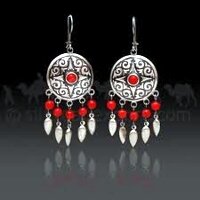
Earrings from Kyrgyzstan
The custom of wearing earrings is found in many diverse cultures; according to the Chandos portrait William Shakespeare sported one and it is said that Pirates used to wear Golden earrings in order to have the wherewithal in order to pay for their funeral when they died.
According to epic poem “Manas”, Kirghiz men wore earrings (Iymek, Kulak Syoikyo). There were considered to possess the power to avert evil influences and bad luck and thus they served a protective function.
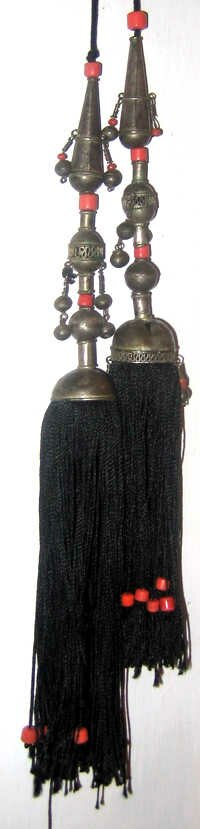
Elaborate tassels forming part of a "headdress"
They were worn at any age, but in particular were given to babies as a form of protection against malicious spirits. When a long awaited child was eventually born into a childless family, or a baby was born into a family where infant mortality was high, jewellery would be collected from seven mothers who had borne several children and fashioned into an earring which was given to the new born child, which it worn until they, themselves, married.
Of course, earrings are mainly worn by women … and they come in many different styles and forms, from simple and small up to complex fringes flowing into necklaces.
The basic theme of the patterns and designs of earrings were the symbols for the Sun or the Moon, (for example: triangles which pointed skywards or earthwards).
Of particular elegance were the earrings known as “Kashgar Earrings” with their fine filigree. The skill of the master craftsman can be judged by examining the patterning under a magnifying glass.
Jewellery such as bangles, earrings, necklaces and rings are also usually highly treasured possessions and may be passed down from generation to generation. It served a number of purposes:
- it was decorative;
- it had magical connotations – silver in particular was thought to ward off the attentions of malicious spirits;
-
it was a status symbol:
- it could be represent a badge of office – for example a governor’s ring;
- rich people would wear more elaborate examples than poorer people
The type of jewellery worn by women tended to vary according their age, social status and the purpose of the decoration. The richer the family, the larger and more diverse the collection of jewellery she had available. Girls and young women wore more than older women.
Earrings played an important role in the betrothal process: After the groom’s relatives learn of his intention to marry, they go to the bride’s home and a formal proposal is made. Sitting around thedastarhan, (an cloth spread on the floor which served as an oriental “dining table”), the parents of the young couple get acquainted with one other – and with the bride and the groom, (assuming that mutual agreement has not been reached earlier). When the parties have agreed, the groom’s mother will put golden earrings in the bride’s ears – which means that the young couples are engaged. This custom of giving earrings is called “soiko saluu”.
Amongst the earrings worn by the nomadic Kyrgyz was the ”headdress” - soiko jelbirooch - which was a special part of a bride’s wedding attire. It would hang suspended from hooks looped over the ears and it is probably one of the most magnificent examples of female jewellery in Central Asia. It usually comprised a triangle with tassels and fringes suspended from it. These fringes consisted of silver chains alternating with coral and would be decorated with coloured enamels and beads, inlaid with corals, and coloured glasses. They framed the person of the bride. These earrings were very expensive and highly treasured. They were handed down from mother to the daughter through generations and worn during the wedding (it formed part of her dowry) and when migrating from place to place.
Sometimes parents would put a bracelet on their child’s leg, or an earring in one ear, as an amulet to ward off evil spirits – assuming that such entities feared metallic things, and silver was thought to be especially powerful in this respect and so was prized for making jewellery. Bracelets made of black beads were put on a child’s wrist or a black bead in an earring was also assumed to act as a protecting amulet.
Archaeological finds show that the form of the earring has been maintained over the centuries and the same types created more then two thousand of years ago were still popular in both the 19th and 20th centuries, although nowadays new decorative forms are preferred.






 Bishkek