Hsuan Tsang – Pioneer Silk Road Traveller
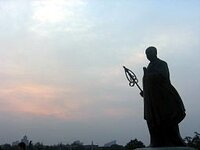
Statue of Hsuan Tsang at the Great Wild Goose Pagoda in Xi'an which was built to house the manuscripts that he brought back from his travels.
Hsuan Tsang was one of the early travellers along the Silk Road. Although he is known as Hsuan Tsang, (Xuanzang), his real name was Chen Yi.
Born in 599 – some sources say 602 - near Luoyang in Henan, China, he was the youngest of four children. Some sources say that his siblings were all brothers, but others say one was a girl … the attitude of the Chinese towards girls was not very positive (apparently called “slaves”).
His was an established, educated family which was to provide a good grounding for this intelligent and earnest young boy. His great-grandfather had been a local official, (a prefect); his grandfather was a professor at the Imperial College in the capital and his father also served as a local official - although he resigned his office, withdrawing into seclusion, to escape the political turmoil that gripped China at that time.
His early upbringing was in a Confucian environment. His father was a ”conservative” Confucian and set about ensuring that his four children received a sound education – introducing them to the classical works on filial piety and other canonical treatises of orthodox Confucianism. However, according to traditional biographies, even he was amazed by the devotion displayed by the careful observance to the traditional Confucian rituals by his eight year old son, Hsuan Tsang. Despite this education and apparent devotion, one of his elder brothers became a Buddhist monk – and upon the death of their father in 611, Hsuan Tsang followed in his brothers footsteps. Despite his youth – thirteen years old – the Buddhist abbot made an exception in his case because of his precocious knowledge – and accepted him into the order as a novice. He was ordained as a full monk in 622
The two brothers spent years studying different branches of Buddhism. There were many inconsistencies, contradictions, discrepancies and anomalies in the holy texts that were available in China at that time – and Hsuan Tsang resolved to go to India – the birthplace of Buddhism – in search of authentic texts. Somewhat hampered at the outset by the fact that the emperor had forbidden foreign travel, in 629 he finally succeeded on embarking on what was to be a 17 year journey which was to establish him as one of the pioneers of the Silk Road.
He travelled across China to Turfan, where the Buddhist king gave him letters of introduction and valuables which he could sell as a means of funding his pilgrimage. Travelling further westward he visited the Theravada monasteries at Kurcha and then onto Ak Suu on the Chinese side of the Tien Shan mountains.
His route then took him over the Bedel Pass from Ak Suu into what is now Kyrgyzstan. The crossing was a traumatic experience … heavy snows had delayed his departure from Ak Suu, a portent of worse to come, in a 40 mile stretch, (about 65km), he lost a third of his companions and animals.
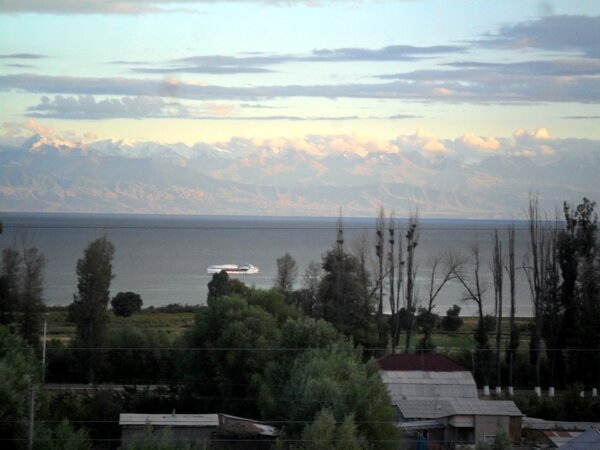
After the pass, his caravan rested at Issyk Kul before passing on to Tokmok here he witnessed the gathering of the Western Goturks. Here he met the Great Khan, who enjoyed friendly relations with the Tang emperor of the day, and who welcomed him with a grand feast in a large pavilion decorated with golden flowers. The assembled crowd sat in two long rows on silk mats. The Khan was dressed in a green satin robe. His long flowing hair was tied back with a long silk band which was twisted round his head and fell down his back. He was accompanied by a bodyguard comprising about 200 officers dressed in brocade – with their hair similarly braided – and a large number of soldiers – also well dressed in fur and finely spun garments – with horses and camels, carrying bows lances and standards. In deference to his religion, he was served with “rice cakes, cream, sugar candy, honey sticks and raisins” and a non-alcoholic drink – whilst the rest ate veal and mutton. He was invited to deliver a sermon. When it was time to leave, the Khan and his offices accompanied on the first few miles of his onward journey” and he was given further letters of introduction for the various vassal rulers he would meet on his way. In his description of the encounter, he states that “although the Khan was but a lord living in a camp, he had an air of elegance which commanded respect.
From here he travelled via the Talas valley to Tashkent (the most westerly point of his travels) before turning South and crossing the Parmirs and eventually reaching India. His account of his travels include some detailed descriptions of Samarkand as it appeared in his day.
His accounts also describe many of the marvels he saw on his way – the Buddha statues of Afghanistan (destroyed by the Taliban in 2000) and the various kingdoms of India, as well as the dangers he encountered such as the band of outlaws he encountered in Afghanistan. His account tells a great deal about Buddhist history and many of the religious sites he visited as a pilgrim.
He finally left India in 643, to return to his homeland. He was given an armed escort to accompany him and the various texts (657 of them) and holy images that he had been collecting during his travels. He was welcomed back to the capital by vast crwowds and monks paraded the various reliquies he had brought with through the streets in a grand procession. The emperor questioned him closely about his experiences and wanted him to become an advisor on Asian affairs – but he refused and was asked, instead, to write a book aout his experiences, which he completed in 646. This was to be part of his popular legacy in China. His accounts of his journey, the escapades and dramatic escapes intrigued the Chinese for centuries and was the basis of a 16th century epic. He is still remembered as a great folk hero in modern China.
His journey covered over 10000 miles (16000km) over difficult terrain and lasted 17 years.
He retired to a scholarly life – translating the texts he had acquired over the remaining 19 years of his life – in the White Goose Pagoda in Xian which he persuaded the emperor to build to house his collection.
He died in 644AD in Yu Hua Gong, in China.




 Bishkek