Checkpoint Charlie
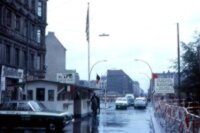
Checkpoint Charlie in 1963 - at the height of the Cold War
When Caesar approached the Rubicon in 49BC, he was about to do far more than just crossing the border from Gaul into Italy, he knew that he had reached a point of no return. There are few border crossings that have had such important repercussions in shaping human history. Unfortunately we don’t know exactly where he crossed the shallow river because its course has changed much since then.
There are some famous, (or in some cases infamous), border crossing points that we can fix more easily: The legendary (at least to the British with its associations with the Afghan Wars) Khyber Pass between Afghanistan; San Ysidro and Tijuana between the US and Mexico – and the Casa del Tunnel Art Center based on an tunnel used to smuggle drugs; the Kashmir Line of Control between India and Pakistan; the Gaza and West Bank frontiers; the Berm between Morocco and Western Sahara; the underground border between Austria and Germany in a salt mine at Bad Durrnberg; the “Cactus Curtain” around Guantanamo Bay in Cuba, separating the main part of the island of Cuba from the American base; the DMZ which separates North and South Korea; the summit of Signalkuppe between Switzerland and Italy … and not forgetting the Torugart Pass between Kyrgyzstan and China which is considered to be one of the most difficult border crossings in the world – it isn’t if you do it properly.
Perhaps the famous of all border crossing points was Checkpoint Charlie – or Checkpoint C to give it its proper name - through the Berlin Wall constructed to control migration between East and West Berlin. During the period of the Cold War, it symbolized the tense relationships between East and West. When the wall finally came down, it was turned into a tourist attraction before it was finally dismantled twenty three years ago, on 22nd June, 1990, and was moved to a museum.
The borders of Kyrgyzstan have been in the news again this week … when I first came here I was told, and believed, that there were no border disputes, but that has been shown to be wishful thinking on someone’s part. It was an argument over the border that began to spark public disapproval of the Akaev regime when he arranged land swaps with China and Kazakhstan allocating a relatively large section of a largely unpopulated remote mountainous area to China. The mounting protests that resulted were a forerunner of what was to come.
Nowadays the problems are mainly in the Ferghana Valley with our our other two neighbours: Tajikistan and Uzbekistan. The densely populated valley has nine enclaves – areas belonging to one country but completely surrounded by the territory of another. Unfortunately, the borders are not always well demrcated -
There are all sorts of stories about how they came about, but it is not clear how accurate they are; one says that one of the enclaves in Kyrgyzstan was the birthplace of an important Uzbek official who wanted to ensure, when the borders were being drawn up in the 1930′s, that it became a part of Uzbekistan; another tells how the fate of one of the enclaves was settled in a game of cards between officials between the two republics.
Whatever the truth in these stories, in the days of the Soviet Union the borders were little more than an administrative barrier. With the collapse of the Union following the abortive attempted “coup” in 1991, they became full bloodied international borders with all the paraphernalia and formalities that go with this new status: border posts with customs and immagration facilities; barbed wire fences and watch towers; even landmines in some places – although they are supposed to have been cleared away.
The population of the valley in distinctly mixed with Tajiks finding themselves living in another country, (Uzbekistan or Kyrgyzstan), or vice versa. Sometimes inter ethnic tensions erupt in violence as one group feels outraged at the antics of another. Although recent incidents have involved people of three nationalities, in recent weeks most of the controversy seems to have revolved around the Kyrgyz and Tajik communities. This week there was an incident on the Kyrgyz-Uzbek border in which the Uzbek border guards discharged their weapons, shooting a Kyrgyz citizen who subsequently died. The local Kyrgyz community are understandably upset – especially when there seems to be an argument about which country he was in at the time he was shot.
At the time of writing this, there’s is talk of indignation – about how the standing orders of the Uzbek border guards give them more leeway to open fire than those of their Kyrgyz counterparts … and so on.
There was an article in the local media about a new military unit set up in the southern part of the country, where the soldiers are all “professionals” employed on a contractual basis, that is they are not conscripts, and, it is claimed, are ready to meet any eventuality – working regular hours (08:00 to 18:00 most days and receiving a salary above the national average).
Another entry point to the country that never seems to be out of the news is Manas airport – and particularly the Transit Base used by the Americans in transporting goods and personnel to and from Afghanistan. Well, things have some to a head with the Parliament formally voting the renounce the agreement and effectively evict the Americans. There has been lots of talk about the part played in the decision of the failure to proceed with the extradition of Maxim Bakiev from Britain, the recent plane crash and so on but I think that, although they may helped to aggravate the situation, that they didn’t play a decisive role. It’s been evident for some time that the President and many of the population have been unhappy with the presence of the base, and wanted it to close. Back in 2009, the Bakiev regime announced that it would close the base, (probably under financial inducements from the Russians), only to change their mind, and the base underwent a renaming and restructuring … and the Americans paid more for the facility in rent.
A visit by the former Secretary of Defence, Donald Rumsfeld, (on the day of the actual vote, as it happens), took everyone by surprise – as least no-one seemed to be aware that it was about to happen – and was seen by some as a sign that there were negotiations going on in the background with a view to finding a way out of the current impasse, but it turns out he was here in a purely private capacity to do with an educational fund that he heas set up … and the timing was all a coincidence.
What has been surprising is the strident way that some of the players have not only insisted that the visit had nothing to do with the dcision and that there were no “backroom negotiations”, but have also been stressing that the present government were not going to repeat the “mistakes” of 2009; that there would be no fudging around the details. In the past the main thrust seems to have been that although the airport can continue to be used as a “hub” it had to be on the basis as a civilian establishment … but the military component had to go. As it happens, several countries have expressed an interest in helping Kyrgyzstan develope the airport as a civilian “hub”, including Russia, Turkey … and America!, but even if the American’s do play a role, then the “base” will not be a part of their contribution – it will not exist – and various people have made plain statements to the effect that no military presence will be tolerated at all.
The Ministry of Finance has been outlining the likely effect on on the economy and particularly the budget shortfalls (150 million soms – approximately 5% of GDP), and have been commissioned to find alternative sources of revenue in order to replenish the state’s coffers.
They have quite an uphill task ahead of them, it seems to me … in that it will take time to build up the civilian hub but the loss of revenue will have an impact straight away. Add to that to losses already incurred as a reult of the situation surrounding Kumtor, (including the loss of of dividends), they might have quite quite a big gap to cover … especially when the effect of joining, (or not), the Customs Union with Russia, Kazakhstan and Belarus is still unclear.
One way round the budget shortfall, of course, is to raise taxes. At the moment they are not thinking of a general increase in taxation, which would help slow the economy down, but the Parliament has decided to go ahead with an increase in the duties on tobacco products.
Amongst the other big stories in the media this week was the Appeal of the three “Ata Jurt” parliamentarians who were convicted earlier in the year of attempting to effect a forcible seizure of power, storming the White House which houses the Parliament, last October. They were given prison sentences, which everyone, (except, that is, them and their supporters), as being remarkably lenient. In fact the Procuror, (prosecutor), also appealed the sentences on the basis that they were too lenient.
When it came to the hearing, however, the prosecutor lst the argument and the politicians won the day, having their convictions quashed and being released. It first glance, that appear to be a victory for justice; the system works in that although they lost in the first hearing, being convicted and sentenced and served time in prison … but then exercised their right of appeal to a higher court where they were duly vindicated and released without a stain on their names or characters, able to go about their everyday business – including representing their electorate by returning to their posts and attending to affairs in the parliament … but it needs to be remembered that “nothing in life is simple”.
Over the last nine months there have been numerous protests staged by their supporters … including outside, (and inside), the courtroom during the week … and by many accounts threatening continuing violence if the demands to release the three were not met. Apparently, the three judges were going to adjourn the case in order to consider their judgment but were “trapped” inside the building and conferred on the spot. They decided on acquittal and many saw this as a sign of succumbing to intimidation. I understand it was a majority verdict which means that one of the judges disagreed and wrote a dissenting opinion which, in the event of a hearing in the Supreme Court, will be taken into account.
The judges have come under more pressure since taking their decision. The following day, a group of protesters gathered outside the court and demanded a meeting with them, saying they wouldn’t go away until their demands were met. That sounds all too familiar. More worrying, however, was the fact that grafitti appeared on a wall outside an apartment block where one of the judges was thought to live.
Meanwhile the three have started to go about their business – resuming their lives and so on. Although it seems that two of them have asserted that they have no desire to seek further high office, the third said in a Press Conference that, “God willing …” – he wants to be President.
Incidentally, the Prosecutor has said that they do intend to take the case to the Supreme Court … so this story is far from over.
One of the other big stories in the news recently has been the furore over language, and the draft law which the President returned to Parliament for further consideration, that was supposed to support and strengthen the position of the Kyrgyz language in society. If that action suggested that he opposed the move, then his statements this week, have indicated and underlined that this is not exactly the case. His problems with the bill were to do with the loose drafting and practical matters, particularly how the law would be implemented. He takes the view, (which has been reiterated by a number of other people), is that, in time, although Russian and other languages, such as English, will still be important, everyone should to be able to speak Kyrgyz … and that at the same time the Kyrgyz language does need to be strengthened especially in terms of developing teaching materials.
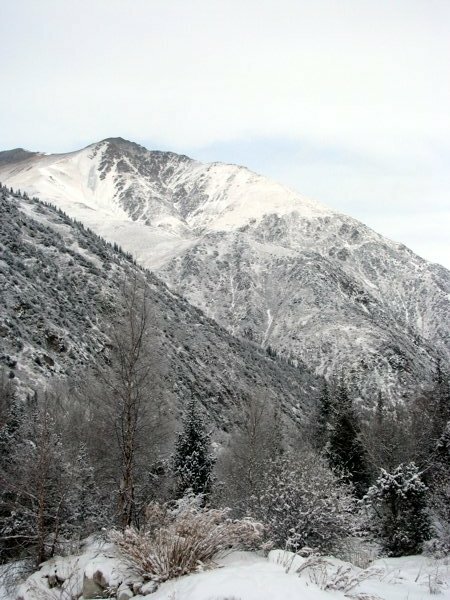
It’s been a busy week in many other respects. Whereas London has been experiencing a rather colder than usual spring, we have been experiencing very English weather – that is, changeable. Well, Summer may technically be considered here to start on June 1st, (back when I was growing up in Britain, we used to consider June 21st to be the first day of summer), but someone forgot to tell nature that and parts Issyk Kul and Naryn found themselves under snow during the week, (even in Kochkor where tradition has it that is never snows), and there was a considerable loss of livestock. Initial reports put the figure at about 200 in the Issyk Kul region, but the latest reports now put figure at around 2000. The Meteorological service tell us that we experience such unusual storms about two or three times every fifty years.
The plans for a new North-South Road connecting the Chui and Ferghana valleys seem to be faring better than those for the CKU railway, which have been sent back for further study. The feasibility study has selected a route which is 412 kilometers long, will cost almost three quarters of a billion dollars with the construction of abouit 200 kilometers of new road including two tunnels.
One positive item of news is that Kyrgyz politicians are considering a new law which will make it illegal to carry a firearm when drunk or under the influence of drugs … it would also prohibit carrying guns in schools, bars and restaurants that serve alcohol, and government buildings.
Perhaps the strangest story of the week was the delivery to the government depot of eight Cadillacs – a one million dollar “gift” from the Chinese government for use as official transport in the forthcoming summit. What will happen to them after the summit is anyone’s guess … and has been the subject of a certain amount of speculation.
It seems that those of you living in Germany may soon be able to enjoy the taste of Tien Shan Mushrooms. Entrepreneurs from Issyk Kul have started to export mushrooms gathered in the mountains to Germany as part of the “One Village – One Product” project.
Another form of transport, cycles, has also been in the news. The annual Mountain Bike Festival is about to get uinderway, but in a move that Boris Johnson, the mayor of London, would approve of, a velopark is going to be constructed in the city center and a number of cycle racks are going to be placed around the city in order to help promote the use of cycles.
There has been another interesting festival held last week: a Graffiti festival, The walls along a stretch of one of the roads on the edge of the city center were decorated by street artists.
Following last weeks news of the success experienced by a Kyrgyz show jumper in an international competition in Kazakhstan, this week saw that followed up by three gold medals won in another competition.
_______________________________________
Postcard from Bishkek: the weekly postcard that I send out as an email also gets posted on the website ianbek.kg each week – and there are other postcards which don’t get sent out. This week, for example, there has been the following postcards:
- “Museum Fatigue” - Museum visits are often an integral part of an organized tour … and there are a wide variety of museums here in Kyrgyzstan – 16/06/13
- The Silk Road – a well trodden route – We’ve all heard, (probably), of Marco Polo – but he wasn’t the only person to travel all the way along the Silk Road – he wasn’t even the first – 17/06/13
- Sary Djaz – The fast flowing river in the East of the country is the site of a new proposed Hydro electric project – 18/06/13
- 13 steps with Kazat Akmatov – a review of a book by the famous Kyrgyz author Kazat Akmatove which was being launched at an event in London on Thursday – 19/06/13
- What to wear for Ladies’ Day – International Women’s Day may have been back in March, but Thursday was Ladies Day at Royal Ascot, where hats are de riguer – 20/06/13
- Kuurdak – a traditional Kyrgyz dish – in which I describe a recent encounter with this this popular Kyrgyz dish – 21/06/13
It is possible to follow me on Facebook, (where I have specific pages for Celestial Mountains and ianbek … and also links.kg, Kyrgyz Diary and Kyrgyzstan Visitki), and also on twitter, (@Bishkekpostcard and @celestialMTC ).



 Bishkek