The Declaration of Arbroath
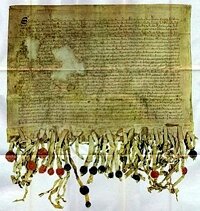
The declaration of Arbroath
If you happen to be in parts of North America today, then you might be surprised to see lots of people wandering around in Tartan. Today is Tartan Day – a celebration of Scottish Heritage … similar to the way that St. Patrick’s Day is an occasion for the Irish to celebrate theirs.
April 6th was chosen because it was on this day in 1320 that the Declaration of Arbroath, (a letter to the Pope asserting Scotland’s independence – especially from England), was signed and sealed by 51 Scottish nobles.
Apparently in the southern hemisphere they celebrate in the middle of their winter – on 1st July, the anniversary of the Act of Proscription passed in 1747 which banned the wearing of Tartan
The original was sent to the Pope in Avignon and was lost but a copy remained in the state archives.
In a way, it and the other two letters, (one from four of the Scottish bishops and the other from Robert himself), were successful in that the Pope wrote to Edward II, putting pressure on the English King to make peace with the Scots. It was a short success, however, as a year later he switched sides once more.
The declaration is interesting as a political document because it asserts that Scottish independence was an issue that lay within the purview of the Scottish people – not the King of the Scots. When appealing the excommunication of the King of the Scots, Robert the Bruce, it stated that that if he proved unable to maintain that independence, then the people would choose another person to fill the role … implying that the people could “elect” a king rather than having been “anointed by God” – although it is doubtful that, at this time, the earls and barons who signed the document would have had anything approaching the modern concept or notion of democracy.
One of the most fundamental roles of an independent state is protecting its borders, and Kyrgyzstan’s borders have been in the news this week.
There was an intriguing story, for example, that the parliament are discussing a draft law and one of the deputies proposed that foreigners shouldn’t be allocated land in the border zone … which was odd because foreigners aren’t allowed to own land. I am not sure, but I presume it refers to “allocation” of land for things like mines … the Kumtor gold, for example.
If it wasn’t such a serious topic, the claim that the border with china in the Naryn region is basically protected by local shepherds might have raised the odd smile. In the days of the Soviet Union, this was a very sensitive border – the USSR and China actually enterred hostilities on at least one occasion – and heavily fortified – there was a barbed wire electric hence … but the power has been turned off and most of the fence has disappeared. The region was declared a border zone and special permission was needed to live there and even to visit … but now permits are only needed for the immediate zone neighbouring the border itself. The checkposts have garrisons of about only 30 soldiers on duty and border patrols are, apparently, not carried out … at least according to the Head of the At Bashy District. It seems a long way from the situation described by Peter Hopkirk in Setting the East Ablaze, (his account of the civil war period), or the experiences of Paul Nazaroff in Hunted through Central Asia.
The border authorities do seem to have their hands full as there have been more stories of “mules” being arrested on the borders, (and even at Manas airport), carrying narcotics.
The demarcation of the disputed border areas with Uzbekistan is a continuing but is a slow process, we were told, and although the responsible commission headed off to Tashkent for discussions, there are still many problems as many areas are poorly documented.
Passports are an important document when it comes to crossing borders. At the moment Kyrgyzstan doesn’t have a biometric passport, (a combined paper and electronic “passport” – a contactless smartcard including a microprocessor and antenna embedded in the cover or center pages- that contains biometric data used to authenticate the identity of the holder), but it was announced that we should start issuing them from 2015 … I hope they have more in developing the system than they did with the current system … apparently they got some of the Kyrgyz text wrong, and they were complaints about the printing quality.
When I first came here, the passports were all handwritten. The current version involves a printed data page and photograph. One of the problems of these simpler (nonbiometric) passports is that they are easier to forge and a workshop has been discovered for this very purpose. Apparently the authorities have identified something like 90 suspect passports, including ones held by an Israeli wanted by Interpol and a Georgian crime boss..
Mind you, some new equipment, obtained thanks to financial assistance from Japan, has been delivered to automate the border control system at the 15 international border control posts, including Bishkek and Osh airports … That news took me a little by surprise because I thought there were only 9 international border posts, (Torugart and Irkeshtam with China; Ak Jol, Chaldovar, Basharina and Kenesh with Kazakhstan; Kara Myk and Kyzyl Art with Tajikistan and Dostuk with Uzbekistan), add the two airports and and the railway crossing and you get 12 … so where are the other three?. I suppose that it’s possible that I have missed some and then again there is the airport in Tamchi, (which receives flights from Kazakhstan and Russia) as well as the airport in Karakol which last year received flights from Kazakhstan … but that still leaves one more.
Anyway, in theory the new equipment should make life easier for travelers as well as improving the efficiency in the fight against cross-border threats, or so it is claimed. The terminals will run software specially adapted for Kyrgyzstan and be integrated with a central server checkpoint. It will record all the information contained in the passport, including the photograph, and it is claimed that this will aid the rapid exchange of information on cross-border statistics and data analysis.
As well as the technology they have their fingertips, one of the instruments which is supposed to help them is the Visa system. In theory, possession of a visa meant that the traveler had applied at an embassy or consul for permission to enter the country (… although it doesn’t guarantee that officials of the immigration authority and/or border guards would let the holder pass – and, for that matter, that is true for anywhere in the world), and had satisfied the necessary requirements … including passing certain security checks. For citizens of friendly countries, where there is little or no perceived threat, a country may decide to waive the requirement to obtain a visa before crossing its borders.
Well, last year, Kyrgyzstan adopted a visa free regime for citizens of some 44 countries – bringing the total of visa-free countries to over sixty – at least until 2020. That decision was never very popular with the Ministry of Foreign Affairs and various officials and politicians have started to raise the question again … even though a whole year hasn’t elapsed since it came into force. One politician said that by abandoning the visa requirement, the state had lost five million dollars and we needed to recoup that money. I am not sure where he got the figure of USD5 million … which would suggest something like 100,000 visas … but let’s assume it’s correct ,,, however, as I understand the law on state fees and charges, they are supposed to reflect the cost of providing the service … not pump money into the national exchequer. The trouble is that the visa fees were used to help finance the embassies abroad and with that source of income, some of them appear to have a cash flow problem. However, that always raises the question in my mind of how the embassies in places like Minsk and Moscow can survive as they rarely ever have to issue visas and never have had the additional finance to supplement their budget.
To help recover the “lost” funding, it was suggested that a system of compulsory insurance be instituted instead. One deputy pointed out that, if we did that, then we would need to have vastly improved services, commensurate with the cost of the insurance … and anyway, the suggestion is confusing two totally different things.
One official said that we need to analyse the working of the new system … but, admittedly, he did say something like “in order to decide if we can extend it”. I have my suspicions, however, that someone, somewhere, is still hoping that an analysis will show that the measure needs to be rescinded.
One of the chief arguments against introducing the visa free regime was that it removed a element of control over who could come into the country – which is true – and that this meant that we would open to an influx of terrorists and criminals – which is more debatable. Well, there was a very interesting article that pointed out that not was it debatable … it simply hadn’t happened.
One of the countries that wasn’t included in that list of 44 countries was Iran, and at the time the ambassador expressed his surprise … which I took to be a form of “diplomatic language” for something far stronger. Well, discussions are underway to liberalize the visa regime between the two countries, but we are still waiting for details of what might eventually be agreed.
I was extremely surprised to see a news headline that the Minister of Foreign was insisting that Japan should be included in the list of countries whose citizens can travel to Kyrgyzstan without a visa. It wasn’t in the list of 44 countries because Japan already enjoyed visa free status – and has done so since 2001. His point seemed to be that the decision in 2001 rested on a Government resolution whereas last year’s measure rested on a law passed by the parliament and so the earlier decision needed to be brought into conformity with this law. OK – I can follow that, but then what about the other countries like Cuba and Vietnam, Russia and Kazakhstan … ?
There’s talk of opening more consulates (in Kazakhstan) and even an embassy (in Thailand) … but I am not “holding my breath” … these things take time to organize and it will be some time before it happens.
Enough about visas – for the time being … I have a sneaking suspicion, however, that we will return to this question again in the future … and probably before 2020.
Another issue the border authorities may have to face in the near future is whether or not they should let the person standing in front of them cross the border … if they are female and under 23 … if so, then the traveler will have to provide proof of parental consent. The draft law which proposes such a ban on international travel for women under 23 is supposedly an attempt to deal with people trafficking and girls being forced into prostitution abroad. It has come under more fire this week … as depriving a significant part of the population of their constitutional rights; as being a blunderbus approach affecting many innocent people regardless of any real threat; as “punishing” the victims rather than the perpetrators of any offence; as being based on an arbitrary age – 23 doesn’t seem to appear else in the legislation as an “age of majority”.
One more issue arose during the week related to “crossing borders” but it had nothing to do with the government. Several travelers turned up at Manas airport in plenty of time to check in and go through the customs and immigration formalities for a flight to Istanbul … but discovered there was no plane. To be honest, that sometimes happens … the inbound flight has been delayed, perhaps by bad weather, and there’s nothing to do but sit and wait. However, they were amazed to discover that the inbound flight had arrived on time – and the plane had already departed on the return journey. The airline had made a mistake in the time that was printed on their tickets. They should have turned up several hours earlier. I think it is safe to say that they were very regal and Victorian in their response … that is, they were “not amused”.
It’s not the first time I have known this to happen. On one occasion, we had a tour group who had tickets to go to Tashkent and arrived to discover that the timetable had been changed and the flight had been cancelled … and they had been transferred to the flight on the following day. The airline and the ticket agency where we had bought the tickets had failed to inform us of the change and we were left with having to rearrange the itinerary which, fortunately, wasn’t too difficult – but it could have been critical had it meant they missed a connecting flight back to Brazil. I am pleased to say that the clients were very understanding about the situation and took it in their stride as a “bit of an adventure”.
One another occasion, many … many years ago, I turned up to at the airport to see some friends off on the inaugural flight to Kauala Lumpur … only to be told that the airline had cancelled it … not just that flight, but the route as a whole … there wouldn’t be another flight and all we could do is turn around an go back home. They got a refund for the ticket price, but they were not as regal in their reaction.
It was announced on Monday that the Rock Group Metallica would be coming to perform a concert in the stadium in Bishkek. (It was said that one of the group had come to Kyrgyzstan last year and persuaded the rest of the group that they should come and perform.) Well, the social media was hot with comments … but then it turned out that Monday was April 1st … and it was just a journalist’s April Fool’s joke. He may well have been laughing … but quite a few Rock fans were feeling very Victorian, (that is, not amused), when they realized that they had “been had”.
Some other people who are not amused are my neighbours – but, I am pleased to say, it’s got nothing to do with me. Just over the road a new shopping center, (Mall – for the Americans amongst you), has opened: Bishkek Park – a Turkish investment. It’s a pretty big complex and the although the shopping center on the bottom five floors has opened for business, construction continues of the two towers of residential accommodation which are going to rise another 18 storeys above the the city. Well, the residents of the nearby buildings have been raising the roof complaining. They say that there is an underground stream that runs under the site and the construction of such a tall building on the site should never have been given planning permission; it is in an earthquake zone, (and we’ve had two earthquakes this week), and is too close to other buildings – including a school; a gas pipe has electricity wires running too close to it and a spark could set off an explosion; there’s too much traffic causing chaos on the approach roads … and so on. The administration of the center have met with the residents, but the only thing that seems to have come of the meeting is that they drank tea together … and now the residents have taken their case to both the local authority and the court of public opinion – writing letters and holding press conferences. They have threatened to block the street outside – which will bring them into conflict with the law following a recently adopted law which introduced penalties for such actions following a number of highly publicized incidents in recent years.
I think I could understand if the Turkish investors decided that they were’t particularly amused either. Problematical relations with the local population seems to be “par for the course”, a common experience for many foreign investors … Kumtor have certainly felt the effect over the years, as have many other mining companies. Indeed, according to the head of the State Geological Service, the protests staged by the local population is having a negative influence on the development of the industry.
Kumtor is facing new claims that it is damaging the environment with an “expert” saying that they will pollute the whole of the Naryn River, the Syr Darya of antiquity.
Another mining company, (a Canadian company, just like Cameco, who run the Kumtor gold mine), is also facing problems … with the State Prosecutor trying to get their license annulled. A statement from the company said that it considers the prosecutor’s case to be “baseless, with no legal merit” and went on to state that “”Kyrgyzstan is unlikely to be able to operate … complicated projects like Stans’ Kutessay, or Centerra Gold’s Kumtor by themselves.” Perhaps someone should warn them that President Atambaev doesn’t necessarily agree with them … an auction is being held for the license to develop Kyrgyzstan’s second largest gold deposit at Jerooy (minimum price: USD300million – not withstanding the fact that there is an arbitration claim of USD400 million against it) and if there are no investors bidding, then he has told the Prime Minister that “we will develop the mine on our own.”
Sometimes the opposition comes from an unexpected quarter. This week, one of the Deputies surprised us all by speaking out against a loan from the Chinese loan of USD129 million for the development of some of the roads … he thinks the rate of interest is too high, especially when there are tax exemptions involved as well.
Having said that there is still plenty of interest in major projects here … for example, the latest news is that Chinese investment in an oil refinery in Kara Balta is on track to open in the fourth quarter and Singapore is interested in the development of the China-Kyrgyzstan-Uzbekistan rail link.
Kumtor is not the only organization facing claims about environmental damage. In recent years there has much criticism of the Bishkek Heating plant which supplies central Heating and Hot water to much of the city – especially the city center. The large smokestacks are visible for miles around and smoke billowing out from them is often blown across the city. Well, this week, it was announced that there are more emissions from vehicles, which increased in number by 11% last year, and, it as announced, something like 20-40,000 vehicles transit the capital every day.
Congratulations must go to the European School which has now been granted accreditation by Cambridge International Examinations as an International School. Started by a mixed group of ex-pats and locals, the school currently operates from reception classes up to the Middle School age range following the English National Curriculum.
During the week a policeman had his hand shot off by a packet placed outside a police station that exploded as he went to investigate it. I haven’t seen anything to suggest who might claim be responsible … or how it got there. I suppose it is possible that was a terrorist incident, but the lack of reports suggest that there may be some other explanation. Not long ago a policeman manged to shoot himself in the leg.
Apparently, following the 2010 events, some 30 firearms went missing and still haven’t been located. Its a good job then that the Organization for Security and Cooperation in Europe has decided to help out by donating a million dollars to strengthen arms depots in the country.
Oddly enough, weapons and ammunition, (apart from very limited exceptions), are not going to be allowed though the country as part of NATO’s withdrawal from Afghanistan. The list of prohibited items is quite interesting and includes items as telescopic sights, tanks and armoured vehicles (with or without weapons), helicopters and satellites, radar and radio navigational aids … even “rescue vehicles”.
So9me equipment that will be coming to Kyrgyzstan, however, is “spying equipment” for monitoring mobile phone conversations, SMS messages, radio communications and even on-line searching … all courtesy of the German government
The Bishkek Municipality has decided to impose a moratorium on renaming streets for five years. That will come as a relief for several of us who have difficulty coping with the different names by which one street can be known. Once I got lost looking for a particular shop on Tashkentskaya Street and asked a passerby for directions. They told me where to go, (that is, they gave me directions), that just confused me even more … I said, “But that’s Jibek Jolu … not Tashkentskaya“. I was told that Tashkentskaya was the old name for the street … “But,” I said, “Jibek Jolu used to be Fifty Years of the Kyrgyz Republic.” ”Yes,” I was told, “but before that it was Tashkentskaya“.
Fortunately, I had named the shop I was looking for and she happened to know it … because if I had simply asked for Tashkentskaya, she would have sent me in totally the wrong direction … little did I know it at the time, but the next street down from where we were standing is now called … you guessed it … Tashkentakaya.
Finally, knowing my penchant for statistics … I hope you’ll understand that I felt that I just had to bring these two to your attention.
- Apparently, according to one of the deputies, there is a correlation between the level of water held in the Toktogul reservoir and revolutions in Kyrgyzstan … there is a low just before the revolution and and a high just afterwards (in 2006 and 2010 for example). The Minister of Energy, however, says that in the 113 years for which we have figures, the average flow of water at that point is 12.7 billion tons of water, with a regular cycle lasting 6-7 years. As it happens, there were record inflows, (of 19 billion tons), in 1920, 1969 and 2010 …
- According to the State Statistical Service “43% of companies in Kyrgyzstan operate at a profit …” (!)
_______________________________________
Postcard from Bishkek: the weekly postcard that I send out as an email also gets posted on the website ianbek.kg each week – and there are other postcards which don’t get sent out. This week, for example, there has been the following postcards:
- Guides - Finding your way round when visiting a strange country isn’t always easy – a guide can make or break a holiday
- The Prezhervalsk Monument, Karakol - March 31st was the birthday of the Russian explorer Nikolai Mikhailovich Prezhevalsk … he died in Issyk Kul in 1888 and 1894 a monument to him was erected at the spot
- State – v – Official Languages - I confessed that I am confused … just what is the difference between a State language and an Official language?
- The postman … or postwoman - In 1860, the Pony Express was launched on April 3rd – but today’s post office involves a lot more than just mail delivery.
- Garlic – the “stinking rose” - An April Fool’s joke and an announcement of a newly discovered strain og Garlic inspired this look at an important ingredient in Kyrgyz cuisine.
- Apricots - There’s a festival in Batken to celebrate the Apricot blossom … the fruit is one of the symbols of this southern province.
It is possible to follow me on Facebook, (where I have specific pages for Celestial Mountains and ianbek … and also links.kg, Kyrgyz Diary and Kyrgyzstan Visitki), and also on twitter, (@Bishkekpostcard and @celestialMTC ).




 Bishkek