The Prezhervalsk Monument, Karakol

The Prezhervalsk Memorial in Karakol
A little boy called Nikolai was born on 31st March, 1839, (or 1st April – I have seen both dates quoted – in the same book(!)), in the village of Kimbor, in the Smolenmsk region of Russia.
The boy, Nikolai Mikhailovich Prezhevalsk, went on to become a great Russian explorer who opened up vast areas of Central Asia, from Mongolia to Tibet, with his expeditions.
In the middle of October 1888, whilst making preparations for yet another expedition, he was struck down by Typhoid, having drunk untreated water on a hunting trip in the Chui valley. When the symptoms first appeared he was unconcerned and dismissed the idea of consulting a doctor: “It’s not the first time,” he said. “it will pass.” A few days later, however, his condition had deteriorated and he relented. He moved into the Military Hospital on the shore of the Lake. Apparently he faded in and out of consciousness but was lucid enough to hold conversations with his traveling companions.
He was a man of experience and obviously knew what was happening. He told his comrades “I am not afraid of death, I have come face to face with it several times”, and asking doctor how long he had left, he said “I have a lot to do, you will not frighten me if you tell me the truth, I am not afraid of death at all.”
Two more days passed and in the morning of 20th October 1888, he was very week and could stand only with the support of his friends … within an hour he had passed away.
His companions fulfilled his last request, that he be buried in the hospital grounds, overlooking the lake, with a simple inscription on the gravestone: Traveler Prezhervaskiy. They chose a spot 12 Kilometers out of Karakol, on a flat promontory between the mouth of the River Karakol and that of the Kara Suu River.
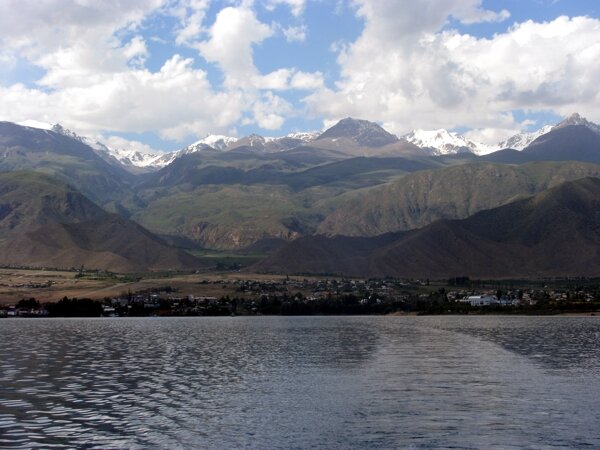
The vast blue lake, surrounded by the snowy peaks of the Tien Shan Mountains, the cliffs with edelweiss and blue irises, the visiting water fowl, (including Swans and even Pink Flamingos), and the romantic legends of sunken cities under the surface of the lake, made for a fitting final resting place for the great traveler.
Because the ground was so hard it took two days for soldiers and Cossacks from the barracks to dig the grave, and the body was covered in fabric and lace placed in a double coffin – one made of wood encase in another made from iron which had been specially forged in the garrison battery – before being interred a week later when a telegram granting permission for the funeral arrived from the District Commander. During that time, requiem masses were said twice a day in his memory.
Some local womenfolk made a wreath of artificial flowers and some of the soldiers made another from branches of a Fir tree to dress the coffin.
A Copper plaque was erected in the barracks inscribed with the text, “Here Major General Prezhervalskiy died on 20th October, 1888, at 9 a.m.”
In 1889, the Tsar decreed that Karakol should be renamed Prezhervalsk in his honour. He also decreed that a memorial to the explorer should be built. A design submitted by the Omsk Military Commission proposed three pyramids some 32 meters tall. However, a simpler design submitted by a General Bilderling, (one of the explorer’s friends ), was selected.
The monument was built in 1893, but the official dedication ceremony only took place on 26th June 1894.
It represents boulders from the Tien Shan and stands just over 8 meters tall, and is 2.5 meters wide. Made on site from cement, it is topped by a the figure of an eagle landing on the rock, (twice life size – with a wingspan of two and a half meters). In its beak the eagle held an olive branch, a symbol of peace and knowledge. Originally, in its talons was placed a golden baton … but in the uprising of 1916 it disappeared. Now, clasped in its talons there is an unfurled map of Central Asia fashioned in Bronze, with Prezhervalsk’s journeys of exploration marked on it.
Under the eagle was placed a Orthodox cross – set into the cement rather suspended over it – apparently to avoid it being moved or toppled in an earthquake.
Under that there is a bronze medallion, (one and a half meters in diameter), a copy of the gold medal awarded to Prezhervalsk by the Imperial Academy of Sciences in 1886, bearing a bas relief portrait of the explorer and the inscription: “”Nikolai Mikhailovich Prezhervalskiy. The first explorer of the nature of Central Asia. Born on 31st March, 1839. Died on 20th October 1888.”
A flight of eleven steps is set into the “rock” forming the monument.
The Imperial Geographical Society also started a subscription to erect another monument in St. Petersburg, raising some 30,000 roubles. After meeting expenses of constructing the monument in the Alexander Orchard opposite the Admiraly, more than half the subscribed funds remained and were used to establish the Prezhervalskiy Prize.





 Bishkek