Garlic – the “stinking rose”
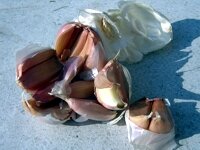
Cloves of garlic
According to the BBC website, a draft law presented to the State Duma, (lower house of parliament), in Russia earlier this week proposed banning the consumption of garlic – popular among Russians – in public places. The aim of the bill was to address “the impact ambient garlic aroma has on human health”. Apparently, however, written in convincingly impenetrable Russian legalese - it was intended as nothing more than an April Fool’s joke.
Garlic is a perennial plant, a species in the onion genus, Allium. Its close relatives include the onion, shallot, leek and chive that originally came from central Asia, (where it still grows in the wild), and is now cultivated throughout the world.
It has been used by humans for both culinary and medical purposes which perhaps stretches back thousands of years. There is evidence that it was used in Ancient Egypt at the time of the construction of the Great Pyramids.
Today, it is a staple in the Mediterranean region, and a frequent seasoning in Asia, Africa, and Europe. It is widely used here in Kyrgyzstan in a surprisingly wide variety of recipes.
However, it is not often used in traditional English cuisine …
My father once went to a restaurant and ordered a succulent steak accompanied by one of his favourite vegetables, Brussel Sprouts, but he couldn’t eat it because the sprouts were coated in a Garlic sauce.
There are several species of the plant and a number that have been misapplied as garlic which are really other types of Allum. Indeed, there are also several types or subspecies of garlic, although the classification of subspecies is a fairly recent development – probably occurring only over the last one or two hundred years. Early sources do not distinguish between types.
Generally, there are two types of subspecies referred to as hardneck - which gets its name from the tall hard woddy flower stalk – and softneck - which has a floppier stem. Further classification can be confusing since garlic color, size and taste can be influenced by environmental factors.
What’s more, new varieties are still being discovered – as recently as 1998 a new variety was discovered in the Sary Chelek Nature Reserve. Growing in clusters in the low alpine forest zone (at altitudes between 1600 and 1700 meters above sea level), in river valleys, on open sunny slopes with sparse vegetation.
The plant can grow two feet high … or more. It produces hermaphrodite flowers which are pollinated by insects and bees. A hardy plant, it can grow in a variety of soil conditions. It is easily cultivated and can be grown all year round in mild climates. Here in Kyrgyzstan, cloves are usually planted in the autumn before the ground freezes and then cultivated in the spring.
Although it is cultivated throughout the world, but China is by far the world’s largest producer and accounts for over three quarters of the world’s crop of just over seventeen and a half million tonnes. According to official FAO statisics, (Food and Agriculture Organization), garlic production in Kyrgyzstan rose from about 10000 tonnes since 1992, (when statistics began), to about 30000 tonnes in 2010.
It is mentioned by Hippocrates, Galen, Pliny the Elder, and Dioscorides as being used in the treatment of many conditions, including parasites, respiratory problems, poor digestion, and low energy.
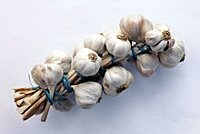
String of garlic cloves
The cloves are normally stored in warm and dry conditions – in order to prevent further sprouting, and usually hung in strings.
Several parts of the plant that can be used but the compound bulb is the part which is most commonly used. Each bulb is made up of 4 – 20 cloves, and each clove weighs about 1 gram. Garlic supplements can either be made from fresh, dried, aged, or garlic oil, and each may have different effects on the body.
It is not exactly an appealing an appealing name, but garlic is sometimes referred to as “stinking rose” because of its strong odour; when eaten in quantity, the effects of garlic, (as the chemicals in the herb interact with others used as part of the digestive process), become evident as a strong and pungent, distinctive smell in the diner’s sweat and breath the following day … and may linger for some time.
Garlic is rich in antioxidants, which help destroy free radicals, (that is, particles that can damage cell membranes and DNA, and may contribute to the aging process as well as the development of a number of conditions, including heart disease and cancer). Antioxidants neutralize free radicals and may reduce or even help prevent some of the damage they cause over time. There is even some evidence that suggests that it can help to prevent the common cold, not to mention ringworm, “jock itch” and athlete’s foot.
As such, Garlic is used to help prevent heart disease, including hardening of the arteries, (where plaque builds up in the arteries which can block the flow of blood and may lead to heart attack or stroke); high cholesterol – although the evidence for this is not conclusive; high blood pressure, and to boost the immune system. Garlic may also help protect against cancer.
Although herbs have long been used for medical purposes, they can contain components that can trigger side effects or interact with other herbs, supplements, or medications. As a result, herbs should be taken with care and under supervision. the use of garlic, however, is generally recognized as safe, (and listed as such, GRAS, by the U.S. Food and Drug Administration).
Among the more common side effects from garlic are: upset stomach; bloating; bad breath; body odor; and a stinging sensation on the skin from handling too much fresh or dried garlic. Also, handling garlic may cause skin lesions. There are other, more rare, side effects that have been reported, such as: headache; fatigue; loss of appetite; muscle aches; dizziness described as vertigo and allergies such as an asthmatic reaction or skin rash. Garlic has blood-thinning properties, which can increase the risk of bleeding.




 Bishkek