An Aladdin’s cave of treasures
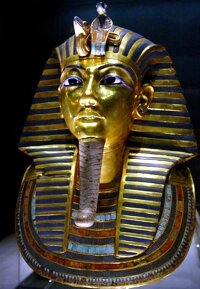
The famous mask of Tutankhamen
Howard Carter is known for discovering, in 1922, the tomb of 14th-century BC Egyptian pharaoh Tutankhamun. For several years he had been excavating sites in the Valley of the Kings and he thought he knew roughly where the elusive tomb was likely to be located.
The event captured the world’s imagination, probably because the tomb proved to be the best preserved of the Pharaoh’s tombs discovered, having remained almost intact, despite the attempts of early grave robbers … and contained a mass of wealthy objects. The discovery was to awaken a great interest in Ancient Egypt, of which the fabulous burial mask of Tutankhamun was to become an enduring symbol.
It was the to be the last year of excavation. Lord Carnarvon, who had financed the project for several years, had given Carter one more season to find the tomb. Then, on 4th November, 1922, the excavation found the steps leading to Tutankhamun’s tomb. Carter telegraphed Carnarvon to come to Egypt and on 26th November they made the “tiny breach in the top left hand corner” of the doorway and were able to peer in by the light of a candle and see that many of the gold and ebony treasures were still in place.
He made the breach into the tomb with a chisel his grandmother had given him for his seventeenth birthday. He did not yet know at that point whether it was “a tomb or merely a cache”, but he did see a promising sealed doorway between two sentinel statues. When Carnarvon asked “can you see anything?”, Carter replied with the famous words: “Yes, wonderful things.”
The following months were spent cataloging the contents of the antechamber and then finally, on 16 February 1923, Carter opened the sealed doorway and found that it did indeed lead to a burial chamber, and he got his first glimpse of the sarcophagus of Tutankhamun.
Since then, there has been a lot of research and much has been written about the discovery of the tomb, about the teenage Pharaoh, the world in which he lived and his untimely death. Personally, one of the interesting facets of this story seems to be the feelings that Carter must have experienced on discovering the tomb, looking through that small hole that he had chiseled into the doorway or when he finally broke through and found the Aladdin’s cave of wonders behind the final wall.
For those who are interested … here’s a short clip from youtube depicting some of the discoveries.
I am often asked by journalists, foreign consultants and tourists alike, how I came to be here in Kyrgyzstan and why I stayed. It’s a long story and my answer often varies with my mood – depending on how mischievous I am feeling at the time.
Like Carter, I feel that I spent a long time searching for something … and eventually found it … a veritable Aladdin’s cave full of wonders and wealth, albeit not always as dramatic or physical as Tutankhamun’s tomb. Like Carter, I have found invigorating and interesting artifacts, along with frustrations and difficulties. In the end, however, the Aladdin’s cave has much to offer a discerning public, eager for elucidation.
The iconic image of the discovery, of course, was the golden mask that for many people became an image of ancient Egypt, possibly challenging that of the Pyramids and the Sphinx. Gold has been in the news a here in Kyrgyzstan lot this week.
Several of the Parliament’s specialist committees have now approved the report of the commission into the operation of the Kumtor mine; calling, amongst other things, for the 2009 agreement struck between the then government and the company to be denounced, (an agreement, incidentally, that had been ratified by the parliament of the day … although the Minister for the Economy has declared that this was in fact an illegal action as they can only ratify “international agreements” – that is agreements with another country or an international organization with countries as constituent members). They also want officials who concluded the agreements, that they see as being one-sided and against Kyrgyzstan’s interests, brought to account – I wonder if that includes the deputies who voted to ratify the agreement If/when the agreement is denounced, they say, there should be a new “government run” company established to run the operation. The President of the parent company has arrived in Bishkek and is having discussions with the government … it looks as if both sides want to come to an arrangement – the country needs the mine to work and the company want to avoid confrontation – but it is not yet clear what arrangement they will be able to reach
The funny thing was that an analysis was published which suggested that if the company was run under the normal tax regime instead of under this agreement, then they would actually have paid less into the budget than they have.
Kumtor, of course, is just one of the gold fields in the country. Kyrgyzstan has a wide range of mineral resources – it is said that you can find all the elements in Mendeleev’s Periodic table but the deposits are often small or in inaccessible locations which tends to make them expensive to exploit. Certainly, the Kumtor gold field is in a difficult location being one of the highest gold mines in the world.
It would be interesting to see a valuation of Kyrgyzstan’s mineral resources to see how we compare to the asteroids that are currently the subject of speculation by companies looking to mine their riches. Mining an asteroid is going to be riddled with all sorts of difficulties, but one they presumably wont have to contend with is a discontented local population.
Some of the inhabitants of Talas oblast, which has a number of gold fields, some of which are close to coming on stream, have called on the government to introduce a 50-moratorium on the development of mineral resources … better, they say, to concentrate on agriculture than possibly ecologically harmful activities like mining.
It is estimated that only 15% of the country’s known gold fields are ready for exploitation and the head of the government’s Geological Agency commented that the industry is currently in a state of stagnation. Even so, it is hoped that five more mines may be put out for tender this year. Mind you, there is a proposal that the investors in one of the next mines to come on stream, Jeroy, should be fined USD200,000 a month if work isn’t started within three months of a license being issued and five million dollars a month if the mill isn’t built within two years.
All of that, of course is an ongoing saga … I’ve mentioned it in the past … and I have no doubt that I will have to return to it in the future.
Another ongoing saga took an interesting turn this week. The trial of the Bakiev brothers, (ex-president Kurmanbek and his chief of security Janish), over the events of April 2010 came to an end with unsurprising guilty verdicts on charges of abuse of power and causing the deaths of protesters. They werem’t there, of course, to hear the verdicts or the sentences as they are both, (we think), in Belarus. Kurmanbek was sentenced in absentia to 24 years of imprisonment and Janish to life imprisonment … with the confiscation of property, (and Janish was stripped of his military rank).
I don’t suppose there is much chance of them having to serve these sentences … Kyrgyzstan doesn’t have a security service like Mossad that can descend on another country and whisk someone away and, anyway, Belarus is technically a friendly country … with whom we are likely to koin in a Customs Union … even if they won’t agree to extradite Kyrgyzstan’s “Most Wanted”.
Following the sentencing, however, at least one person decided to do something to make a protest. He went to the Belarus embassy to demand the extradition and was plannig to burn the Belarus flag … but the police intervened and persuaded him that this was a bad idea … so instead he burned a photograph of President Lukashenko. It made for a nice clipo on the news, but I doubt if it will have had any real effect.
Concerns over the state of the economy is another ongoing saga … and it was announced that last year that whereas we exported 1.3 million dollars worth of goods and services, the value of imports grew by over a quarter and stood at 5.3 million. Now that’s a trade imbalance! It wasn’t helped y a reduction in the export of gold following some problems up at the Kumtor gold mine, accidents and geological problems but also including a strike and demonstrations … leading one analyst last week to ask if an example of industrial action had ever had such a dramatic effect on a country’s economy – so important is Kumtor to Kyrgyzstan’s economy.
At least inflation seems to be steady – running at about 8%, year on year.
Perhaps the surprise in the official figures was the effect of the services sector, especially hotels and restaurants, which got singled out for special mention as helping to shore up the economy as a whole. Personally, I am not convinced … it’s true that there are a lot more hotels and restaurants opening up around the country, but the crucial point, (or so it seems to me), isn’t simply the increase in the number of available facilities, but the question – “where are the clients going to come from?” and “what are they going to pay for?” … in other words we need good marketing and quality of service. The government have allocated the Tourism Department in the Ministry of Culture and Tourism a budget of seven million som, (that’s just under USD150,000); the same as they were allocated in the budget last year, (but they were only allowed to draw down something like just two and a half million – just under USD60,000), and most of that goes on administrative expenses to run the department … which led the Deputy Minister to describe the decision as a “mockery”.
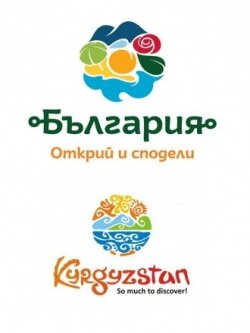
Similar?
Even the development of a new brand, logo and slogan for Kyrgyz Tourism was paid for by a grant, as part of a project to strengthen tourism in Central Asia, (funded by the European Union … thank you tax payers of Europe!). The decision to adopt it last September proved to pretty controversial, but not as controversial as the one adopted in Bulgaria last month.
I came down to the office early one day during the week, having woken up and being unable to get back to sleep. I checked my email and was surprised to see a message from someone in Bulgaria who told me that a page about the new logo on ianbek.kg had “gone viral” after someone had seen it … I went an checked and, sure enough, instead of the usual hundred hits, there had been well over a thousand that day – most of them from Bulgaria.
It seems that they too have been undergoing a re-branding exercise and the agency they had used had come up with a similar logo and slogan, (“Open and Discover” as opposed to “So much to discover”). The Bulgarians spent a lot more money than we did … and the final result was apparently even more controversial (unpopular?), there than it was here.
Both logo are basically circular with swirling motifs in similar colours. Was one based on the other, or did the designers study together, or from the same textbook … or was it a case of “great minds thinking alike”?
As it happens, there are similarities between tourism in Bulgaria and Kyrgyzstan – neither country has a single dominating feature but offer a veritable mosaic of different types of tourism: Beach tourism – Sun Sand and Sea, (or Lake); Historical; Adventure Tourism; Spa and Health Tourism; and so on. They are appealing to a similar market … so, maybe there is a similar logic behind the designs.
One of the reasons for allocating so little to the budget of the Tourism Department is another ongoing saga … tax collection.
It has long been said that many of the businesses in this sector operate in the shadow economy, unregistered, not reporting and not paying taxes. Last year, for example, although the tourism sector brought some 160 million som to the local Issyk Kul budget, (that’s just under three and a half million dollars), the general opinion is that it should have been a lot higher.
Indeed, according to the Head of the Tax Inspection and even the Prime Minister, a lot of companies throughout the country are operating in the shadow economy. If the government is going to succeed in reducing it’s massive deficit, it is claimed, then the Inspectorate is going to have to do a better job at raising tax revenues. The Prime Minister warned inspectors that if they didn’t meet their targets in the next couple of months, then had better start looking for another job. In order to help local authority finances, especially here in Bishkek, he suggested that new taxes could be introduced – although I think he simply meant that rates should be changed – not the introduction of completely new taxes.
What has made all this more surprising was the news that:
- the Parliament has now approved the suggestion of the the Tax Service to postpone the introduction of a compulsory, universal tax declaration to be completed by every citizen … for at least a year;
- several tax inspectors are being investigated for corruption and fraud – conniving with businesses to submit false declarations so that they pay less in tax to the budget … and presumably make some private “contribution” to the inspection … but most interestingly, that
- in January the targets were exceeded by over 5 million som
It’s not just tax inspectors that have been caught with forgeries … a Turkish citizen was detained by police and found to have almost twenty thousand dollars of counterfeit USD100 notes.
I suppose the other long running ongoing saga is the fate of the Manas Transit base. This week, however, there hasn’t been much news on this topic other than that the States have opened another route for the withdrawal from Afghanistan – not Bishkek nor potential bases in Kazakhstan and Uzbekistan … but through Pakistan.
Interestingly, 15th February also marked the anniversary of the Soviet withdrawal from Afghanistan and there were several events to commemorate the event.
In recent weeks, the situation surrounding the enclaves in Southern Kyrgyzstan have also been giving the impression of becoming a ongoing saga … Following last months incident, most of the Sokh enclave has now been fenced with barbed wire, and help is at last getting through to the people behind the wire. Humanitarian conveys have been allowed through; money has been allocated for the construction of bypass roads and for the development of the border regions. There have been some high profile visits down to the region – including one by President Atambaev.
The question of water resources has also been on the agenda for a long time … but usually it is in the background as an acknowledged issue and only occasionally emerges as a matter of urgency … well this week saw the matter raised again, but mainly as a warning shot from the Prime Minister that we could water shortage in the near future and the Prime Minister used this as a spur to urge everyone of the need to conserve electricity and consider switching heating from using electricity to another fuel – gas or coal.
The week saw a number of news items on the of theme of health: a rise in the incidence of hepatitis; the number of children in boarding schools, (orphanages), suffering from chronic diseases; the number of homeless discovered in a sweep of the city to be suffering with TB and the need to persuade newly qualified doctors to working in the regions … after six years of study and one or two years internship, it seems that many of them are not too keen to return home to their own villages in the regions to take up work but prefer instead to stay and work in the “big city” or even to find placements abroad.
Education also featured in a number of stories. Fort example, this week there has been a series of activities concentrating on Science, Engineering and Manufacturing in an attempt to interest young people in the value and importance of careers in these areas. Perhaps the most striking was an announcement that schools are to introduce a new system of assessment. Teachers will not assess a piece of work straight away as at present. First of all the pupil’s class mates will asses it and then the pupil will get a chance to rework it before the teacher finally assigns a mark. Not all the teachers, as you might imagine, are happy with this idea.
Thursday was Valentine’s Day and that brought out a lot of young people intent on celebrating the occasion – although there was, once again, criticism that it was a Christian holiday that had no place in Kyrgyz or Muslim tradition. A group of feminists decided to join a global campaign to draw attention to “V-day” – and protest against dometstic violence. One piece of good news that they had to celebrate was that the parliament has approved a change in the law strengthening the penalties for ala kachuu - bride stealing.
The sentence for blocking the roads as a from of political protest – something which happens a lot here – have also been strengthened, as have the penalties for government officials who have two passports; one Kyrgyz and the other of a different state.
The parliament has indeed been busy. They have also decided to require advertising outlets, (media, billboards etc.), to provide up to 20% of their space for “social advertising” – that is, public service announcements – free of charge.
There were also a number of other interesting items from abroad … -
One involved another story that seems to be an ongoing saga, (that of the China-Kyrgyzstan-Uzbekistan railway link), but this week’s news on that story doesn’t directly affect Kyrgyzstan … it seems that Uzbekistan is planning to re-route the line through the Fergana valley up to Tashkent so that it avoids passing through Tajikistan. That could be good news in that it sill cut down on the border crossings but will add considerably to the overall cost of the network – especially as they looking for potential investors for the project.
Then there was amusement at the news that Members of Parliament are to have a special psychiatric clinic made available to help them with depression and anxiety arising out of the strains and stresses of fulfilling their public duties … the parliament in Westminster, that is, not here.
Perhaps the biggest shock of the week, however, came from the Committee of the International Olympic Committee looking at which 28 sports should be included in the 2120 Games. It seems that they have decided that some sports are not exactly “watchable” and want to exclude some of them in the drive for spectators, and in the vote it was decided to cut Wrestling from the programme. At the moment most of the indignation at the decision seems to be coming from Russia – which tops the medal table in the sport – with calls for an inquiry as to how this situation could possibly have been allowed to come about … even as a subject for discussion. Not only has Wrestling been in all the Games of the modern era, it can trace its antecedents back into antiquity, to the time of the original games. How is it possible that Wrestling could be excluded?, going the way of Rugby, Golf, Polo, Tug-of-war, Painting and Poetry?; especially since 1936 only two other sports have been excluded: Baseball and Softball. Even though Kyrgyzstan didn’t win any medals at the London Olympics last year – wrestling is a popular sport and there are always high hopes that some of the contestants will return with a one.
_______________________________________
Postcard from Bishkek: the weekly postcard that I send out as an email also gets posted on the website ianbek.kg each week – and there are other postcards which don’t get sent out. This week, for example, there has been the following postcards:
- Snakes - To commemorate Chinese New Year, the Year of the Snake, I took a look at the snakes that can be encountered here in Kyrgyzstan – 10/02/13
- Jigsaws, timetables and planning an itinerary - putting together a tour can be a complex, time consuming and difficult task – like doing a jigsaw puzzle or compiling a school timetable – 11/02/13
- Darwin Day - commemorating the birth of Charles Darwin on 12th February, 1809, which is intended to give an opportunity to highlight his contribution to science and to promote science in general, it seemed an opportune moment to consider the biological sciences in Kyrgyzstan – 12/02/13
- Chatyr Kul – the Celestial Lake - the third largest – and one of the highest at 3530 meters above sea level, in Kyrgyzstan – 13/02/13
- MiG - One of the most striking of Bishkek’s monuments is a MiG fighter rising over Kievskaya in the city center – 14/02/13
- The other D-Day - on December 15th, 1971, Britain experienced D-Day – abandoning the time honoured system of pounds, shillings and pence and adopting a decimal currency so I took the opportunity to explore some monetary facts – 15/02/13
It is now possible to follow me on Facebook, (where I have specific pages for Celestial Mountains and ianbek … and also links.kg and Kyrgyz Diary), and on twitter, (@Bishkekpostcard and @celestialMTC ).






 Bishkek