The other D-Day
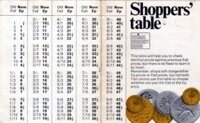
Conversion tables were distributed to help the Great British Public cope with the trials and tribulations of that other D-Day
Mention D-Day and most people will automatically thing of the Normandy invasion on 6th Jume, 1944, when the allied forces landed in Northern France during the Second World War … and which eventually led to the collapse of Nazi Germany.
In actual fact the terms D-Day and H-Hour are general designations used by the military for the day and hour on which a combat attack or operation is to be initiated. Although detailed plans had been made for the invasion, the actual day for the invasion was originally set for June 5, 1944, but due to bad weather and heavy seas, Eisenhower delayed the commencement of the action for one day … and the date June 6th has been popularly identified as D-Day, ever since. (Because of the association with the invasion of Normandy, planners of later military operations sometimes avoided the term to prevent confusion.)
I was not born until well after the Second World War, so my knowledge of the events of that historic occasion, and my understanding of what it meant for those who did live through it, is based on the collective consciousness fed by media reports and stories told in books and film.
I did, however, live through another D-Day which involved similar scale planning and preparation, and which was to have a marked effect on British history, culture and psychology – 15th February, 1971 … Decimalization Day.
It seems hard to imagine now, over forty years later, how much of a break this actually represented. The Good old British Pound, was to undergo a profound metamorphosis … instead of being comprised of twenty shillings of twelve pence each, (a total of 240 pence), it was to divided into just 100 pence. Each “new penny” was to be worth 2.4 “old pence“.
There was a lot of concern that people would have trouble coming to terms with the change, especially members of the older generation.
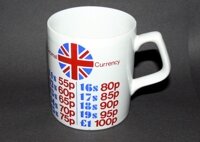
Conversion charts were everywhere
I couldn’t see what all the fuss was about … but then, I was young and quite good at Maths. It amazed me that although the older generation had learned to cope with the mental gymnastics of a mixed base arithmetical system – 12 pence in a shilling and 20 shillings in a pound, (not to mention 16 ounces in a pound, 14 pounds in a stone, 112 pounds in a hundredweight and 20 hundredweight in a ton …), dealing with sums in decimal currency should have been “child’s play”. The problem, of course, wasn’t the question of calculations in the new money … but the comparing the prices between the two systems … they would constantly be trying to compare the prices they had were being charged by be harping back to the equivalent price in “old money” – or “real money“. the prospect of having to convert into base 10 was so difficult.
It shouldn’t have been so difficult because a shilling was the equivalent of 5 “new pence” … so it should have been easy enough to convert, say, 34 pence into “almost 7 shillings”.
The authorities had made suitable preparations … they had been issuing new coins for some time labelled 5p and 10p – the same size and weight of the old one shilling and florin (two shilling) coins … they were withdrawing from circulation the coins which didn’t convert easily – the “old” penny – 1d -, the ha’penny -1/2d – the thre’penny bit-3d - the tanner or sixpence – 6d – the half-crown – 2s/6d or two shillings and six pence and replaced the ten shilling note with a new fifty pence piece.
Conversion charts were printed and distributed … even on everyday items like mugs, and lengthy publicity campaign was conducted with the popular performer, Max Bygraves, recording a special song to be played on the radio and television:
It could have been worse – in Elizabethan England, they had not only pounds, shillings and pence … there were also farthings, ha’pennies, groats, crowns, angels, Ryal and Sovereigns (later to be known as Guineas). The florin, (worth two shillings), was a later addition which was especially introduced as it was a tenth of a pound.
Before decimalization, the situation was even more mindboggling in places like India and Pakistan where a system of 1 rupee = 16 annas = 64 paise = 192 pies was used. (After decimalization process, 1 new paisa = 1⁄100 rupee … not 64).
Over the years, and over the globe, there have been many different systems of money. Most of them have involved coins made of precious metals such as silver and gold. In the days of the Silk Road, some Roman coins even found their way into Asia and were highly regarded as being of consistent quality and weight.
The first example of a decimal monetary system didn’t emerge, however, until 1704 when Russia adopted a system where the Ruble, (or Rouble) was divided into 100 kopecks.
The word Rouble is thought to derive from the word rubyt’, (which means “to cut, chop or hack”), and that it re[presented a piece of metal of a certain weight chopped off from a single ingot of silver.
This was quite a common practice in the ancient world - coins would be cut into pieces representing a fraction of the value of the complete coin ... hence the song and musical comedy based on a story by HG Wells, , "Half a sixpence" ... Early Angl Saxon Pennies depicted a cross on one side, and these crosses were used as guidelnes to cut the penny into halves or quarters ... the original ha'penny and farthing, (or "fourthing").
This still practiced as late as in the American colonies where the two bits and four bits were different sized pieces of a Spanish Peso, used because of a shortage of coins and the scarcity of silver.
It was 90 years later when, following the French Revolution, France followed suit by replacing the livre tournois with the Franc divided into centimes.
The livre tournois, or the Pound of Tours, which had in turn superceeded the livres Parisis or Pound of Paris to become the standard unit of currency thoughout the country and was divided, like the British pound into 20 sous each of 12 deniers.
Slowly, other countries also chose to reform their currency based on decimalization - dividing units by powers of ten.
For the record: There are still two countries in the world that use currencies that are not based on a decimal system ... in Madagascar the basic unit of currency, the ariary, comprises 5 iraimbilanji and in Mautitania, the ouguiya is worth 5 khoums.
Although it's not a country the Sovereign Military Order of Malta, (which retains its claims of sovereignty under international law and has been granted permanent observer status at the United Nations), also has an official currency: the scudo, which is subdivided into 12 tari, each of 20 grani with 6 piccioli to the grano. (The value of the scudo is pegged to the Euro at a rate of 1:0.24).
Some currencies are not divided into subunits, like the Abkhazian Apsar, the East Timor and Ecuadorian Centavo, and the Vanuatu Vatu
The local version of the dinar in Bahrain, Iraq, Kuwait, Libya and Tunis is divided into 1000 fils, (Dirham in Libya and Millime in Tusisia), the Lithuanian Litas into 1000 Centas, the Omani rial into 1000 Baisa.
Twenty years ago ... the Som was introduced
Here in Kyrgyzstan we use the Som, which is dividied into 100 tyiyn, which was introduced on 10th May, 1993, replacing the Soviet Rouble at a rate of 1 som to 200 Roubles. Thjat bmeans we are coming up to the 10th anniversary
In the Soviet Union, native speakers of Kazakh, Kyrgyz and Uzbek called the rouble the som, and this name appeared on the back of banknotes, among the texts for the value of the bill in all 15 official languages of the USSR.
The word som, (sometimes transliterated “sum” or “soum”), comes from a Turkic word for “pure” and implies “pure gold”. The word tyiyn is roughly equivalent in meaning to “small change”.








 Bishkek