Chatyr Kul – the Celestial Lake
Torugart
There are almost 2000 lakes in the Kyrgyz Republic, with a combined area of 6836 sq km. Most of them are small mountain lakes, located at altitudes between 2500 and 4000 meters above sea level and were formed as a result of glaciations.
Chatyr Kul : Kyrgyzstan's Heavenly Lake
The largest lake, of course is Lake Issyk Kul, followed by Son Kul and the third largest is Chatyr Kul, with a surface area of 175 square kilometers, (23 kilmeters long at it’s maximum length and with a maximum width of 10 kilometers). It is basically a shallow lake, (only 2-3 meters deep for the most part), although at its deepest point it descends 16.5 meters. The shoreline slopes gently into the lake except in the North where limestone cliffs come close to the shoreline.
The name “Chatyr Kul” means “Celestial Lake”, “Heavenly lake” or “Lake on the Roof” in Kyrgyz. That seems appropriate as it is surrounded by mountains and lies at an altitude of 3530 meters above sea level, which makes it Kyrgyzstan’s highest mountain lake.
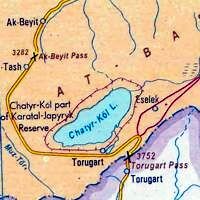
The lake lies in the Ak Sai valley, betyween the At Bashi and Torugart Too mountain ranges, near the border with China and the Torugart border crossing. It’s an enddorheic lake, which means it lies in a closed drainage basic that retains water but has no outflow. Some seventeen rivers feed the lake, (some sources say twenty four) – but only one of them is permanent: the Kekaygyr or Kok Argin.
The valley offers good grazing for shepherds and their flocks of livestock. It is said, for example, that there are over 20,000 yaks here. There are no settlements along the shoreline, although there are a few small hamlets in the valley in the valley, a meteorological station … and the border post encampment nearby. The result is that is an almost undisturbed, pristine natural site.
The climate varies considerably throughout the year. The lowest recorded temperature is apparently -50°C and the highest, 24°C. The average temperature of the water in July and August is between 6 and 16°C – but the average temperature in January is -22°C. From October until April, the lake freezes over. The ice can be about 1.5 meters thick.
The lake seems to be getting smaller and the thawing of frozen ground is causing the emergence of some new small gulfs in the south-western part of the lake.
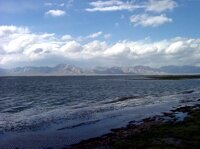
Despite the evidence of the photograph above, the water tends to be a yellowish green rather than blue. It contains a number of minerals, (chloride, hydrocarbonate, sodium and magnesium), but has a low degree of mineralization. The transparency of the water is up to 4 meters.
The lake and a two kilometer wide buffer zone around its 58 kilometers of shoreline form part of the Karatak-Japyryk State National Reserve … and it is a RAMSTAR site of globally significant biodiversity.
A result of the transparency and shallowness of much of the lake is that there is an abundance of submerged macrophytes over much of the bottom of the lake. Large accumulations of portmogeton, (freshwater plants – a form of pondweed), are found around the edge of the lake – possibly detached during stormy weather.
Although there are some fish in some of the inflowing streams, (for example Serertov’s scaled Osman – in some of the SouthWestern feeder streams), there are no fish in the lake itself. Apparently, however, there are some freshwater shrimp – and it is thought that the population could not coexist together with fish … hence the lake offers a unique resource. Some of the zooplankton in the lake grow to a considerable size, (for planktom, that is – maybe up to 4 mm in length), and they tend to coloured an intense red.
It is also known as a resting place for several breeds of wild birds, especially from late August until October, (an expedition in 2004 noted 52 species of birds with an estimate total population of 21903 birds):
- it is an important site for a relative large breeding-colony of Bar-headed Geese - Anser indicus;
- the Ruddy Shelduck (Tadorna ferruginea) – the numbers (between 5,000 and 10,000 birds) representing a large proportion of the Central Asian population;
- several species of dabbling ducks (Common teal Anas crecca, Mallard Anas platyrhynos, Nothern Pintail Anas acuta,Garganey Anas querquedula) and
- several species of diving ducks (Common Pochard Aythya ferina, Ferruginous duck Aythya nyroca, Tufted Duck Aythya Fuligula);
- The rare Bar headed Goose is known to breed on the plain;
- Towards the end of summer, a large variety of migratory birds, (more than a hundred different species), that rest around the lake before continuing their migration over the Himalaya Mountains. Chatyr Kul provides a last stop before they will cross the mountains.
The surrounding area is also known as an important habitat for the endangered Argali Sheep, (Ovis Ammon - otherwise known as Marco Polo Sheep).
Those travelling to Torugart may be tempted to make a detour and stop here, but the land surrounding the lake is swampy and can be treacherous – and a special border permit is needed.
Nearby there are some hot springs and there is a mausoleum at the Western end of the lake.




 Bishkek