From Seven Bulls to Golden Springs
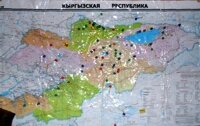
Where I have been in Kyrgyzstan
On my wall, above my computer, I have a map of Kyrgyzstan with almost a hundred little coloured pins stuck in it. Visitors often ask if it shows where we, (that is, the Celestial Mountains Tour Company), take visitors … but I have to explain that, no … it’s a personal record to show where I have been.
Although that might seem impressive, the pins are quite concentrated around Northern and Central Kyrgyzstan and there are quite large areas where I have to admit, I have yet to venture.
Although there are several pins around Lake Issyk Kul, for example, there are are some notable gaps in the Terskey Ala Too to the South of the lake. Most notably, although there is a pin in the Ak Suu valley, (white Water), to the East of Karakol, there isn’t one in the neighbouring valley of Altyn Arashan , (Golden Springs or Golden Spa).
In a way that is quite ironic … because that is probably one of the spots most often visited by tourists and on many a checklist of things that qualify as “Must See / Must Do …” here in Kyrgyzstan.
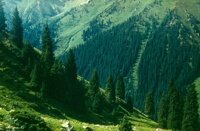
The alpine slopes of Altyn Arahan
Having said that, it’s really like many other tourist spots … it’s very unlikely that visitors will run into lots of other tour groups … each following their guide who is holding up an umbrella and trying to talk above the general murmur of other groups … as might be encountered in somewhere like the Notre Dame Cathedral in Paris. There are places in Kyrgyzstan where that sort of thing might happen … Son Kul and Tash Rabat, for example, or in the Historical Museum in Bishkek ….but Altyn Arashan isn’t really one of them.
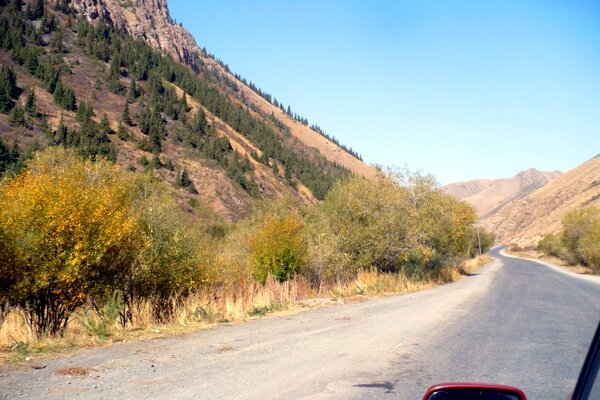
For one thing, although it is quite close to the regional center of Karakol, it’s actually quite difficult to reach. When I went up the Ak Suu valley, we were in a 4-wheel drive jeep and our driver pointed out to me the turn off for Altyn Arashan. ”You must go there sometime,” he said, “but not today! We’d never make it in this vehicle.” It’s only about 14km from the turnoff where my driver made his observation … and its a 2 hour drive.
That took me by surprise … but I now understand … the road is really quite something, not really a road but a sort of trail, which can be very steep in places. A special heavy duty, 6-wheeled, off-road vehicle, which is usually referred to as a sort of “military vehicle” is the only sort of vehicle that can tackle the route. As one tourist put it, it was “really very bumpy – but lots of fun”.
So, although lots of people head for Altyn Arashan, you are unlikely to meet another vehicle, yet alone to be caught in a traffic jam … although you might need to stop from time to time to make way for the sheep.
That’s part of the attraction, of course, getting off the beaten track … and most of the people who do visit are trekkers out for a strenuous hike in the wilderness …
I say strenuous because the start of the valley is about 2400 meters above sea level … but it is flanked by tall snow covered peaks – some of which rise to over 5000 meters. The peak of the glacial Mt Palatka stands over the Southern end of the valley, at 4260m.
The valley has a stream and some hot springs … they are pretty spartan, basically just concrete lined pools of naturally heated sulphur bearing water … with wooden huts mounted over them. It’s not all basic, however; there is a “resort” with a rustic guesthouse and and yurt camp which can provide accommodation, but most people pitch a tent and camp.
The valley is famous for the pritsine beauty of its alpine landscape; pine forests which contain many more hidden springs, (both hot and cold). Also in the valley, above the “resort”, there is the Kyzyl Tash Cave and nearby are the Tergen Ak Suu,Djergalan, Koi Djailoo and other ravines.
The area includes the Arashan State Nature Reserve which is a special botanical research preserve. During August people arrive to collect wild mushrooms and fruit like blackberries are abundant into September.
As well as the sheep which might hold up progress up to the valley, there always the chance of meeting more varied wildlife; bears, for example, are known to frequent the area, and the are is thought to be home to about 20 of the elusive snow leopards. (There is a small museum with stuffed animals, typical of the region.)
Although it is possible to turn round and go back down to Karakol, many people simply use the valley as a starting point and wander off up into the mountains. There are several well known routes that were popular back in the Soviet period – one over to the Ak Suu valley to the East, which involves two or three nights camping; up to the picturesque Lake Ala Kol before descending to Karakol valley, which really needs three nights; or even further to Djety Oguz, (Seven Bulls) or beyond … extending the length of the trek accordingly.
Here is one specimen itinerary which we put together for a group a few years ago: Itinerary: From seven bulls to Golden Springs
The weather, however, may well dictate what is possible. Although a visit to Altyn Arashan is possible from about May onwards, snow can still lie on the ground and hinder access to the mountain passes well into June. Evenings and nighttime are also likely to be cold and storms can strike up suddenly.
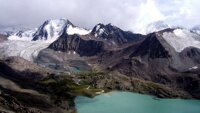
Lake Ala Kol
For the record: Ala Kol lake lies at an altitude of 3532m. It is often the first overnight stop on the route between Altyn Arashan to Djety Oguz, but it can be reached in a (long) day from either of the Altyn Arashan or Karakol valleys – but only in the summer months – and, although the trek is popular, the route is not regarded as “easy”.
It is set in a barren, rocky depression and surrounded by the peaks of the Terskey Ala Too range. The lake is approached along rocky paths and scree slopes.
The lake is 2.3 km long and 700m wide which makes it the largest of the 729 lakes in the Issyk Kul basin. No one seems to know how deep it is, at least, (we can’t find a recod of its depth anywhere in the literature), but the Encylopedia Kyrgyzstana says that the volume is 4.3 million cubic meters.
The crystal clear waters of the lake are fed by glacial streams and the outflow forms a waterfall. It freezes from October until May.
The lake’s colour changes according to the time of day, the season and the weather – the waters can seem violet, dark blue or even pink.





 Bishkek