Snakes
You don't see many of them ... but there are snakes in Kyrgyzstan
Today happens to be the Chinese New Year, and this year it is the turn of the Year of the Snake!
I have encountered snakes three times here in Kyrgyzstan – each occasion was on the other side of the Kyrgyz range of mountains.
I was so surprised the first time, partly because it is a rare to see a snake, but more so because of my driver’s reaction … he was so insistent that I keep my distance … “We have poisonous snakes in Kyrgyzstan!”, he warned.
Well, in Britain we also have some snakes, including one venomous viper, (commonly known as the Adder), but just like here in Kyrgyzstan it is very rare to come across one.
There were three species of reptiles included in the original (1985) Red Data Book of the Kyrgyz SSR:
- Transcaspian Desert Monitor: A species of lizard, found in the south of the republic, in the foothills of the Turkestan range and in the arid gorges of the foothills of the Alai, Ferghana, Babash Ata and Atoivnovsky ranges. It is one of the widely spread monitor lizards in the world with a distribution from the Sahara to Central Asia. In spring they are active during the day, but as temperatures rise in the summer months they adopt a pattern of behaviour where they forage for food twice a day – in the cooler temperatures of the morning and evening. They hibernate over the winter from about October onwards.
-
Spotted Desert Racer: (Coluber karelini Brandt). A rare species of snake - there has been only one occurrence recorded of its existence in the territory of the Kyrgyz Republic, which was obtained by V. V. Ozarovsky in the Kara Archa gorge of the Western foothills of the Kyrgyz range.
Coluber snakes are thin fast moving reptiles – and commonly known as “racers”. In fact the term used to be used to designate snakes, but modern science has reclassified snakes so that the term is now restricted to a small subset of species. Most, but not all, are non-vemomous – or, at least, the venom is known not to be harmful to humans.
- Cliff Racer: (Coluber rhodorhachis). Another species of snake where only a single specimen has been found in the territory of the Kyrgyz Republic. This one was collected in the Uzun Akmat valley of the Western Tien Shan. Cliff racers are found throughout North Africa, the Middle East and into Central Asia.
In 2005 the list was revised. The two species of snake were dropped from the list – and nine species were added to join the Monitor lizard, including three snakes:
- Diadem Snake; (Spalerosophis diadema Schlegel, 1837). A large colubrine snake, (adults can grow to about 1.8m or 6 feet), found throughout Central Asia, the Middle East and Northern Africa. Coloured a pale buff or sandy grey with dark, blotchy patches
- The Steppe Viper, Ursini’s Viper, Renard’s Viper; (Vipera renardi Christoph, 1861): a venomous snake which is found over widespread areas, from the South of France to Xingjian in Western China. It usually grows to between 40 and 50cm in length – although some specimens have been reported which are twice as long. It is coloured grey, tan or yellowing with a dark wavy stripe, edged with black, down the back.
- The Tartar Sand Boa; (Eryx tataricus). This is a large snake, (adults can measure anything from 50 to 120cm, the females tend to be larger than the male of the species) found throughout the Middle and Far East. They are typically a sandy brown colour with brown and green “blotches”. It inhabits dry grassland and has been known to hide in the burrows vacated by rodents. There are some accounts of the snake being used as the basis for medicinal treatments.
In addition there are the following species of snake found in Kyrgyzstan:
- Tessallated Watersnake or Dice Snake; (Natrix tesselata) – a European non-venomous snake which may vary greyish green, brown or even black, but the belly is sometimes coloured a vivid yellow or orange with black spots, resembling a dice – and hence the name. Adults measure about 1 to 1.3 metres, but females are larger than males. They are found near streams or lakes, and often feed on fish and amphibians, (frogs and toads). The mating season, when snakes gather in large groups, is between March and Early May, and eggs are laid in June/July in clutches of anything between 10 and 30, with the young hatching in August/September. The snakes hibernate over the winter in dry holes near to water.
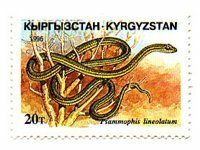
- The Steppe Ribbon Racer; (Psammophis lineolatus) distributed across Asia East of the Caspian Sea. A long thin snake that moves swiftly across land and lives at altitudes of up to about 1700m asl.
- Pallas’ Coluber, Halys Viper, Mamushi, Karaganda pitviper; (Gloydius halysi, Eichwald, 1831). A venomous snake found thoughout Asia. Specimens grow to between 50 and 60cm. In hot weather it favours shady positions. The colouring can be grey, brown, olive otr kharki with a darker pattern.
- Levantine Viper, Blunt nosed viper; (Macrovipera lebetina). A venomous snake found across North Africa, through the Middle East and as far as Central Asia. A large snake which can reach as much as one and a half meters in length.
- Oxus (Central Asian) Kobra; (Naja oxiana). This venomous species averages about a meter in length, and are usually coloured a light brown. It favours arid or semi-arid rocky or stony, shrub or scrub covered terrain
Although the following snakes are included on one or other list of flora and fauna to be found in Kyrgyzstan – I can’t find other references to support this. They seem to snakes that are distributed
- Ladak Racer; (Platyceps ladacensis).
- Reuss’s Racer, Red Headed Whip Snake; (Hemorrhois nummifer).
- Mountain Racer, Spotted Whip snake; (Hemorrhois ravergieri).
Although it is not a snake, there is also the Scheltopusik or European Legless Lizard; (Pseudopus apodus). As the name says, this is a species of legless lizard, not a snake … but as these two animal species look and behave very similar, it is very easy to confuse the two.
For the record: A legless lizard doe not have flexible jaws and so is limited to prey which is smaller than its own head as it cannot “unlock” it’s jaws in order to swallow larger prey as a snake can. It also has moveable eyelids, (snakes do not have eyelids) and have ear openings, (which snakes don’t) . Legless lizards can only move sideways and propels itself forward by pushing against objects, wheras a snake can use its scales to propel itslef forwards as well as sideways. A legless lizard can also detach it’s tail which remains writing in order to distract a predator, and although it can regenerate it’s tail once, this is still once more than a snake can.
It’s name is derived from Russian for Yellow Belly. It can grow to about 135cm and has a distinctive side groove. Although it is called a legless lizard, there are some very small rear legs, (just 2mm long). It likes short grassland and is particularly active in wet weather.



 Bishkek