A nice cup of tea …
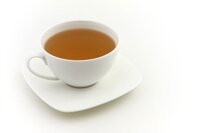
A nice cup of tea!
Tea is one of the staple items of the local diet. As one blogger has put it: “People in Kyrgyzstan love tea. It is like a replacement for water here, and you drink tea with pretty much every meal.”
Traditionally, especially in the North of the country, tea is brewed strong in a small pot and then mixed with boiling hot water to taste. There is a ceremony involved but it is not as complicated as that found in China and Japan: the first few cups are poured back into the pot to mix the infusion even more before any is served to the guests.
The cup, (or pialka – a small handless bowl), is not usually filled to the brim. This is so that the cup can be constantly refilled and will always be hot – and it is refilled again … and again … and again until you’ve had enough and don’t want to drink any more, cover the cup and say, ‘Ichtym‘ (I’ve drunk). Even so, the host is likely to continue offering a few more times which is to make sure that you are truly satisfied.
Afternoon Tea is an old British tradition for which we are well known throughout the world. In his adventure, the comic hero Asterix the Gaul travels to the island across the Channel to help the British Celts in their fight against the invading Roman legions and is astounded when the local insist that hostilities cease at four o’clock in the afternoon for a ritual cup of hot water … to which he adds herbs to make tea.
Well, today is International Tea Day; a day observed since 2005 in many tea producing countries, (such as: Bangladesh, Nepal, Vietnam, Indonesia, Kenya, Malawi, Malaysia, Uganda, India and Tanzania). The idea behind the day to draw global attention of governments and citizens to the impact of the global tea trade on workers, small growers and consumers.
As, the old song has it that:
I like a nice cup of tea
In the morning
For to start the day you see
And at half past eleven
Well my idea of heaven
Is a nice cup of tea
I like a nice cup of tea with me dinner
And a nice cup of tea with me tea
And when it’s time for bed
As I think I may have said
I’d like a nice cup of tea
To be perfectly honest, however, although I do like a “nice cup of tea”, and my mother would make a pot of tea at “the drop of a hat”, I drink more coffee than tea. A nice cup of tea, on the other hand is a great way to break the ice, is extremely refreshing and has a calming effect and, as the song puts it, is great at any time of the day.
In fact, it a hot cup of tea was very welcome yesterday when the temperature here in Bishkek plummeted. I actually saw reports of -21º Celsius! It made me smile when I thought of those complaints about the temperatures in Britain. The Ministry of Emergency situations had earlier issued a warning of an impending storm – intense snow conditions were expected … and arrived!
Tea may be a popular drink, but it was also reported during the week that 85% of those over 14 drink alcoholic beverages. ”Of these, 25% will eventually become chronic alcoholics.”- said a narcologist at the press conference. He went on to mention how the elders of the Djumgal district of Naryn tried to prohibit the use of alcohol in the area, but this modern attempt at Prohibition failed just as the American experiment failed … residents who wanted a drink just travelled to other areas.
Incidentally, it was 79 years ago today that the Twenty-first Amendment to the United States Constitution, repealing the Eighteenth Amendment that prohibited the sale, manufacture, and transportation of alcohol, (Prohibition), officially becomes effective.
The Ministry of Economic Affairs is planning to put out for discussion a draft Government Resolution on the introduction of state regulation for the price of vodka … which proposes establishing a minimum wholesale price of Kyrgyz vodka at 60 som for a half litre bottle with a shop price of 70 som, (that’s about USD1.50, EUR1.15 or just GBP1) – which is an increase on the current level of 50 som .
I am not sure why they are only talking about controlling the price of vodka … what about Kyrgyz Cognac or Sovietskoye Champagne or beers which are produced here in Kyrgyzstan … not to mention other spirits, wines, beers and cocktails made abroad.
That’s not a problem for me because I am not allowed to drink anything alcoholic at the moment – a result of being bitten by a stray cat that got itself trapped in the office and then having to have anti rabies injection. No drinking for three months! When the Doctor told me this, she looked all the time at Lisa, (who I had taken with me in case there was some complicated translation needed) … “Will it be a problem?,” she asked, “Does he like Beer?”. I felt very much like the disabled person who was invited for tea … and where the hostess turns to a relative and asks “Does he take sugar?”. I wanted to shout and scream … “I’m over here … I understand Russian … No, it won’t be a problem and Yes, I do like a glass of beer!”
Several supermarkets, cafés and restaurants, (some of which are quite well known and popular), have had their licences to sell alcohol revoked or suspended, (and some actually had bottles confiscated), whilst other applicants have had their applications turned down … all because they are within 100 meters of a school … apparently the move came as a bit of a surprise because, although law has been on the statute books for some time it has never been enforced before. This led to an interesting spat between one of the news agencies and the Narodniy(People’s) chain of supermarkets. The agency had reported that the supermarkets were going to appeal the decision in the courts, but the shop’s executive later denied this and demanded a retraction be placed on the agency website.
Apparently, they ought to ban alcohol sales from all sorts of places, given on the fact that it is based on the distance from a school … if a survey by the International Labour Organization is to be believed. According to them, it seems that Kyrgyzstan has 592,000 working children aged 5-17 years, (57.9% of them boys and 42.1% girls). However, it can’t be assumed that they are working in factories or shops because the majority of the working children in Kyrgyzstan are actually domestic workers. To make matter worse, they say that 21.3% of working children are exposed to various hazards at work places, around 75% of them work in smoky places, 36% children work in extremely hot or cold conditions and 15% work in harmful conditions of gas or fire. They also work with dangerous tools, carry heavy loads and work with mechanical and other heavy equipment.
The local “Mafia” boss, Kamchybek Kolbayev, was caught in the UAE and extradited to Kyrgyzstan – actually, the story appears to be that he walked into a police station and surrendered … but nobody seems able to understand why.
Kolbayev is considered to be one of the biggest drug dealers in Kyrgyzstan, and the U.S. government has him on their black list of the world’s largest drug lords … and he has a fascinating history:
Back in 2000 he was sentenced to 25 years in prison but six years later escaped and after a year searching for him, the authorities seem to have stopped looking for him. Before the revolution in 2010 he is supposed to have led a semi-open Kolbay life, indeed he is said to have hosted a large celebration somewhere in Naryn at which several officials from the Bakiev administration were supposedly seen. Following the revolution of 2010, however, he was arrested again, only to escape again eventually ending up in the UAE. Then, last year, the Kyrgyz government demanded his extradition but in September of that year, he was released.
Apparently he is now facing charges for: kidnapping; illegal imprisonment, robbery, organizing a criminal community; the illegal purchase, transfer, sale, storage, transportation or carrying of firearms, ammunition, explosives and explosive devices; the illegal manufacturing, purchase, storage, transportation, transfer with intent to sell, and the illicit production or distribution of narcotic drugs, psychotropic substances, their analogues or precursors … and not forgetting the use of violence against a government representative.
And … he apparently walked into a police station and surrendered himself?
According to the Border Service, he was accompanied across the border by agents of the GKNB, (basically, the KGB). I presume they didn’t include the two agents who were arrested for shooting from their firearms in one of the city’s suburban districts. There are a lot of questions about that incident as well!
All that added interest to the story that the Kyrgyz are apparently asking the Russians to support the police, with materials and training, as well as the support already promised for army. I presume they are already supporting the GKNB.
There have been lots of stories about the activities of the GKNB recently. We’ve known for some time that have the facility to listen in to our phone conversations and I believe they can monitor internet traffic … which seems to also be an issue in the West at the moment. Apparently all out tweets are stored in the Library of Congress, so I don’t understand how anyone can consider tweeting to be a private correspondence, however a deputy in the parliament was surprised to find that her tweets from the parliament, in “real time”, were seen by some 1200 followers (“some of whom she had never met”) and then used in reports by a news agency. She’s complained and deleted her account.
Incidentally, the best tweet of the week came from another journalist and offered a new definition ofor the word Chutzpah: Lukashenko suggesting that Kyrgyzstan deliver Bakiev’s pension to Belarus.
Another news agency has decided to go to court to complain about what it sees as the illegal blocking of its website. Ferghana.ru is/was one of the most popular news agencies in the country and concentrated on news from the south of the country, but ran foul of the authorities for it’s coverage of the events of June 2010.
The statue of the journalist Gennadiy Pavluk, (who was killed in Almaty, apparently with the complicity of the Security services, in 2009), has now been replaced. It had been stolen from its pride of place on one of Bishkek’s main streets in the dead of night not long ago and then found carved up suggesting that it might have been stolen for the scrap value. Well, it’s now back in its place … and for several days been garlanded with flowers.
The end of the week saw a flurry of reports about press freedom, libel and censorship. Forum 18 published and interesting report about the censorship provisions in the new law on Religion and I see that the report from Freedom House rates religious freedom in the country as “limited”.
One of the more publicly notable deputies of the parliament has declared that, “Kyrgyzstan needs a ban on travel abroad girls younger than 23-25 years”. According to her, after the girls go abroad little is known about their fate. Drawing attention to the recent measures introduced in neighbouring Tajikistan, she said that the government should check marriage agencies, as many of the girls had left abroad for marriage. In a sign of gender equality, she also said that a similar ban should be introduced for young men.
Those people who do go abroad in search of work remit money back to their families here in Kyrgyzstan – and it was reported this week that these remittances amount to something like two billion US dollars a year, or 30% of the country’s GDP.
Those migrant workers will be some of the 13 million people who have apparently crossed the country’s borders so far this year. Apparently, during the tourist season some 26397 “foreigners” crossed the borders … 114 of them remaining in Kyrgyzstan, including 9 more Brits(!). I was surprised by that until I realized that “foreigners” didn’t include Kazakhs and Russians … there were 6250 people from Germany, 4695 from the States, 2406 fro Korea, 2149 from France, 1714 from the UK. At the other end of the scale, there were 9 from Bosnia and Herzegovina, 5 from Bahrain, 4 from Iceland, 3 from Malta, 2 from Qatar and just one person from each of Leichtenstein and Monaco … whilst no one from the Vatican and Brunei Darussalam – Maybe next year!
The Department of Tourism claim that the number of foreign tourists is 66% more than last year, and gives the credit for this increase on the new visa free regime. Personally, I am not convinced about this … in my opinion, although it may have had some effect, the measure was introduced far too late to have had a substantial influence on the figures.
Incidentally, it appears that the main investments made in tourism in 2011 came from China and the US. Unfortunately, there were no details about individual investments in the report.
Those foreigners who come here to work in Kyrgyzstan’s markets are in for a shock as the Foreign Ministry has proposed to ban them in order to protect local merchants. ( Most of these traders are from China, Turkey, Iran and Pakistan.) They are also proposing a quota of 10% for the number of foreigners allowed to work in retail outlets. In support of the proposals they point out that the number of foreign workers far exceeds the quotas already set and they claoim that many of them, (especially from China), are here illegally.
President Atambaev also crossed the border this week, as he left for an official visit to German, where he met with various officials, including Chancellor Angela Merkel. He took the opportunity to warn that extremism could develop in Kyrgyzstan and we ran the risk of becoming a second Afghanistan. I am not sure, but it looked to me like a plea for more support from the international community, especially as he also complained that the EU hasn’t given a loan to “the only country that is developing Parliamentary Democracy” in the region.
He also made another couple of interesting statements: that Presidential power should be cut back in the future – presumably after he has left office, and that “dictatorship of the law” would make Kyrgyzstan truly free. I suppose that depends on the law in question but I took it to mean a plea for the “rule of law”, which is welcome.
I see that the World Bank consider that something like 44% of all legal entities do not declare all of their income, but hide some of it – and just over two thirds under report the salaries they pay – handing out wages to their employees in envelopes.
What surprised me about the first statistic is that it is so low; the generally held opinion here is that it “is impossible to work properly and disclose all your income” – which is not true … we don’t have a chorniy kassa, a separate set of accounts hidden from the taxman, and the officials seem to assume that everyone is doing a Starbucks – or worse.
Worse? – yes, by actually breaking the law. It’s not a question of “fairness” but rather one of “the rule of law”. I tend to agree with the head of Google that they are not necessarily doing anything wrong – just using the advantages that the system gives them. That’s the difference between “avoidance”, which is legal, and “evasion”, which is not. They are helped by the complexity of the system; if it was a lot simpler, then it would be harder for them to “cheat”.
Incidentally, the chief Mufti is currently being held on charges of tax evasion, he’s apparently been in custody since the end of October.
There was an interesting variation in the debate about people not paying taxes … the Kyrgyz parliament are apparently outraged that the Russian airbase in Kant is exempt from tax. One said that he did “not understand on what basis it is not paying for utilities and land.´
Talking of military bases, there hasn’t been that much news about the Manas Transit Base this week, but it has been announced that India wants to rent the Torpedo testing range on Lake Issyk Kul for ten years. They have been buying the torpedoes produced by the Dastan company for several years and had already offered to upgrade the base.
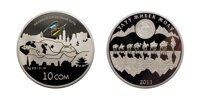
Click the picture to go to the National Bank's Press release, (in Russian)
It’s about time that I signed off for this week … but before I do … one more story. The National Bank announced that Kyrgyzstan had taken first place in an international numismatic competition … they had submitted two entries in different categories and the 2011 coin commemorating the Silk Road beat off stiff competition from Australia, Bulgaria, Canada, the Czech Republic, the Falkland Islands, France, Germany, Italy and the United Kingdom.
Timу, I think, for a celebratory cup of tea!
_______________________________________
Postcard from Bishkek: the weekly postcard that I send out as an email also gets posted on the website ianbek.kg each week – and there are other postcards which don’t get sent out. This week, for example, there has been the following postcards:
- Silk Road Lodge panoramas – a view from the outside - Some more of Victor’s Sperical Panoramic views of our hotel, the Silk Road Lodge, in Bishkek
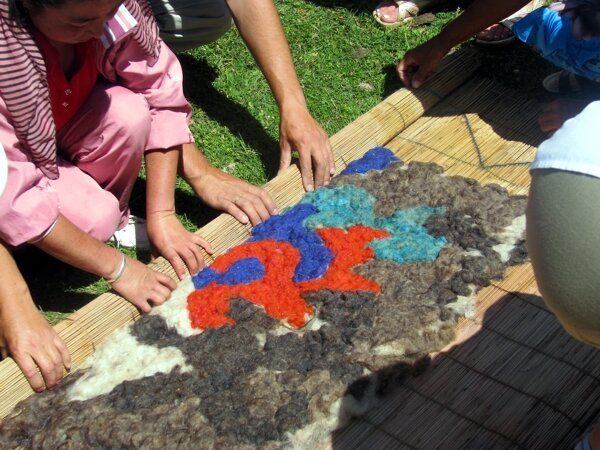
- Weaving - Usually, when people think of Kyrgyz crafts they think of felt – but there are other sorts – such as weaving.
- Mount Nansen - On International Day of the Mountains I take a look at another of Kyrgyzstan’s lesser known mountains.
- The Day of Kyrgyz Literature - which fell on Wednesday and also happens to be the birthday of Chinghiz Aitmatov
- Abdy Suerkulov - the former Prime Minister who gave me a parking problem, which is not bad seeing he has been dead for twenty years
- Open Skies - the next step towards making Kyrgyzstan a Tourist Mecca after the relaxation of the visa regime
It is now possible to follow me on Facebook, (where I have specific pages for Celestial Mountains and ianbek … and also links.kg and Kyrgyz Diary), and on twitter, (@Bishkekpostcard and @celestialMTC ).



 Bishkek