Abdy Suerkulov
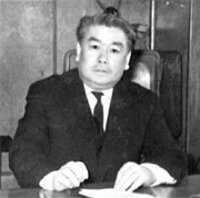
Adby Suerkulov, (Photo from AkiPress)
Yesterday, Abdy Suerolov gave me a parking problem. That’s not bad seeing he has been dead for twenty years. Let me explain:
I had to go to a meeting at the Ministry of Culture and Tourism and we drove up to the side of the building, (Dom Druzhba on Propect Chui, next to the main Ala Too Square), we had a lot of trouble finding a space to park the car.
Now, there is nothing unusual in that. As in many large cities, the drivers in Bishkek often have trouble trying to find a suitable parking space. We often have people park across our gateway because there is no space to park nearby – and they are so lazy that they are not happy about having to walk fifty metres or so. Several of the “hot spots” on Bishkek’s city streets have been designated as platniye stayanki, fee paying car parks – and “officials”, as often as not in bright yellow jackets and carrying a baton, stand be the pavement and wave you in or out … charging 10 som, or so, for the service.
The was something unusual here, however, as there are not normally that many cars parked in the vicinity of the Ministry. It didn’t help that at least one of the cars was so badly parked that it not only blocked a spare parking space, it also successfully blocked in a vehicle … and I wondered what the owner of the trapped vehicle would do if he arrived before that of the vehicle which was holding his car captive.
As in most older cities, Bishkek streets are not really designed for the amount of traffic that use them, especially at rush hour. The army engineers who laid out the original city plan had to think of horse drawn vehicles … and even in the Soviet period, there weren’t that many vehicles – yet alone private cars.
There were also a lot of people standing out in the snow, and getting out of one of the cars I saw a man holding a basket of flowers, who made his way to join the crowd as we made ours to in the Ministry building. My colleagues and I speculated why the crowd had gathered. It was the Day of Kyrgyz Literature, which also happens to be the birthday of Chinghiz Aitmatov, and I speculated that it was probably a ceremony to mark the occasion. As one of my colleagues pointed out, however, Aitmatov’s statue stood on the other side of the square … if there was to a ceremony in his honour it would have been taking place there, but the people were gathering in the Alley of Statesmen.
For the Record: The Alley of Statesmen – to the east of the Historical Museum behind Friendship house there are busts of some important statesmen including several who also have streets named after them in Bishkek:
- T. Kulatov, (1908-1984) – who at was the Chairman of the Council of People’s Commissars between 1938 and 1945 and the Chairman of the Supreme Soviet between 1945 and 1978.
- B. Isakiev, (1897-1938) - who was the Chairman of the Council of People’s Commissars between 1933 and 1937
- I Razzakov, (1907-1979) – who was the Chairman of the Council of People’s Commissars between 1945 and 1946 and then became the Chairman of the Council of Ministers until 1950.
- Y. Abdrachmanov, (1901-1938) – who was the First Secretary of the Communist Party between 1924 and the Chairman of the Council of People’s Commissars between 1927 and 1933,
- A. Orozbekov, who was born in the Kyzyl Kia district of Osh and was nine years old when his father died. He participated as a revolutionary in the events of 1916 and later rose through the ranks of the Communist Party to become the Chairman of the Executive Committee of the Khirghiz ASSR. He was accused of “nationalism” under the Staliist purges and executed in 1938, and
- A. Sydykov (1889-1938), Although born into the tribal aristocracy, Abdykerim Sydykov played an important role following the Boshevik Revolution, only to be accused of “nationalism” and executed during the Stalist repressions. He is known as one of the fathers of the nation
In the middle of these six, a the pathway leads to the south through the park and here are busts of
- S. Ibraimov, (1908-1984) – who was Chairman of the Council of Ministers between 1978 and 1980,
- B. Mambetov (1907-1990) - who was Chairman of the Council of Ministers between 1961 and 1968 … and others
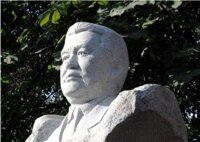
Bust of Abdy Suerkulov in the Alley of Statesmen, (Photo from KNews)
Apparently, one of those others was Abdy Suerolov.
When I got back home, I discovered that the reason the crowd was gathering was to commemorate the 100th Jubilee of Adby Suerkulov, who was born on 12/12/1912, (according, that is, to the Julian Calendar – the 25th according to the modern Gregorian system of reckoning), into a peasant family in the village of Torkent in the Toktogul district of, (what was then), the Osh oblast, (and is now part of Djalal Abad).
In 1927, he studied at the School of Office and Commercial Apprentiship in Frunze, (now Bishkek).
He held a number of posts in the Ketmen-Tube district, (Chairman of the Consumer Union, Head of the District Finance Office, Chairman of a Collective Farm, Head of the Tax Office of the Commissariat of Finance), eventually becoming the Chairman of the Djalal Abad Oblast’s Executive Committee, (in 1941/2).
He had formally joined the Communist Party of the Soviet Union in 1940 and following his term of office as the head of Djalal Abad, he went on to become a Secretary of the Communist Party in charge of “propaganda and agitation”, before studying for two years at the Higher Party School of the Central Committee of the Communist Party.
For the next thirteen years he served as a Secretary in the Communist Party before becoming the Chairman of the Supreme Soviet of the Kyrgyz Soviet Socialist Republic, w(hich was the parliamentary speaker of that unicameral legislature from March 15th, 1947 to July 10th, 1950). When he left this post he succeeded the Ishak Razzakov and effectively became the Chairman of the Council of Minister, (and therefore effectively the Head of the Government), of the Kyrgyz Soviet Socialist Republic, which he held until March 6th, 1958.
During his time as chairman of the Council of Ministers, the Kyrgyz State University was opened in 1951, the decision to build the Bishkek-Osh highway, the Academy of Sciences was established, Chernyshevsky library, the worsted mill and the “Tyazhelektromash” factory were built.
He then undertook two years of further study on retraining courses before becoming the republic’s Minister of Trade for ten years, before retiring in 1969.
That wasn’t the end of his active life, however, and between 1971 and 178 he served as the Director of the Exhibition of Economic Achievements of the Kyrgyz SSR, and was awarded the Order of Lenin, (twice), and the Order of the Red Banner, (also twice).
He died on 10th October, 1992, aged 79.
He is highly regarded for his great contribution to the development of Kyrgyz Statehood and nation building, the development of the economy and the country as a whole. Having held so many important positions in public life he gained a reputation for honesty, hard work, justice and a love of his country and its people.
The flower laying ceremony at his bust in the Alley of Statesmen was just one of several events held to commemorate his 100th anniversary. In October, for example, the State Historical Museum held an exhibition dedicated to his life and work, displaying his state awards, archive documents and photos. Apparently, there have also been other exhibitions and conferences.
According to speech of the Chief of the Government Office, Nurhanbek Momuliev, at yesterday’s ceremony: “His work aimed to serve the common people, Abdy Suerkulov earned great respect among his colleagues and compatriots. During the years of its operation by the Prime Minister of the Kyrgyz SSR began construction of a number of important industrial, cultural and educational, which still serve the people. The name of Abdy Suerkulov as a man who dedicated himself to working for the good of the people, rightfully occupies a worthy place in the history of Kyrgyzstan.”




 Bishkek