Open Skies
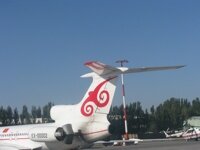
Tail fin of a Kyrgyz airplane
Today marks two important anniversaries in the history of flight:
- It was on 14th December, in 1782 the hot air balloon of the Montgolfier brothers took off on it’s first test flight and
- in 1903 the Wright brothers made their first attempt to fly with the Wright Flyer at Kitty Hawk, North Carolina …
and, as a result, I thought it was an appropriate time to take a brief look at the latest issue we are campaigning about here in Kyrgyzstan in our attempt to develop the tourism industry: Open Skies.
A couple of years ago I, and I suspect a lot of other people here in Kyrgyzstan, had never heard the phrase “open skies”, so what exactly is it?
The phrase refers to an international policy concept that calls for the liberalization of the rules and regulations of the international aviation industry—especially commercial aviation—in order to create a free-market environment for the airline industry. Its primary objectives are:
- to liberalize the rules for international aviation markets and minimize government intervention as it applies to passenger, all-cargo, and combination air transportation as well as scheduled and charter services; and
- to adjust the regime under which military and other state-based flights may be permitted.
A sovereign state must have both de facto (actual) and de jure (legal) control over the land sea and air within its territorial boundaries. Hence, permission is needed to cross the “border” and enter that state – whether it be to cross a land border, enter the country’s territorial waters or air space. That may include individuals having to obtain a visa, or having to get permission for an aircraft to overfly a country.
Failure to obtain permission can lead to serious consequences – arrest, prosecution and deportation. It can be seen as an act of aggression and in the worst [possible scenario can be considered an act of war.
In May 1987, a young German called Mathias Rust pulled off a dramatic historic feat by flying his Cessna 172 light plane from Helsinki to Moscow and landing in Red Square, (actually, because of the crowds in the square he landed on the bridge over the River and taxied into the square). He was extremely lucky to have evaded all the Soviet air defences and this fact cost several, red faced, high ranking officials their jobs. In an interview on the BBC he described how he was expecting to be shot down as Soviet Mig fighters buzzed the plane.
Indeed, in 1983 a Korean plane strayed into Soviet air Space near Kamchatka and was shot down.
Rust, himself, was given a prison sentence of four years.
The Chicago Convention on International Civil Aviation, (1944), sought to provide the conditions for the development of Air transportation and introduced the concept of the “nine freedoms of the air“, (although the term “freedoms” may be a little misleading in that they are not absolute in themselves but rely upon agreement between the states). These were that, subject to the agreement of the two sides, scheduled air services could be granted the rights or privileges:
- To fly across the territory of either state without landing.
- To land in either state for non-traffic purposes, e.g., refuelling without boarding or disembarking passengers.
- To land in the territory of the first state and disembark passengers coming from the home state of the airline.
- To land in the territory of the first state and board passengers travelling to the home state of the airline.
- To land in the territory of the first state and board passengers travelling on to a third state where the passengers disembark, (e.g., a scheduled flight from the Britain to Japan could pick up traffic in the Kyrgyzstan and take all the passengers to Japan).
- To transport passengers moving between two other states via the home state of the airline, (e.g. a scheduled flight on a Kyrgyz airline from Russia lands in Kyrgyzstan and then goes on to China on the same aircraft).
- To transport passengers between the territory of the granting State and any third State state without going through the home state of the airline, (e.g. a scheduled flight on an Uzbek airline from Kyrgyzstan to Canada that does not connect to or extend any service to or from Uzbekistan).
- To transport cabotage traffic between two points in the territory of the granting State on a service which originates or terminates in the home state of the foreign carrier or outside the territory of the granting State, (e.g. a Russian airline flies from somewhere in Russia, lands passengers in Bishkek and then boards passengers to fly to Osh).
- To transport cabotage traffic of the granting State on a service performed entirely within the territory of the granting State, (e.g. a Kazakh airline operates a service between Bishkek and Karakol).
In 1979 the United States began pursuing a Open Skies policy and in the following three years had signed some 23 such agreements.
Most of the existing civil agreements include the following features:
- A Principle of Free Market Competition: there should be no restrictions on international routes; number of designated airlines; capacity; frequencies; and types of aircraft.
- Pricing should be determined by market forces: A fare can be disallowed only if both governments concur and only for certain, specified reasons intended to ensure competition.
- Fair and equal opportunity to compete: For example: All carriers (airlines) of both countries may establish sales offices in the other country, convert earnings and remit them in hard currency promptly and without restrictions. In addition, “Designated Carriers” are free to provide their own ground-handling services. Airlines and cargo consolidators may arrange ground transport of air cargo and are guaranteed access to customs services. Charges should be non-discriminatory and based on costs; computer reservation system displays are transparent and non-discriminatory.
- Cooperative marketing arrangements: Designated airlines may enter into code-sharing or leasing arrangements with airlines of either country, (or with airlines from third countries), subject to usual regulations.
- Provisions for dispute settlement and consultation: procedures for resolving differences that arise under the agreement.
- Liberal charter arrangements: Carriers may choose to operate under the charter regulations of either country.
- Safety and security: Each government agrees to observe high standards of aviation safety and security, and to render assistance to the other in certain circumstances.
- Optional seventh freedom all-cargo rights: Provide authority for an airline of one country to operate all-cargo services between the other country and a third country, via flights that are not linked to its homeland.
For the record: Although it is not related to civil aviation, I should also mention that in 1992 the Helsinki Treaty on Open Skies was agreed. This was a confidence building measure designed to enhance the military of signatories to operate observation flights in the airspace over the land of another of the signatories – although there are some restrictions. It took ten years before the treaty came into force on 1st January 2002. There are 34 countries that have signed and ratified the treaty … including Kyrgyzstan, although it hasn’t yet ratified it.
So the idea is basically to liberalize the skies above Kyrgyzstan and allow foreign airlines the use of the airspace. The question remains, however, Why do we think this is important for the future of tourism?
At the moment we have no overriding document defining government policy in Kyrgyzstan. The previous Concept lapsed in 2010 and due to the revolution which overthrew the Bakiev Presidency, it has not proved possible to develop a new one.
For the record: I should acknowledge that there is a section on Tourism in several other documents such as the Poverty Reduction Policy and Country Development Policy, but there isn’t a central defining document.
It is said that “Nature abhors a vacuum“ and Politicians and Civil Servants are no different. As a result, in order to fill the gap, there are currently something like four different groups attempting to develop a policy.
Interestingly, most of the drafts I have seen have not addressed what we in the industry consider to be the crucial central issues:
- Safety and Security: Tourists have to feel safe and secure … but this is a general issue and limited to Tourism … all the citizens of Kyrgystan need to safety and security and if this general issue is addressed properly then this problem should resolve itself.
- Marketing: the biggest question for any business is “where are the clients?”, “who is going to buy our goods and services?” At the moment we face a major problem in that people outside Kyrgyzstan know little about the country – and what they do know is often coloured by the “news coverage” which, by its very nature tends to be negative. What is needed, therefore, is an active campaign that promotes the image and country. This should concentrate on the country not on selling a particular tour or hotel, or promoting a particular company as advertising these is the responsibility of the individual enterprise.
-
Access to Kyrgyzstan: Once potential tourists have been attracted to the idea of visiting Kyrgyzstan, they then face a number of practical considerations … how to get here. The removal of the visa requirement for some forty four countries has made this easier … and, according to some statistics, (although, personally, I have some doubts about some of these statistics as the measure was introduced so late in the season), this has already led to a sharp influx of visitors.
During the discussions about introducing the visa free regime for new countries, there was a lot of attention paid to Georgia and the Ukraine, which both saw a large rise in the number of tourist arrivals after they introduced a similar policy. I see, however, that the list of countries reviewing their visa policies is growing … and is quite impressive, including: Bangladesh, China (Beijing only though), India, Mexico, the United Kingdom and the United States.Visitors to Kyrgyzstan, however, still have the problem of how to get to Kyrgyzstan. Being in the centre of Asia we are quite a long way from most of the tourists who might be interested in travelling here.Landlocked, we have no ports – it’s not possible to arrive by sea.
Overland, it is possible to arrive through China, Kazakhstan, Tajikistan and Uzbekistan. Apart from the distances involved, each of these usually require visas, but there are some moves afoot to simplify this bureaucratic requirement. The main problem potential visitors who want to travel overland are the distances involved and the time required to make the journey. There are roads and a limited rail network … although there are plans to develop new rail links through China, Uzbekistan and possibly Tajikistan. The road networks are in the process of reconstruction which is welcome. It would also help if there were more International Border Crossings available for them to use.
The most direct route to the country is by air. At the moment, however, there are a very limited number of international flights (regular scheduled or charter flights). An Open Skies policy would help to make our airports attractive for air carriers and increase the number of potential flights and destinations.
In the report of the UNWTO, (United Nations World Tourism Organization), reviewing the Mexican experience following the relaxation of their visa policy which led to a massive increase in the number of visitors, the issue of air connectivity is also important to the development of tourism in a destination.
- The lack of a central Government policy or strategy: I think I covered that earlier.
The argument is that an Open Skies policy would mean more flights, more choice for the traveller and which would mean more visitors for Kyrgyzstan, more tourists for the tour operator, more guests for the hotels, more diners for the restaurants, more customers for the souvenir shops, more fees for the airport and more taxes for the state.
Attention had been drawn to the experience of Georgia which has introduced an Open Skies policy … which saw advantages not only in that it offered a wider range of routes into Tbilisi, but also brought advantages to the local population by bringing a reduction in the cost of tickets.
Oddly enough, this is a big issue for those who oppose the introduction of an Open Skies policy. The local airlines are concerned that the big foreign airlines will come in and snap up all the profitable routes leaving a few “poor pickings” for them – especially on domestic routes. Foreign airlines are unlikely to want to fly Bishkek-Osh, for example. The local airlines are concerned that they will not be able to operate these routes efficiently and economically and this will lead to a deterioration in the number and levels of service available. Although I can see that they want some element of protection, personally, I am not entirely convinced by that argument.
As we prepare for the removal of the military element of the Manas Transit Base, it seems to me that we need to prepare the airport for the world post Afghanistan, and if we really want the best for the airport, then we need to make it attractive for airlines to consider it as a transport hub – Open Skies would help to do that.




 Bishkek