The Day of Kyrgyz Literature
A selection of books
Today is the Day of Kyrgyz Literature.
Because the nomadic Kyrgyz had no written language until the twentieth century and relied on oral tradition, most of the information about them come from external sources such as the Chinese Chronicles. That is not to say that there was no literature.
The stories of the nomadic Kyrgyz were communicated down through the centuries by means of oral tradition. They included a wide variety of legends and folk tales, songs and poems, and a number of longer works called epics – most notably The Manas Epic.
Ancient written sources, however, include the works of such characters as Djusup Balasagyn, Kashgari – and Babur.
It is, however, probably correct to say that Kyrgyz literature is a recent development and can be said to have really begun with the transcription of folktales and epic works in the early twentieth century.
Poetry has been a notable element of the literary tradition and a number of early collections were published as early as in the 1920’s. Under the Soviets, many of these had a political character – such as the collection of Tokombaev’s poems, “About Lenin”, published in 1927. Tokombaev also went on to write “Bloody Years” – a “novel in verse”.
Alay Tokombaev was born in 1904 and is sometimes hailed as “The first Kyrgyz Writer”.
His major work was a poem called “Bloody Years” – devoted to the events of 1916, and event he had lived through himself. One of his poems was published in the first issue of Erkin Too – the first Kyrgyz language newspaper – in 1924.
He also translated a number of works into Kyrgyz – such as works by: Balzac, Dante, Gorky, Pushkin, Shakespeare and Tolstoy.
As a founder of the Uchkun literary association, (which later became the Union of Writers) Tokombaev was a leader of literary society.
Although a socialist and patriot, all was not “plain sailing” in his life. He was arrested under Stalin as a “nationalist” but did not suffer the same fate as many others similarly accused. While in prison he suffered deprivations – one of the most severe for a literary man, he was deprived of pen, paper and ink. There is a story that one time he made a bust of Lenin out of breadcrumbs and on another occasion took thread out of his prison clothes and used it to embroider a portrait of Pushkin on his bed linen … and a poem dedicated to the poet which included the line: “As you were, I have been guiltlessly slandered”
He died in 1988 – and left behind an impressive collection of works: poetry, plays, prose (novels) and translations.
In the 1930’s the journal “Chabuul” featured a number of short stories, poems and scholarly articles. The same decade saw the establishment of the Kyrgyz State Theatre which led to the development of theatrical arts and the creation of play scripts, opera librettos and ballet scores. There was also an increase in historical events and biographical accounts of notable characters.
During the war years, there was a natural tendency to explore themes of patriotism, heroism and inter-national relationships between the various ethnic groups of the Soviet Union.
After the war, in 1948, the publication of Sydykov’s “People of our days” represented the initiation of a new genre in the Kyrgyz novel. It won the Stalin Prize and was translated in several foreign languages. In the 1950’s there emerged several notable examples of prose writing – by authors such as Chingiz Aitmatov and Kaimova – introducing an element of realism.
As well as Kyrgyz authors, there were works published by writers of other nationalities – notably Russians and Dungans. There were also considerable numbers of works written and published for children.
Probably the most widely renowned Kyrgyz author in the West is Chingiz Aitmatov. Today is also his birthday! He is said to have been one of Mikhail Gorbachev’s favourite authors and a number of his works have been translated in a many foreign languages. He is seen as a major character in Kyrgyz Affairs.
For those would like to know more about the various writers there are a number of websites which are well worth a visit, especially those who read Russian because not all of these have sections in English),
- Сайт о писателях и поэтах Кыргызстана – Писатели Кыргызстана, поэты Кыргызстана
- Literator.co.kg – biography, writers, critics, playwrights, writers, translators, akins, storytellers, manaschy Kyrgyzstan
and this site which presents examples as well as news about literature:
- New Literature of Kyrgyzstan
More general; information can be found on БИБЛИОТЕКА – Билим – Бийлик! | Knowledge is Power! | Знание – Власть! as well as the sites of the National Library of Kyrgyzstan (in English and in Russian).


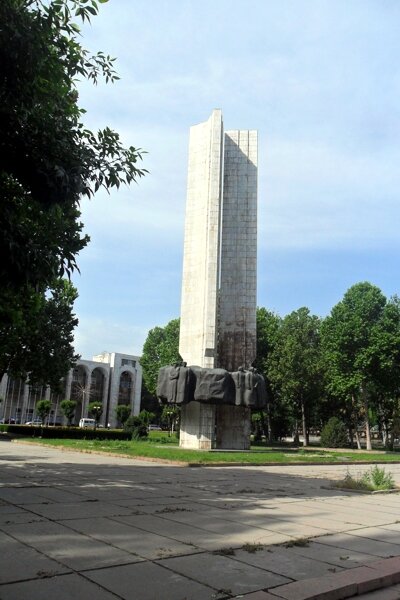



 Bishkek