Mount Nansen
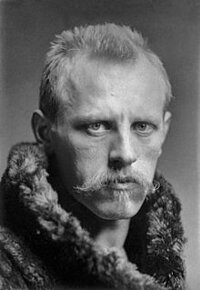
Fridtjof Nansen
Despite our name, The Celestial Mountains Tour company doesn’t undertake mountaineering expeditions. Even so, being in Kyrgyzstan, which is over 90% mountainous, it is difficult to ignore the various peaks.
Today is the International Day of the Mountains, so I thought I would take a look at another of Kyrgyzstan’s lesser known mountains.
There aren’t many people who have a mountain named in their honour … and, obviously, even fewer who have several mountains named after them.
Fridtjof Nansen is one of them, with mountains in:
- Antarctica … actually there are two of them:
-
- one in the Eisenhower Range at 2740m, and
- another in the Queen Maud Mountains rising to 4070m
- Canada a volcano which rises to 1827m … and
- Kyrgyzstan which, at 5697m, is the tallest.
Nansen, (10th October 1861 – 13th May 1930), was a Norwegian explorer, scientist, diplomat, humanitarian and Nobel Peace Prize laureate. A champion skater and skier in his youth, he led the first team to cross the interior of Greenland in 1888 and achieved international fame after almost reaching the North Pole in 1896.
Although he retired from exploration upon his return to his native Norway, his impact on Polar exploration remained and influenced many subsequent expeditions.
A zoologist by profession, he served as curator of the Bergen Museum. After his polar exploration his attention turned to oceanography, contributing to the new science.
He supported the independence of Norway from Sweden, and played a role in persuading Prince Charles of Denmark in accepting the throne of the new country. He also served as a diplomatic representative in London.
It was a part of this aspect of his life that led him to devote the last decade of his life to the League of Nations, being appointed in 1921 as its Commissioner for Refugees, being awarded the Nobel Prize in recognition of his work on behalf of displaced victims of conflict in the First World War. One of his innovations was the “Nansen Passport” for stateless persons.
He died suddenly, at the age of 68, in his native Norway, in 1930.
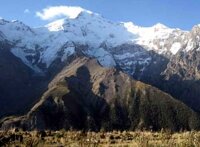
Nansen Peak - Photo Anastasia Yahno
The Kyrgyz mountain was first “spotted”, (that’s the word used in a newspaper report), by the German geographer Gottfried Merzbacher who, despite his experiences in the great mountain ranges the Alps, the Caucasus, the Himalayas and the Karakoram, was impressed by the mountain range that flanked the Southern edge of the Inylchek Glacier. He even referred to the sight as “one of the greatest alpine paintings in the world”.
He picked out one peak in particular he described as the range as “beautiful” and “the greatest in the Tien Shan.” In his opinion, rhe most magnificent of the range was “the peak that rises above the Tuz Asha.” ”It is hard to conjure up”, he wrote, ” a picture of the powerful, long slopes of the giant savage, its numerous ridges, the sweeping grandeur of glaciers, rugged into a thousand different forms, and divided into infinite pieces.” He added, “It certainly should given an appropriate name.”
It was given the name Nansen at the suggestion of a Ukrainian climber, Michael Pogrebetsky, in particular recognition of his great contribution to the establishment between Europe and Soviet Russia and helping the starving people of the Volga region.
From the distinctive summit, the Northern slopes fall some 2100 meters to the Enilchek valley, and the lower cslopes are covered in pine forest.
Apparently the view from the summit offer a panorama which is just as magnificent as the view which Merzbacher described.
The first ascent of the peak was attempted a party of Russians lad by Cherepov in 1937, along the South West ridge. Another route, along the Southern ridge, was pioneered in 1980. Modern day tours often take the well explored route up the North eastern ridge from the base camp in the foothills, just below the peak, and then climb the Western Ridge up to the summit. As I understand it, the Northern slopes have yet to be conquered.
I am not a mountaineer, myself, but I am told that it is neither an easy nor a difficult ascent, lying somewhere between a “technical climb” and a “walk up” but, as there’s about 6-7 hours of walking time each day, anyone attempting the ascent needs to be reasonably fit and should have experience of both Summer and Winter mountaineering. Often there is a lot of snow and the route can be steep in places, (about seventy degrees), and has sections over rock, snow and ice, and some sections of the route are prone to rockfalls and avalanches.
The mountain is notorious for strong winds even during clear skies, and for changeable weather and snow conditions.
There is an interesting account, with photographs, of an ascent made in 2007, followed by an attempt on Khan Tengri and Peak Pobeda, here.




 Bishkek