Weaving
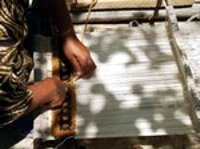
Working at a traditional loom
Although it does not necessarily leap into the mind when thinking about Kyrgyz handicrafts weaving has long been an important skill in nomadic Kyrgyz culture, and used to play an important role in nomadic life
In fact it was a widely practised craft and most women would have some skill in producing woollen fabrics, (taar), produced from sheep’s wool, goat and camel hair were to make overcoats and other household articles and might well have been embroidered as well. In the south of the country cotton and even silk were also used.
Traditionally, only home produced materials were used in decorating yurts and so most women would practice the craft to some degree. The final products, however, as well as being decorative also served a practical purpose – such as joining the cupola poles to the kerege (trellis), holding together the frame of a yurt and securing the felt that was draped over it.
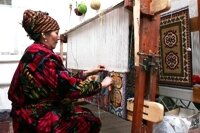
Working on a vertical loom
Woolen fabrics : The raw material was collected, sorted, cleaned, and then fluffed on twigs before being stretched and spun into a yarn on a special spindle called an iyik. Different grades of yarn could be produced, depending upon the purpose for which it was eventually to be used.
Then it would be dyed using various natural dyes.
Finally it was weaved on an ormok – a horizontal loom – to produce a strip of material which may have been as narrow as 4 cm – or as wide as 70 cm and can be as long as 25 m. (Interestingly, it seems that different tribes each had their own names for the loom). The traditional look was a fairly simple wooden device – after all it had to packed up and moved from place to place.
The more complex the pattern, the more threads that were needed – and the width of the final material is considerably narrower than the width of the threads as they are spaced out on the ormok.
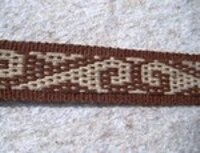
Terme ribbon
There are three basic types of cloth produced by weaving:
- Terme – found throughout Kyrgyzstan, and considered to be most difficult to produce. This is made with yarn of two contrasting colours such as red and blue, or white and brown. It often takes the form of strips of different widths, filled with a repeating pattern;
- Kajary – found mainly in the south and south-west of Kyrgyzstan and uses a thinner (or lighter) yarn; and
- Besh Keshte – (= “five embroideries”) which was very common in the past creating a satin like cloth used for saddle bags, kit bags, and even carpets. It was often used to decorate the cupola of the yurt. The pattern often consists of simply geometric designs, (such as rhomboids and wavy or zig-zag lines), rather the more complex designs such as Ram’s horns, dogs tails and cauldron handle). It is now produced mainly in the south and west (Osh and Talas oblasts).
Rugs were sometimes made by sewing together woven strips of varying widths – and would be used for various purposes – such as wrapping-up valuable clothing. Other pieces might be used as a border for such things as horse blankets.
Weaving was a summer, outdoor, activity and usually involves two women working together. It involves many long hours squatting, back bent and rhythmically repetitive actions. Weaving, today, is mainly preserved as a rural activity.


 Bishkek