I know … because I was there!!!!
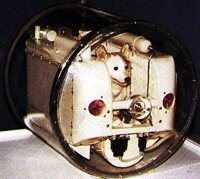
A mock up of Laika in her pressurized space capsule
When I was a teacher, I had a colleague who taught History and he told me that his first lesson with any class was: “What is History?” Apparently he would write a date on the board and ask the class why it was important … and there would be a series of guesses – most of which might try to link with some major world event that took place on that day.
Apparently, the date he chose was the day that Tobruk was liberated from the Germans during World War II – but that wasn’t his reason for choosing it … it happened to be his birthday … not just his birthday, his date of Birth. His argument was that History is divided into two parts … that though which we have lived, (and so has a particular personal interest and importance for us – a history with which we can relate), and that which came before, (a history with which we can only experience second hand through source materials and the accounts of others).
Although I could see his point, I didn’t agree – at least not wholeheartedly. To me, it wasn’t simply a case of “in our lifetime …” but, as Max Boyce used to say, and sing: “I know … because I was there !!!”.
I was alive, for example, on 3rd November 1957 when Sputnik 2 took off from the Baikonur Spacedrome which is in what is now Khazakhstan, with its canine passenger Laika, the first animal to achieve orbit … but I was only only four and a half years old and if I heard the news at the time, it never sunk in. I only came to know the story a few years later when we heard the dramatic news of Yuri Gargarin’s historic flight – which is more real to me because I do remember it … as it happened.
For the record: Laika, (which means “Barker” in Russian and is a name given to a range of “husky” like dogs), was one of a series of animals sent by man into the unknown to test what conditions were like and to see what was possible ever since Noah sent birds from his Ark to see if the water’s of the Great Flood had subsided. In 1783, for example, the Montgolfier brothers sent a sheep, a duck and a rooster heavenward in a hot air balloon. Following the Second World War, a number of experiments sent fruit flies, mice, hamsters, guinea pigs, cats, dogs, frogs, goldfish and monkeys aloft – many of which passed beyond past the Kármán line, (at an altitude of 100km), which is taken to designate the beginning of space.
Whereas we think of the Americans using Chimpanzees in their early space flights, the Soviets used mainly dogs. Tsingan and Denzig were the first, as early as in July 1951, but although they they passed the Kármán line and so reached space but they never entered orbit. By the time that Sputnik 1 achieved orbit was launched in October 1957, some 12 dogs had been lobbed into space on suborbital flights aboard ballistic rockets … some, but not all of them surviving the experience. Laika’s claiom to fame was that she was the first to actually go into orbit.
Laika, had been found as a stray wandering the streets of Moscow and was about three years old when she was enlisted into the space program. It was assumed that the conditions she had survived in the capital would help her cope with the difficulties associated with her new occupation. She was given a number of names during the program but Laika was the one that – although the Americans nicknamed her Muttnik.
Sputnik 1 had been launched on 4th October 1957 and caught everyone by surprise … the launch of Sputnik 2 almost a month later on 3rd November with the news of its canine passenger was almost as dramatic. These were in fact just preliminary to a more serious mission – that of the much more sophisticated Sputnik 3 which was launched in May the following year.
According to some reports, Sputnik 2 was a bit of a “rush job” – designed, constructed and sent into orbit in the space of just four weeks … It orbited the earth for 162 days, eventually burning up in the atmosphere on re-entry in April 1958. Laika had already passed away – according to reports at the time due to a lack of oxygen as the batteries failed; of heat exhaustion when the cabin overheated on the fourth day; by euthanasia being fed poisoned food … but it later emerged that she had died quite early on during the fourth orbit.
Political overtones dominated the reporting of the day and it seems that the ethical issues didn’t emerge in public debate until much later … there had been no provision for recovering Sputnik 2 … it was always intended to be a one way trip for Laika. It was only in 1998 that one of the scientists responsible for the mission expressed his regret about what had happened with the conclusion, “We did not learn enough from this mission to justify the death of the dog.”
Later missions were designed for recovery and when the Americans, in order to avoid controversy about a “named animal” dying on a mission, didn’t name the first chimpanzee they sent into space until it had safely returned.
Laika wasn’t the only dog to be in the news this week. A report from Istanbul about the local authoritiy’s attempts to deal with the population of stray dogs and cats caught my attention. My interest was piqued, partly because we have been having similar debates here in Kyrgyzstan and partly because I have just finished the first course of injections of anti-rabies serum having been bitten by a stray cat … for the record: it was my own fault!
Here the local authority has a policy of shooting the animals – about 10,000 animals a year. The Mayor is on record as saying he would like a more option such as oral contraceptives (as we do with pigeons in London) or sterilization – but the budget just cannot support this. Well, in Istanbul the plan is to gather the animals up and put them in to specially created “natural habitat parks”. Some of the locals, however, are far from happy with the proposals. The strays are seen as a an important feature – even a “protective” feature rather than a threat and animal rights groups are suspicious about the authority’s motives – suspecting that they will slaughter the animals once they are out of the public eye. Apparently it’s happened before – in “the Great Dog Massacre of 1910″ when, apparently, most of the city’s 60,000 strays were rounded up and put on a small island in the Sea of Mamara to die slowly of starvation.
Now, to be honest, that was before my time and so I wasn’t there … hence I can’t actually say that I know it’s true … because I was there! … but there seems to be some evidence that something significant happened and a lecturer from MIT actually held a Seminar to mark the centenary of the event!
The people of Istanbul may be rising up in defence of “man’s best friend” and offering support groups but they don’t seem to be taking Direct Action. Direct Action seems to have become de rigueur here. President Almazbek Atambaev has gone in record as saying that people are too eager to take to the streets … that anyone who seeks power should do by standing for election rather than climbing over fences … and that Kyrgyzstan needs to change from being a protest ground to being a construction site. The deputies also seem to getting a little tired of the tendency to take to the streets … literally. One of the standard methods of protest is to erect unauthorised road blocks and prevent passage until their demands are met. Well, a parliamentary committee has now approved a Bill which would dramatically increase the penalties for such illegal actions.
It may not exactly have been Direct Action, but a picket by something like 200 local citizens, demanding the cessation of work on a gold mine being set up by a Chinese company in Northern Kyrgyzstan, led to fisticuffs with something like 250 Chinese workers, and the incident forced the suspension of work on the site and the relocation of the Chinese workforce to another site.
The gold industry is still in the news with the auction of licenses which had been disrupted by other protesters taking Direct Action being rescheduled … and then cancelled. Cancelled … not postponed. It seems that recent changes in the legislation required that if had to be cancelled and a new one will have to be organized.
Despite all the problems experienced in the mining sector recently, apparently there are still people interested in investing in it … this week, for example, saw news about potential investors from Russia, China, Turkey and Korea.
Whilst I was up in Naryn last weekend, President Atambaev was in the neighbourhood, laying a time capsule in the foundations of a new hydroelectric plant being built on the Naryn River. It’s one of 12 being planned in a cascade down the river. There will be something like twelve of them … construction of four being done undertaken in cooperation with the Russians – with work commencing in the next year and lasting between five and seven years … and there is interest from Turkey and China concerning the others. Not only should the projects generate power, but also jobs and income (as it is planned to export some of the energy produced), and also to help improve water management which should help farmers in the Ferghana valley and other countries downstream.
Amongst the confusing news to emerge this week arose from a couple of reports about the Textiles industry. The fact that the industry is attracting attention shouldn’t be too surprising as the Autumn Bishkek Fashion Festival has been underway. Personally, I am not particularly fond of fashion shows and I always reach for the Next button on the remote control whenever Fashion TV appears on the screen … Anyway, one analysis was really upbeat … concentrating on the fact that the industry saw a growth of almost 50% over the previous year in 2011. Now although that might not seem surprising, remembering that there were a few handicaps in 2010 which depressed all economic activity, but even in 2010 the industry managed to record something like 20% growth. If only Tourism had performed as well!
Those statistics, of course, are all official … which in turn suggests that there are considerable questions associated with them. However, a study carried out in 2011 for the USAID estimated that the official figures undervalued the true state of the industry by 50%.
Part of the reason for that is that much of the industry is still in the Shadow Economy, unreported and without paying taxes. Some analysts blame this on the complex tax system and say that it needs to be simplified.
That’s not the only downbeat, however, as another report at the close of the Fashion Week implied that Kyrgyzstan’s Textiles industry was “lost”. This seems to be based on the fact that it cannot produce sufficient yarn from its own resources – and an appeal to revive the silk industry. In the past, the vast majority of the industry was involved with the production of three main types of natural fibres, (cotton, wool and silk) but, nowadays, 90% of the industry at the moment is concerned with the production of garments.
One of the most intriguing news reports of the week was contained in statement from the US Embassy here in Bishkek. It said that although “the United States maintains an active dialogue with Kyrgyzstan about the Centre and its activities under the current bilateral agreement … there are no formal negotiations as yet about the future of the Manas Transit Centre”. I am not sure why it was felt necessary to issue the statement, (for example, if it is connected with the speculation that the attempt to extradite Maksym Bakiev from Britain could be used as a “bargaining chip” in order to extend the life of the base), and even though it stated, “We understand the Kyrgyz position with respect to the Transit Centre at Manas International Airport until 2014,” … I found the “as yet” a very interesting phrase.
Another side effect from the controversy surrounding Maksym, one of the deputies has made a very interesting proposal to amend the law on Banks and Banking … that in order to prevent money laundering and the financing of terrorism, Kyrgyzstan should prohibit the transfer of funds to “offshore zones”. A list of what territories might constitute an “offshore zone” would be revised and reissued annually.
It wasn’t clear from the report the I saw, but I wonder if the proposal would also prevent the receipt of funds from such accounts. According to one study, some 64% of Kyrgyzstan’s population receives remittances from abroad. These are, of course, largely from family members who have migrated abroad in search of work. The study, however, was commissioned by financial institutions and one of the results seems to show that there is basically a lack of financial management skills amongst the population and several of the financial institutions have started to set up special courses for their clients.
It made me wonder if such courses are long overdue … especially considering the controversy about those people that have entered credit agreements that they have not been able to honour …
Over the years I have been able to observe life back in the UK from a distance which has given me a sense of objectivity … I have watched, for example, the unfolding arguments about the funding of democracy – whether it be the financing of elections such as that going on in America at the moment. As it happens, I have just read The Appeal by John Grisham, one of my favourite authors, who tends to “wear his heart on his sleeve”. This book is about the election of a Supreme Court Judge in Mississippi … and how one of the candidates effectively “buys” his seat on the bench … not by directly buying votes, (offering and paying bribes), but by using his vast financial resources to purchase advertising which shapes and influences voters opinions and intentions. This seems to be a feature of elections everywhere these days: in the States, the UK the Russian Federation and here in Kyrgyzstan.
Another aspect of financing democracy is the payment of representatives and their expenses. In the UK there have been several scandals over the way that MPs have used and abused the system of claiming expenses and the latests wheeze seems to be MPs renting apartments to each other because they can claim for rent but not for mortgages or other property related expenses. Well, a report came out this week that each deputy costs the budget some 6 million som … about 130,000 Dollars, 100,000 Euros or 85,000 pounds. That might not sound an awful lot but there are 120 deputies which means a total bill of about 720 million som – about fifteen and a half million Dollars, twelve million Euros or just over ten million pounds. Bearing in mind that Kyrgyzstan is running a huge budget deficit, it seems to represent a big “piece of the pie”.
_______________________________________
Postcard from Bishkek: the weekly postcard that I send out as an email also gets posted on the website ianbek.kg each week – and there are other postcards which don’t get sent out. This week, for example, there has been the following postcards:
- Earrings - A look at these distinctive adornments from nomadic times;
- Shabdan Baatyr - the first of a series of anniversaries this week, on Ahabdan Baatyr’s brthday we take a look at this patriarch from Northern Kyrgyzstan.
- Chuikov – Record Breaking Artist -on the occasion of what would have been his 110th birthday, I took a brief look at the life of Kyrgyzstan’s highest selling artist
- Olga Manuilova - on what would have been her 119th birthday, I look at the life of Olga Manuilova – a Russian sculptress who was responsible for many of the Soviet statues which grace the streets of Bishkek.
- The Tender Girl and the Seven Bandits - A Kyrgyz legend about the star constellation.
- Kalyk Akiev - marking another birthdays, this time of one of the twentieth century’ famous Akyns, (travelling bards)
It is now possible to follow me on Facebook, (where I have specific pages for Celestial Mountains and ianbek … and also links.kg and Kyrgyz Diary), and on twitter, (@Bishkekpostcard and @celestialMTC ).





 Bishkek