Chokan Valikanov
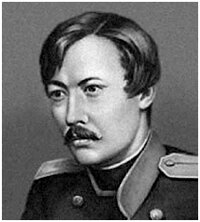
Chokan Valikanov
Being a landlocked country sitting astride a crossroads on the Great Silk Road, Kyrgyzstan has a rich history drawing on a wide variety of peoples and cultures . When I first came here I was intrigued by stories dating back to the times of Alexander the Great or Genghis Khan, but there were also many stories about people of whom I had never heard.
Although I now find it hard to imagine that there was a time when I had never heard of Russians who played an important role in opening Central Aisa to the rest of the world such as Pyotr Semyenov, Nicholai Prezhervalsk or Mikhail Frunze. At one point I came across another who was interesting because although he was soldier in the Russian army and an official of the Tsarist Empire, he himself was a Kazakh: Chokan Chingisovich Valikanov.
For the record: There are several versions of his name. When he was born, he was apparently given the Muslim name of Mohammed Kanaf, and the name Chokan was a nickname bestowed upon him by his mother – but it eventually stuck and became fixed as his “official” name. However, the Kazakh version would originally have been written in Arabic script, (as it was only later that an adapted form of the Cyrillic alphabet was adopted by the Kazakhs), and some of the various alternatives appeared as part of the process of transliteration between the two writing systems. Chokan Valikanov, however, is based on the transliteration from the Russian spelling of his name that he, himself, used.
Valikanov was a scholar who is regarded as the “Father of modern Kazakh history and ethnography”, indeed the Academy of Sciences in Kazakhstan is named after him. He is also recognized as a player in the Great Game which was “played” between Imperial Russia and Britain in order to maintain influence throughout Central Asia.
He was born on October 4th, 1835, in hios father’s Winter camp at the Kushmurun Fort in what is now the Sarakol Kostanay region, which had only recently been absorbed into the Tsarist empire but is now in the North of present day Kazakhstan.
Although he died, (at the young age of 29, on 10th April, 1865), in the village of Sultan Tezek in the Almaty region in the southern part of Kazakhstan, he actually travelled far and wide – and not just in the country of his birth.
He was a descendant, (a great-grandson), of Ablai Khan, a famous leader of the Kazakh peoples, in many respects he could have been considered a member of the Kazakh aristocracy. His father, Chingis, was a grandson of the great Khan and obtained a number of appointments from the Russians, apparently on the basis of his ancestry.
Despite his family connections, the young Chokan grew up in a traditional yurt and, when he was six, his father arranged for him to go to school at a small private school, (maktab). He later moved in with his father’s mother who arranged for him to enter the Siberian Cadet Corps. and at the age of 12 he enrolled in the Military Academy at Omsk where one of the classic, iconic, photographs of him was taken – that was in 1847.
His early education had been conducted in his native language, Kazakh, but also included Kypshak-Chagatai, Arabic and Persian; in Omsk, however, he learned German and French and was expected to study Russian and English literature (although I am not sure if he read the English in the original language). It was whilst in Omsk that he met and became friends with the great Russian writer, Fyodor Dostoyevsky. (There is another, classic, iconic photograph of the couple dated 1858)
As well as an interest in the oral and musical culture of his people, which seems to have been fostered from an early age, he also developed a interest and skill in drawing. This arose from an early encounter with Russian military surveyors. Originally he worked in pencil and ink but he later progressed onto painting watercolours. It is said that his drawings and paintings are he first images of the Kazakh steppes made by an indigenous inhabitant. More to the point, the observation and skills of the artist which he developed were to be important to Valikanov in other aspects of his work in later life.
After graduating from the Cadet School, he was appointed as an Adjutant to the Governor General of Western Siberia, responsible for communications. He also acted as Historian for the region and so access to the archives which gave him considerable material for studying the history, geography and economy of the Turkic speaking countries of the region.
He undertook a number of small expeditions, (some of them official and others “off his own bat”), into the Semirechiye (seven Rivers) region and the area occupied by the Khanate of Kokand – on each occasion writing extensive descriptions of his experiences.
At the age of twenty he undertook a two year mission to “explore” the Issyk Kul region, bringing back reports which were not only academic but also useful for his sponsors – military intelligence. One of the purposes of the mission was to investigate the different nomadic clans and, in particular, the confrontation between the Kyrgyz Bagu and Sarybagysh clans.
Those reports, however, gained him a certain amount of attention and he was invited to St Petersburg where he was elected as a member of the Russian Geographical Society – on the personal recommendation of none other than Pytor (Tianshansky) Semyenov.
Impressive though his first expedition may have been, it was his next that was to make his name and seal his reputation – undertaking a secret mission to penetrate across the border into a relatively unknown region of China.
The importance of Kashgar had long been recognized, and it had been a “bone of contention” between the three great of the region in those days: Great Britain, Russia and China. By the time that the British had finally assumed power in India and Russia had annexed the Kazak steppe, China had already experienced almost a hundred years of suzerainty over the former Uighur state and Kashgar has long been closed to Europeans. The Chinese government tried to prevent any penetration of foreigners into the region and any European who did actually make it to Kashgar was considered to be a spy … and therefore subject to the death penalty. For this reason, the selection of candidates for such an operation could not be a European and Valikanov was a natural choice.
Joining a merchant caravan, he travelled under the alias of Alimbaya, (the name of the Khan, his great grandfather), dressed in traditional garb and with his head shaven in the customary manner, he travelled and traded with the Kyrgyz peasants before crossing the pass through the Tien Shan mountain range and descending to China.
If a modern day crossing of the border at Torugart or Irkeshtam sometimes seem to be difficult and bureaucratic, then if pales into significance compared to the difficulties recorded by earlier travellers such as Hsuan Tsang in the seventh century – or Chokan Valikanov in 1858. As the caravan crossed the pass only 36 of the original 101 camels made it to the other side. In addition, several times had to fend off attacks by robber bands, plundering caravans in the mountain gorges. At the entrance to Kashgar, on the orders of the Chinese government, the caravan was subjected to a thorough search.
Once over the border, he observed and gathered information about the towns, bazaars, peoples, their lives, languages and customs, the climate and nature of the surrounding district. He was also able to establish the details of the death of the German scholar Adolf Schlagintweit, who had been beheaded as a spy on the city wall.
Although he had entered China without raising suspicions, the authorities began to get anxious about his activities and after six months travelling around the region, he returned once more to St Petersburg and reported on his findings. His account was not only a great success in Russia, it was also translated into English and brought him recognition throughout Europe.
He continued to work in St. Petersburg, and there are suggestions that he even travelled as far as Paris.
In 1861 he contracted Tuberculosis and, leaving St. Petersburg, returned to the steppes for recuperation. Unfortunately, however, a number of relapses meant that he was unable to resume his career exploits and several planned trips back to the capital had to be cancelled. He campaigned to follow in his father’s footsteps as a regional administrator, a civil servant, but although he was elected, the appointment was never confirmed because of concerns over his health.
Although this might have proved disappointing, it didn’t exactly stop him working. He collected data, for example, on the Kazakh system of justice which led to a programme of Judicial Reform.
He seems to have played a role in establishing friendly relationships between the Ruissian authorities and the local populations, including the resolution of pasture disputes between the Kyrgyz and Kazakhs. He was also involved in the military campaign directed against the Khanate of Kokand – in particular the 1864 assault on the fort at Aulie Ata, (modern day Taraz in Southern Kazakhstan), and the capture of the fortress at Pishpek, (now Bishkek).
There are different accounts of these years of his life, and although some of the details vary, it seems that he retired from the campaign disillusioned and depressed. Although his superiors recommended him for further responsibilities, he retired to a remote village, where he got married, and continued his researches.
Valikanov was, like Peter the Great, greatly impressed by Europe and European culture and became a proponent for benefits that would come from the Westernisation of Central Asia.
His published works describe his various expeditions and different aspects of the daily life and culture of the Kazakh nomads, but also included compilations of traditional poetry – and in particular the Manas Epic of the Kyrgyz – which he referred to as the Iliad of the Steppe.
As well as the Kazakh Academy of Sciences being named after him, there are many monuments erected in his honour in his native Kazakhstan, in Russia, and even one in Kyrgyzstan and Valkhanov has appeared on stamps and one of the Kazakh banknotes.



 Bishkek