
A cat flap in action
Regular readers of my postcards will recall that every now and again I make oblique references (and sometimes not so oblique) references to my cats. One of my first postcards was about My cats – My “children”.
At the moment I have three cats, or perhaps I should say that at the moment three cats have adopted me as a surrogate “something or other” – master / substitute mother / food dispenser / masseur … or even as their own “pet” – ranging from a sedately veteran of 15 or 16 to a sprightly and lively young kitten.
The numbers vary from time to time: my first cat, (here in Kyrgyzstan, that is – I had one when I was in London – but he died of liver failure), was called Sinock, (which basically means Sonny). He was kidnapped … or stolen … literally … the ladies that picked him up and carried him off were seen climbing into a taxi by a neighbour.
Since then, others cats have come and gone … some have just wandered in and mewed – demanding attention, to be fed or cuddled, others were abandoned or dropped on us by people who seemed to know that we would take them in, and yet others were born in the office as their mother decided to get pregnant before we could take her to the vets. On the other side of the coin, we have managed we’ve managed to find homes for some, others have decided to strike out and wandered off … and, for all I know, some may have met the same fate as Sinock – and got kidnapped.
Visitors often notice the cats in the office – let’s be honest, … it’s a bit difficult not to notice them.
More…
June 12th, 2014 Author ian Sections: Naryn
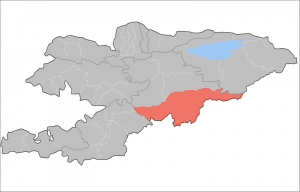
The At Bashi Region
A few years ago, the CBT guidebook to Kyrgyzstan stated: “If Kyrgyzstan feels like the far side of the world, the end of the line, then At Bashy feels like the last stop“.
According to official statistics, parts of the At Bashi region are the “remotest” in Kyrgyzstan. This conclusion is drawn from an index which is based on distance from the capital, and other centers of local administration, (oblast, rayon, ayil-kenesh), that gives a value of between 1.0 (for easily accessible places) to 1.75 (the least accessible places). The highest value for the country is 1.75 – and it’s in the At Bashi region.
More…

On the left – my brother “recoloured” in his school uniform and, on the right – me in mine … but in glorious Black and White … apart, that is, from the wash seeping across from the editing.
There is an old saying the The camera never lies … but I am not so sure …
In the “good old days”, photographs were taken on film, (which was a precious commodity), and time was required to develop the negatives and print the final product. To get a succesful photograph one had to take into account a tremendous number of factors … skill and experience was needed, and although it was possible to “doctor” the final images … that required a lot of effort and very few people did it.
Of course, some people did. The Soviets made great use of either erasing someone from history, (such as Trotsky who, once he had fallen from grace, was removed from pictures where Lenin was giving speeches), or added, (such as Stalin, who was inserted – or moved so that he was closer to the Great Vladimir Illych).
More…
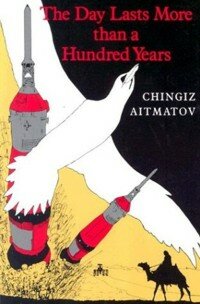
Cover of the English translation
It was on 10th June, 2008, that Kyrgyzstan lost one of its favourite sons and cultural icon, Chingiz Aitmatov.
He was a man of many of many talents. Born in 1928 in the the village of Sheker in the Talas region of Kyrgyzstan, near the border with Uzbekistan, he began working at the age of 14, as the assistant to the secretary of the local Soviet when he was just 14 … and he was later to hold a variety of jobs including as a tax collector, a loader, and an engineer’s assistant.
When he was 18 he began training as a veterinarian in Frunze, but later studied Literary Studies at the Maxim Gorky Institute in Moscow. It was as a writer that he was to make his mark – working for several years for the newspaper Pravda and publishing a variety of short stories and novellas, which earned him recognition in the form of a Lenin Prize and other State Awards. He was later to work in the Film industry and later entered politics – becoming a Deputy of the Supreme Soviet of the USSR, becoming the Soviet Ambassador to Belgium and, after independence, being appointed as the Kyrgyz Ambassador to Belgium and the European Union, based in Brussels.
More…

What time? … exactly?
I was intrigued the other day when an acquaintance pointed me towards an article about how different cultures around the world conceive the concept of time.
I was already familiar with some of the ideas expressed in it … but I found much of interest in the way that the author brought it all together – some of the examples were new and the diagrams helped to bring the points home. (The say that “a picture is worth a thousand words”!).
There was fact, for example, that we, (Westerners), tend to think in terms of time as linear …passing from the past, through the present to the future with the future “ahead” of us – whereas another culture sees time as linear BUT with the past in “front” of us … because we can “see” it, it is a known factor even if some of it is obscured from out view, with the future “behind” us … we cannot see it or know what is in store for us. On the other hand more more oriental view of time is of a series of cycles, similar circumstances differing in particulars, and like an eddy in a whirlpool takes us past the same spot time and time again as we descend into the depths.
More…
June 8th, 2014 Author ian Sections: Tourism

Anyone for Bingo … well Roadside Bingo.
I don’t get out and about throughout Kyrgyzstan as much as I would like … but when I do, (for example, going up to Naryn), it can mean a long journey, (Naryn is four to five hours on the road).
I actually enjoy the journey, although, to be honest, I often fall asleep. When I am awake, there is always something to see and even though I know the road quite well by now, and it’s surprising how often I see things of interest – either something new or something that had, somehow, escaped my attention before.
I have a number of ways of passing the time. The standard are listening to podcasts downloaded from iTunes on my mp3 player, or reading, either one of the six or seven books that I seem to have on the go at any one time, or on my Kindle – which is probably better because it is possible to carry a whole library with me and if I feel myself getting tired of one book, (say Mallory’s Morte d’Arthur), then I can easily switch to another, (say, an Agatha Christie).
Travelling with kids can, however, be difficult. They often plague the adults with questions like “Are we there, yet?” or “How much longer?” … for kids arriving somewhere is always more important than the journey, although adults usually find more of interest in the journey itself.
More…
One of the things about life here in Kyrgyzstan that took a bit of getting used to was the tradition of Professional Holidays - which was inherited from the Soviet Union.
These are days set aside form members of a particular profession to celebrate as a “community” and to commemorate the contribution they make to the economy and society. Although they are not actually “holidays”, (non-working days), they are usually marked by social events as well as more formal events such as seminars and training sessions. Members of the profession will contribute each other on the holiday, as will clients and customers.
Apparently the practice began in the Soviet Union, in what is called “the years of stagnation”, (a phrase used to describe the period of economic, political, and social stagnation which started in the mid-1970′s … when Leonid Brezhnev was General Secretary of the Communist Party, and continued under his successor Yuri Andropov and Konstanin Chernenko, eventually coming to a close with the election of Mikhail Gorbachev … in the mid-1980′s ).
Today, 7th June, happens to the Day of Financial and Economic Workers of Kyrgyzstan.
More…

Ishnaly Arabaev
Some time ago I was invited to an event in one of Bishkek’s many Universities, the one named in honour of Ishenaly Arabaev.
It is one of the oldest and most prestigious Universities in the country – based on six sites located in the city center – the main one being adjacent to the main Ala Too Square. There are about a thousand teaching staff, and caters for something 16,000 students – including 1800 foreign students – across almost sixty disciplines.
Although one source says that it can trace its origins back to 1915, I have been told that it was once basically the pedagogical institute – the Teacher Training Institute – having been established in 1949 as the Women’s Teacher Training College, being transformed into an Institute the following year and obtaining University status in 1994, but still concentrating on Education and known as the Kyrgyz State Pedagogical University.
Nowadays, however, they have a variety of departments ranging from Educational, (including Continuing and Vocational education; the Humanities – including an institute for History, Sociology and Law ; Linguistics – including a specialized institute for Kyrgyz Language and Culture; Economics and Management; Innovative and Communication Technology, (ICT); Oriental Studies and International Relations; the Sciences – especially Biology and Chemistry; and not forgetting Ecology and Tourism), and since 2005 has been known simply as the Arabaev Kyrgyz State University.
The name of Arabaev is well respected in the country as an educator, academic, linguist, philosopher, one of the founders of the modern Kyrgyz language … if not of the modern Kyrgyz state.
More…
June 5th, 2014 Author ian Sections: Calendar

The 2014 World Environment Day logo
Raise your voice, not the sea level: This might seem strange slogan for a small landlocked mountainous country, in the center of the world’s largest continent – about as far as it is possible to be from the sea … but it is the official slogan for this year’s World Environment Day.
On the other hand, World Environment Day is the United Nations’ principal vehicle for encouraging worldwide awareness and action for the environment … and environmental awareness is an important issue in Kyrgyzstan.
More…
June 4th, 2014 Author ian Sections: Bishkek
On June 4th, 1983, a new Bazaar opened in Bishkek.
It was to be the main Town Bazaar, replacing the one that was demolished to make way for Park Pobeda To the East of the City Center.
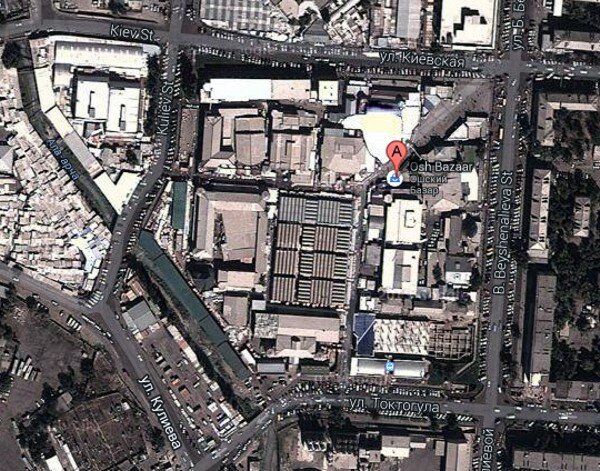
Osh Bazaar on Google Maps
More…





 Bishkek