Whodunit?
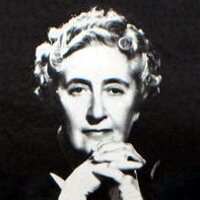
Agatha Christie (15.09.1890 - 12.01.1976)
I am often amazed at the way that people here are so familiar with all sorts of aspects of Britain and Britain culture.
It used to make me really embarrassed that I arrived here ignorant of so much about the Kyrgyz, Central Asia, Russia and the Soviet Union.
I can understand people knowing about Winston Churchill and Margaret Thatcher, William Shakespeare and Charles Dickens, King Arthur and Sherlock Holmes … but it goes a lot further than that. People are familiar, for example, with the works of the crime writer Agatha Christie.
There’s even a rock group named after her, formed in the late 198o’s. (For the record: Today is the anniversary of her birth, back in 1890.) Although she wrote romances, (under a pseudonym), she is best known for her novels, short stories and plays containing detective stories especially those featuring the spinster Miss Marple, (who will confuse investigating Chief Superintendents with seemingly meaningless references to villagers she has known over the years), and the Belgian Private Detective Hercule Poirot, (exercising his “little grey cells”).
A colleague of mine back in the UK once told me that he really enjoyed reading Agatha Christie’s novels – except when she started to introduce that “funny little Belgian” … in a way that was quite ironic … First of all, because Poirot was the hero of her very first novel, The Mysterious Affair at Styles, published in 1920, and secondly because Christie disliked her creation, herself; she found him insufferable but, because he proved to be so popular, she couldn’t drop him.
The classic dénouement of a Christie novel involves the detective massing the various characters, witnesses, virtually each one a suspect, and reveals the guilty party … but it rarely a straight forward matter because the whole mystery has been carefully crafted with clues masterly dropped one by one for the amateur sleuth to try and piece together.
I sometimes think it would be nice to have a Hercule Poirot or Miss Marple to help explain what happened here in Kyrgyzstan. The twists and turns of the various plots can be confusing and there are so many red herrings to sift from the genuine and vital clues.
Take the formation of the new government, for example. The new Prime Minister and his government have all been approved by the parliament … but every now and again there is still a surprise that catches us all unawares. One appointment in particular certainly seems to have put the cat amongst the pigeons and raised eyebrows … the head of the Communist Party has been appointed the Head of the State Tax Inspection. There’s been a lot of comment with references to an alleged, somewhat chequered past, with allegations of trouble following the 2010 revolution. What struck me as odd, however, was that he had just recently made comments about the need for a strong, united, opposition.
There are still revelations emerging in various of the corruption cases. There have been, for example, further arrests. The President made a speech telling government officials to “stop stealing and employing relatives”. Add to that the comments made the Minister for the Economy about the public lacking trust in the government – no, according to the report of the interview, apparently he said that people actually “distrust” the government … he even went as far as to talk of “fear” felt by investors.
According to WOWS, (the World Online Whistleblowing Survey), the population of Kyrgyzstan are not alone in their distrust. The survey was launched in Australia, so most of the statistics I have seen are based on Australian opinions and attitudes. The survey is being extended it has been announced that the 15 minute survey is now available in Russian, Kyrgyz and Turkmen. It will be interesting to see what sort of results may be elicited.
The Deputy Minister Minister of the Interior made some interesting comments on the question of cyber crime at a summit in Baku. Apparently he said something about lacking “contemporary experience in identification, prevention and methodology of investigation of crimes committed with use of information technologies.” I couldn’t help thinking of the announcement a couple of weeks ago that the security services are going to checking the internet for examples of inciting ethnic hatred.
The twists and turns of events in the mining industry continue to cause unfold leaving water far from clear. There was a minor spat over the levels of tax paid by the the various mining companies – with the Deputy Prime Minister calling it “miniscule”. In defence of the companies, it was pointed out that this was based on a selective set of statistics – based on specific particular taxes and not on the total tax paid. (I sympathize have seen this sort of spat before).
The public auction of licenses that was disrupted by protesters last week and had to be called off, is being rescheduled amid calls for stability in government policy, (which the Minister of the Economy – who seems to be prone to making plain, (yet provocative), statements – described in an interview as “incompetent”). One of the leaders of the protest complains that criticism of the group is “unfair” one of the opposition politicians has offered them support.
Another mining company has ordered by the relevant agency to suspend working, despite the fact that it was proceeding ahead of schedule.
The biggest upset, however, came with a “raid” made on a transport depot by a group of disgruntled locals who felt that certain promises had not been fulfilled. They “commandeered” vehicles and plant equipment, but I understand that it has now been returned, and the local chief of police has been playing it down.
Despite all this uncertainty, the expectation is that next year production should be about twenty two tons … which may not sound like much but with the price of gold increasing should provide a reasonable boost for the economy. That will be welcome, because so far this year there has been a somewhat mixed set of statistics … showing an overall decline, but if the figures for gold production are discounted, they apparently show some measure of growth. Perhaps the most surprising statistic to emerge was that the amount of trade actually exceeds the level of GDP.
As far as international affairs are concerned, the dispute with Belarus over the fate of the Bakiev’s seems to be simmering away, although the protests outside the embassy appear to have stopped.
A warning from Uzbekistan’s President Karimov over Water and the plans of Tajikistan and Kyrgyzstan to build dams and hydroelectric power stations. As well as criticising the plans and drawing attention to their potential impact on communities downstream, he suggested that they could not only create tensions but possibly lead to conflict between the countries. One deputy asked President Atambaev if we were prepared for conflict, but got the reply that the Uzbek president was stressing the need for neighbours to come to an amicable agreement over the way forward.
The construction of power stations could be important, for both domestic consumption and possible export. The level of water in the Toktogul Reservoir is already lower than at this time last year, and it is predicted that it will be only half full at the end of Winter – close to the minimum level required for the safe operation of the equipment.
There have been a number of interesting “educational” stories in the press. Some of them reminded me of one of the lecturers from my college days; he made the what, at the time, I considered to be a rather cynical comment – about how everything descended “to the bottom line”. It seemed a particularly earthy comment for a theologian … but as he specialized in philosophy I presumed it was just a case of being “down to earth”. Well, in a country where funding is sparse, there has been a move for some “specialist schools” to given a special status: self-financing. It’s proving to be as controversial as the introduction of Grant Maintained Schools and Academies back in Britain.
Some of the kids are supposed to be starting English lessons in school, but there seems to be a problem attracting a teacher … no, I am not going to be applying. They tell me that “playground gossip” has it that newly qualified graduates apply and when they told the salary, ask if they can have their CV’s back. Although teachers were promised a new and improved salary structure last year, it’s not clear how effective it has turned out to be.
Another interesting twist is that payment is no longer based simply on the number of hours taught, but on the number of children in the class.
Anyway, parents are the same the world over and they often gather together and adopt measures to improve provision for the children. There seem to be an increasing number of Private schools being established, (i.e. where the parents pay fees for their children to attend lessons – rather than the schools being funded from tax revenues). I have mentioned before the European School in Bishkek which was established by a group of ex-pats together with a group of local businessmen. The main language of instruction is English.
Another new school has opened, but not in Bishkek, in one of the villages in the Chon Kemin valley – and there are plans to expand by creating a second campus in the city of Kant. The interesting thing in this case is that the school is that the language of instruction is Russian.
Another interesting story was a report on a survey which suggested that “racketeering” was rife amongst the school population – claiming that 52.9% of boys and 50.4% of girls were “involved”. It seems that the situation varies according to the different school years. You sometimes see stories in the press on this subject, and I have heard quite a few stories, these figures seem extremely high.
Today is yet another one of those specially designated days …and once again, I have absolutely no idea of who was behind it … but apparently today is Felt Hat Day. Up until the 20th century, hats played an incredibly important role in fashion and attire – arguably much more so than today, although woollen hats, hard hats, and the ubiquitous baseball cap all have their places in modern society. In the 19th century, felt was a common material for hats, and Felt Hat Day is supposed to encourage us all to don a felt hat in tribute to this historically significant, but now somewhat neglected accessory. Here in Kyrgyzstan, where the Ak Kalpak, the traditional man’s headgear, is made of felt, Felt Hat Day takes on a different significance.
Tomorrow is going to be a rather hectic day. The Japanese International Cooperation Association, (JICA), are organizing a Street Festival – on Kievskaya, outside our office. The road is going to be closed and there are going to be all sorts of festive events, games, competitions, exhibitions, food stalls and so on. Maxim is going to be taking part with his friends doing a demonstration of BMX biking. I am a bit worried about the majority of Bishkek’s population descending on the small stretch of road … outside our office.
Next week is the Week of Men’s Health. For five days, specialist physicians at medical institutions will give free examinations and offer advise to the public and there will be a variety of other activities to help raise public awareness of the issue – and the week got off to an early start with a marathon being run on Friday. According to one spokesman, men do not usually complain of health problems, especially in what are seen as simply minor ailments, which means that serious problems develop that could have be dealt with if tackled early on. It’s the eight such week of activities and to date some 15,000 inspections have been carried out. The more I read about the week, the more uncomfortable I began to feel; when announcing the event a spokesman pointed out that the country has seen an increase in the incidence of male infertility and prostate cancer … and, apparently 60% of men over 40 are impotent and 70% of men over 55 suffer from “frequent urination” … Hmmmm … I’m 59.
Staying with the subject of health, another official announcement informed us that there are 4417 cases of HIV infection registered in Kyrgyzstan, (out of a population of just over 5 million), (3009 men and 1219 women), including 209 foreigners, and there are 492 people living with AIDS. More than half of people living with HIV, are injecting drug users according to the Ministry of Health.
Well, I am not sure what words Agatha Christie would put into the mouths of Miss Marple or Hercule Poirot in order to explain the various twist and turns, but she always had the distinct advantages that her characters were talking with the benefit of hindsight … and the fact that she had craftily constructed the plot.
Unfortunately, life isn’t exactly like that.
_______________________________________
Postcard from Bishkek: the weekly postcard that I send out as an email also gets posted on the website ianbek.kg each week – and there are other postcards which don’t get sent out. This week, for example, there has been the following postcards:
- Happy Chrysanthemum Day! - Sunday was Chrysanthemum Day, one of the ancient Japanese festivals – and here in Kyrgyzstan we have a very rare specimen: Pyrethrum leontopodium (C. Winkl.) Tzvel
- Kasym Tynystanov - marking the 110th anniversary of the birth of the scholar and linguist who appears on the 10 som note.
- Em-Chay-Es … the Ministry of Emergency Situations - When diasater strikes … “Who ya gonna call?”
- Safed Bulan - a mausoleum said to be the last resting place of one of the descendants of the prophet Mohammed and a gruesome heritage of betrayal which he came to avenge
It is now possible to follow me on Facebook, (where I have specific pages for Celestial Mountains and ianbek … and also links.kg and Kyrgyz Diary), and on twitter, (@Bishkekpostcard and @celestialMTC ).




 Bishkek