Em-Chay-Es … the Ministry of Emergency Situations

Emblem of the Em-Chay-Es
Some dates on the calendar “will go down in infamy” to misquote FDR … (his phrase in the speech to Congress following the bombing of Pearl Harbour was that December 7th was “a date which will live in infamy“) … and, following the events in New York 2001, September 11th is surely another one of those dates.
Despite Roosevelt’s assertion some sixty years earlier, “that this form of treachery shall never again endanger us“, America and the rest of the world was caught unaware once more by a “surprise attack” … a “bolt from the blue” … and had to respond once more with “unbounding determination” in order to “win through to absolute victory“.
It is the nature of such occasions that a particular group of civil servants are thrust into the limelight, to be hailed as heroes as they risk their lives to save others and eliminate the combustible dangers presented in a wide variety of circumstances: Fire Fighters, (or as we used to call them back when I was growing up in the UK: Firemen).
Here in Kyrgyzstan, the fire service is provided by an agency of the Ministry of Emergency Situations.
I must admit that I was a little surprised when I first came across the Ministry, doing a double take and asking myself if I had really come to such a “dangerous place” that they had a special ministry dedicated to coping with “emergencies”. Of course, back in the UK, we he have emergency services: the Fire, Police and Ambulance services – and if someone needs their assistance, then all they have to do is pick up a phone and dial 999. Being an island, for those who live near to the shore, a call to 999 can also connect you to the Coastguard service.
These services are provided by separate organizations, but there are protocols as to how they cooperate in any incident; a road accident; a train crash; a major fire or explosion; a terrorist incident; floods … and so on. One agency will take the lead role, coordinating the work of the others. If necessary they can call on the reserves of the army.
For Search and Rescue services there are also some special services – for example: The RNLI, (the Royal National Lifeboat Institution), is manned by volunteers who turn out in all weathers to help rescue sailors in trouble at sea; the army, navy and air force offer helicopter search and rescue services – again at sea but also along the cliffs and mountains around the country; there are volunteer mountain search and rescue services … and so on.
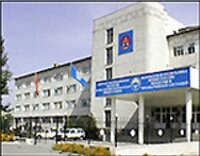
Ministry Headquarters in Bishkek
The Ministry is based upon the rescue and civil defence services of the former Soviet Union. In fact, just before the dissolution of the USSR, on 15th December 1990, the Council of Ministers in Moscow adopted a resolution “On the establishment of the State union system for the prevention and resolution of emergency situations.” This was followed in July and August with the implementation in Kyrgyzstan of the first stages of the decision and the Ministry, itself, was established in 1996.
The Ministry is the government agency in the field of civil protection, fire protection, nuclear and radiation safety and meteorology.
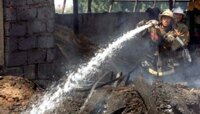
Firemen at work
Its activities are directed towards forecasting possible natural and man-made hazards, planning Civil Protection measures for the prevention, and handling of emergency conditions in both peace and war time; the organization, and search and rescue, disaster recovery and other urgent emergency response work, (for example: in the event of fire, earthquake, avalanche or landslip) and Humanitarian response.
It also maintains several monitoring agencies such as meteorology; hydrological; avalanche protection; and pollution, (such as air and water quality) as well as being responsible for public education services.
For the record: the Ministry has a number of websites – the main one of which is here. Although it implies that it has pages in Kyrgyz, Russian and English, but the English pages are mainly blank, (“under construction”).
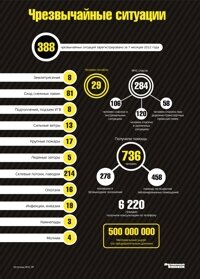
Infographic
UPDATE
No sooner had I published this postcard when one of the local newspapers published an interesting infographic : It’s in Russian but it says that in the first seven months of the year there were 388 “emergencies” registered involving damages amounting to 500 million som:
- 8 earthquakes
- 81 snow avalanches
- 8 flood situations
- 13 strong winds
- 17 major fires
- 5 ice flows
- 214 mudstreams
- 16 landslips
- 19 infections
- 3 rockfalls
- 4 lightning strikes






 Bishkek