Kasym Tynystanov
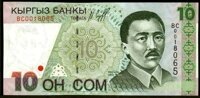
Tynystanov on the 10 som bank note
Kasym Tynystanova (1901-1938) was a scholar, cultural worker, professor and poet who served as the first Minister of Education in the fledgling Kyrgyz Socialist republic.
Born into a poor peasant family in the village of Chirpykty in the Issyk Kul region on 10th September, 1901, he was taught to read and write, (in Arabic), by his father before attending a religious school in Karakol (and later in what is now Ananevo).
His studying was interrupted by Urkun, the events of 1916 when an unsuccessful revolt against Tsarist rule swept through Central Asia, only to be severely repressed leading to many thousands fleeing across the border to China – including the Tynystanov family who returned home only at the end of the following year..
He later went to went to Almaty and then Tashkent to study.
In his final year in Tashkent, he began to be published, for example in the newspaper Ak Jol, and the magazines Jas Kairat amd San. It was also when he was a student in Tashkent that he began the work for which he is probably best known: the development of the Kyrgyz language, and, in particular, the Kyrgyz alphabet. At first this was based on the Arabic that his father had taught him, (as is, still to this day, the Uighur language); then into Latin characters and finally in Cyrillic. Apparently he wrote a play script in his newly defined alphabet as early as 1921, whilst still a student in Tashkent. His career as a poet began with the composition “Ala Too” and the only collection of his poems which was published in Moscow in 1925. Some of his early writings are preserved because they were published in newspapers in Kazakhstan, but most, and the manuscripts, have been lost.
Along with some colleagues he continued established the first communist Party newspaper in the Kyrgyz Language, Erkin Too, (Free Mountains), which is still published today and is the official Government Gazette. The day when the first issue was published, 7th November, 1924 is considered to be the “birthday” of the written Kyrgyz Language.
His report, “The Main Principles of creating a new alphabet” was given at the first congress of Turkologists in Baku in 1926 – and became the main document in the formulation of the new written form of Kyrgyz based on a Latin alphabet. Perhaps less well known is the fact that over the next couple of years he also worked on an alphabet for both the Uighur and Dungan languages.
In 1933 he published a dictionary of linguistic terms and in fact he compiled a number of specialist dictionaies in topics as varied as zoology, philosophy and the Social Sciences. His “Spellings of Kyrgyz Literary Language” appeared a year later and was just one of a wide range of linguistic works which he wrote and published.
He was also a scholar of , and expert on, the Manas epic. He was a strong supporter of the publication of the Semetei cycle and two of the main versions, (the Karalaev and Orozbakov versions), of the epic saga. He wrote the script for a play based on the Manas epic produced in the National Theater and he also translated part of the epic into Russian.
He was a member of the communist party but never really held any high office within the party, although he was the first People’s Commissar of the National Committee for Education, (Minister of Education).
He also translated revolutionary songs (such as the “Internationale”) into Kyrgyz.
He fell into disfavour with the authorities, was “repressed” on 1st August 1937 and executed in on 6th November, 1938, as part of the Chong Tash massacre during the Stalinist purges. It is not clear why – one story is that it was the result of having written one particular song, another that it was a result of his scholarly work on the Manas epic. As with many of the other vistims of the Stalinist purges, Tynystanov was posthumously rehabilitated and reinstated into the Communist Party in 1957.
In 1991 a State Prize was named after him, and 2001 was named the “Year of the Kyrgyz Scholar – Kasim Tynystanov” by UNESCO.
Towards the end of 2002, a monument was erected in Karakol to him and Khussein Karasaev – a writer and scholar who also worked on the development of the Kyrgyz alphabet and one of the first Russian/Kyrgyz dictionaries, who was born in the village of Tup in 1901. There is a street named after Kasym Tynystanov in Bishkek. His portrait appears on the 10 som banknote.





 Bishkek