The Big Cheese
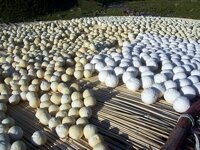
Kurut cheese balls drying in the sun
During the summer we drove up into the mountains and about 40 kilometres up into the valley, we pulled over near to a yurt to talk to some locals and take some photographs.
After answering our questions, the locals invited us into their yurt for some Kumys, (fermented mare’s milk). Now, to be perfectly honest, I am not all that keen on Kumyz … apart from being mildly alcoholic, it also tends to be fairly sour and … sometimes the pure white liquid has not been properly strained. On this occasion, however, everything from the low slung table to the large container holding the white fluid was clean and so I agreed to take one pialka – or bowl.
On the table there were bread and kaimak, butter, plus some salad tomatoes. Also there was a plate of small white balls, (about 2cm in diameter which was quite large, most of the balls you see for sale in the city is only only 1cm in diameter) - Kurut.
Kurut is found throughout Central Asia, (where it is sometimes known as Kurt or Qurt – and even aaruul in Mongolian), and depending upon the consistency which can vary, is similar to dried dairy produce found elsewhere.
Kurut is produced by drying a special traditional yogurt, (which is called Suzma, elsewhere it is sometimes called tarag). However, thare are a lot of varieties, by adding salt or herbs such as basil or chilli pepper, and even by smoking.
Although it generally encountered rolled into balls, the dried milk can alternatively be sliced into strips or cut unto chunks.
Kurut can be encountered throughout Kyrgyzstan, for example there may be entire stalls stacked with the pungent smelling balls, or a street seller may have them placed side by side with cigarettes and sweets.
A typical shepherds family pasturing its livestock in a mountain jailoo has cattle, horses and sheep. The job of milking the cows and the mares usually falls to the women in the family, which can mean a very early start to the day – and after preparing breakfast, the mares will be milked a second time. In fact, they are milked every two hours throughout the day for the four month season. The milk is then used to produce kumys and kurut.
as well as being a sort of garnish, it is often used as a snack food and in Mongolia can even be flavoured and used as a candy.
Kurut is also dissolved in water to make a form of “milk drink”.
Sometimes some locals will even dip their kurut balls into their beer!
Kurut is an important part of the local diet providing a valuable source of protein. It is estimated that something like 90% of women and children suffer in some way from anaemia due to the poor diet which consists predominantly of meat, milk, tea and bread with very few vegetables or fruits which are not historically and culturally important crops.
To be honest, just like Kumys, Kurut is an acquired taste, and I am sorry to say that it is not a taste that I have acquired and there is little sign that it is growing on me.
For the record: Kurut is a traditional cheese made fro centuries by nomadic herdsmen. In more recent years other forms of cheese are being made here in Kyrgyzstan. The Swiss have even sponsored and invested in a cheese making factory, providing dairy farmers with a market for their milk, selling through supermarkets and their own shop.






 Bishkek