Happy Chrysanthemum Day!
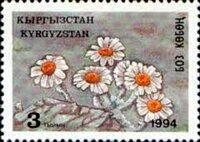
One of the Kyrgyz set of "Tien Shan Mountain Flowers" stamps from 1994
Chrysanthemum Day, (菊の節句, kiku no sekku - I don’t know Japanese, but several websites seem to cite this), is one of the five ancient sacred festivals of Japan, celebrated each year on the 9th day of the 9th month.
Although this referred to the Japanese lunar Calendar, with the adoption of the modern Western Calendar, it has been transferred to 9th September. Fortunately, this is about the right time for the flower to burst into bloom
Although these days it is sometimes described as a “minor festival” its origins can be traced back to 910 when the Japanese imperial court held its first chrysanthemum show, (and, for the record: Chrysanthemums are the symbol of the Imperial House of Japan). It is commemorated throughout the far east in areas which have come under Japanese influence: China, Korea, Singapore and, of course, the Japanese islands themselves.
As it happens, 9th September is also known as Double Yang, (which is to do with Oriental numerology), and the Chinese festival of the Nine Imperial Gods.
For the record: To mark the day there are usually special displays of different varieties of chrysanthemum, as well as figures made from trained chrysanthemums. In keeping with the floral theme, chrysanthemum wine is drunk and, in Korea, chrysanthemum cakes are eaten.
Chrysanthemum cakes are a kind of dumpling made from mixing yellow chrysanthemum petals with rice and flour.
The petals, (especially white and yellow ones), are used to make a sweet beverage known as chrysanthemum tea – which is supposed to useful for those recovering from a bout of influenza. In Japan a chrysanthemum leaf is put into sake when it is drunk.
The leaves are boiled and used as “greens” in some Chinese dishes and petals are sometimes added to Chinese soups.
In Korea a rice wine is sometimes flavoured using chrysanthemum flowers.
Apparently, there is also an interesting custom associated with this festival is that of putting cotton wool on the chrysanthemum flowers in the evening, the night before so that in the morning the cotton, (now wet with either dew or frost), is removed and used to wipe the body with. This is known as “cotton nursing of the chrysanthemum” and is supposed to be symbolic of the desire to protect the flowers and of using the dew of the early frosts to cure the ailments of mankind … or “as way to stay young”.

Chrysanthemum blooms. Photo by: Vladimir Bobrovsky
Chrysanthemums are a perennial flowering plant, (a member of the Aster or Daisy family), which are native to Asia and Northern Europe and something like 30 species have been identified, although there were many more before botanists refined their system of classification dividing off various genus.
It seems that they they were first cultivated in China in the 15th century BC.
The name seems to come from Greek and means “golden flower” although the flower heads can white yellow or pink in the wild. The plans usually grow to anything between 50 and 150 cm tall, with deeply lobed leaves and large flower heads.
Al;though prized for their beauty, in some cultures they are symbolic with death, (as in France, for example, where the association seems to be related to the fact that Chrysanthemums bloom around November 1st – All Saint’s Day), and as a result are used almost exclusively for funerals or for laying on graves in cemeteries. On the other hand, in Australia, they bloom in Springtime and are associated with Mothers’ Day.
Here in Kyrgyzstan: Chrysanthemums are to be found growing in several places, high in the mountains. One species, Pyrethrum leontopodium (C. Winkl.) Tzvel , was added to the Red Data Book of endangered species in 2005. (Pyrethrum is a term which refers to several Old World plants of the genus Chrysanthemum which are often cultivated as ornamentals for their showy flower heads.)
_________________________
For the record: the other four of the five ancient Japanese sacred festivals are:
- Nanakusa, the 7 Grasses Festival (Jan. 7)
- Girl’s Day (Mar. 3)
- Boy’s Day (May 5)
- Tanabata (July 7)





 Bishkek