Kochkor Ata – one of the seven shrines
There is a Kyrgyz legend that tells of the seven mazars, (or shrines – a term often used to refer to the graves of men venerated as Muslim “saints”), which have been built and named for the seven fathers of the Kyrgyz: Baba Ata; Cholpon Ata; Issyk Ata; Jumgal Ata; Kochkor Ata; Suleiman Ata and Tastar Ata.
For the record: Ata means Father
To be honest, however, although I could place all of these on a map, there were a couple that I have never heard of in any other context and, in particular, I have often wondered why Manzhiliy Ata wasn’t in the list. The other day I was reading an article about Shamanistic healing rituals when I came across a different list which ran: Cholpon Ata, Karakol Ata, Manzhiliy Ata, Kochkor Ata, Oisul Ata, Oluia Ata and Shing Ata … but, although this omitted the entries from the first list that had caused me problems and included Mazhiliy Ata, I have to admit that it also included names which were new to me.
To make matters worse, Kochkor Ata always used to cause me a problem because, as if quite often the case here in Kyrgyzstan, there is more than one place called by this name.
For the record: Kochkor Ata is the name of a fairly modern city down in the Djalal Abad oblast, situated on a relatively flat stretch of land, (lying between 600 and 800 meters a.s.l.), in the Ferghana valley not far from the Uzbek city of Andijan and the main Bishkek-Osh highway. Bishkek is 525km away… and Djalal Abad 56km.
When I say “modern” that’s because it seems to have its origins in a “tented settlement” which grew up around the newly discovered Isbastken oil deposit, in the early 1950′s. Since then it has grown into a small city, (it was granted city status in 2003), with a population of about 20,000 and is home to businesses in the oil and gas, building and ceramics industries. There are also links to agriculture of the neighbouring region.
As well as a couple of bazaars, several schools and a hospital complex, the city also boasts a relatively new football stadium built by one of the local oil companies and which is home to the local team, Neftchi – “Oilmen” – founded in 1952 when the original settlement was created.
Unfortunately, I haven’t been able to find out why the city was given the name Kochkor Ata.
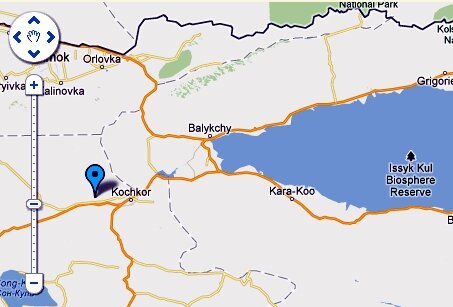
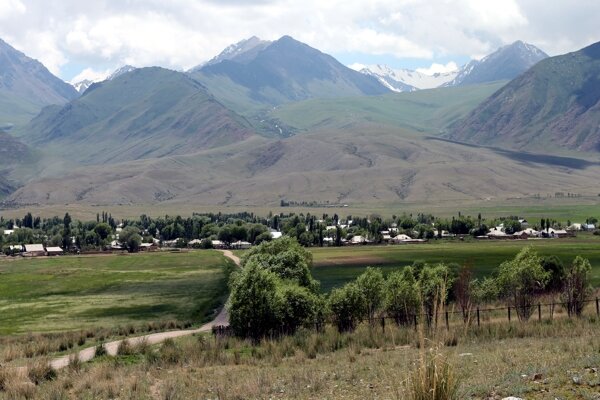
Kochkor Ata
The legendary Kochkor Ata was an old man, a sage, seer, who lived in the village of Kum Debe, North West of the village of Kochkor in the Naryn oblast.
For the record: Although the term mazar usually refers to a Muslim holy place and they are usually administered and supervised by a mullah, in Kyrgyzstan there are often vestiges of Tengrism, or the old shamanistic traditions also associated with it, and so they tend to represent a fusion between Islam and non-Islamic traditions and practices.
The shrine at Kum Debe is located where there are two low hills connected by a shoulder, (and which some people say resembles the humps of a camel). Some people, for example, say that it is the burial place of a Muslim saint. Others connect the history of Kochkor Ata shrine with Kyrgyz folklore.
Pilgrims include people who come to the shrine pray for recently departed relatives, childless couples, and healers with their patients.
There are several stories and legends associated with Kochkor Ata:
For example, the Kazakh explorer and ethnographer Chokan Valikhanov who travelled through the region in the nineteenth century on behalf of the Tsarist empire, mentions that the eighteenth century Kazakh sultan Barak, “became careless, and showing off his strength he invaded the sacred place of the Kyrgyz, Koshkar Ata.” In reponse, the Kyrgyz became angry, attacking the Kazakh camp and pursuing the invading army as far as the Ili River. Although Barak escaped their clutches, according to Valikhanov, the Kyrgyz gave the credit for this to “the holiness of Kochkor Ata”.
There is one folktale which emphasizes the importance of approaching the mazar in an appropriate manner: when praying at the mazar one must pray not just for oneself but give thanks for one’s fortune and pray for the health and happiness for all the family.
The tale tells of a young couple who lived in Kochkor. Unfortunately, the husband was a very mean and cruel man. Although they had been married for five or six years and had been trying to have a child, they had been unsuccessful. Though it was not her fault, the husband would come home at night and start to beat her. One cold and snowy February night, hew returned home again. He was drunk and began to beat her even more mercilessly than before. Eventually he threw her out into the cold without even a headscarf or shoes, saying: “Go to the Mazar in Kochkor Ata and pray for a child.”
Despite her sadness and the cold, she set out and had walked some distance when she came across a small fire and she stopped to warm herself by it. As she warmed her almost frozen body she noticed a small man with a long white beard sitting nearby, wearing a small white hat, (Bakai Kalpak), and a coat, (Ketmentai), like those that were worn by heroes. He seemed a very pleasant and peaceful old man.
The Aksakal spoke to her, saying: “Come. Come. I have been waiting for you. What wish did you come with?” She poured out her heart to him, crying she begged him for a good child who would grow up to be successful and helpful to her family – and others.
At that point, her husband burst onto the scene … and unaware of who the old man was he demanded a child from Kochkor Ata.. The old man looked at him and scolded: “Only a child! Then go away from here.”
The couple returned home and in the course of time, she found that she was expecting. The child was born whilst the husband was away, returning a few days later, anxious to see the child. When his wife proudly presented the child to him, he took it, looked upon it … and promptly died.
According to popular wisdom, the man sealed his fate by his selfishness and failure to respect age old customs and traditions.


 Bishkek