Housing
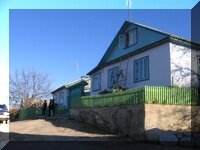
As a nomadic people, travelling from place and erecting yurts wherever there was pasture for their livestock … the Kyrgyz don’t have a wide heritage in terms of architecture. Indeed, some people say that the closest they came to architecture was in erecting mausoleums for people after they had died.
Of course, the Kyrgyz were not the only people to inhabit the land – and some remains of former settlements are to be found … but not many. Apart from the various mausoleums that are found throughout the country, and the occasional mosque – such as Babur’s mosque in Osh, the best known examples of old structures that have survived to the present day are: the Burana Tower; the Tash Rabat caravanserai and the Archeological complex at Uzgen. One feature of interest in these monuments is the decorative brickwork that adorn them.
The architectural landscape of the country really dates from the twentieth century. It is a complex mix of functional design, monumental art and individualism.
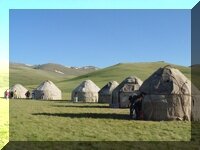
As nomads they used yurts and settled in groups called ails. In summer time they erected these ails in the high mountain jailoos, but in winter they descended to lower slopes and created winter camps – kyshtok The main criterion for the choice of a winter camp was the presence of a water source, but there were other important factors, such as the kind of terrain. During the 19th Century, a time of radical changes in the life of Kyrgyz as they adapted from a nomadic lifestyle to a more settled one, many “permanent” settlements appeared in place of winter nomad camps.
When building a house, a few customs were kept. Firstly of all, the ashar custom was widely practiced – a form of communal effort – especially when carrying out the most labour-consuming work processes, such as building walls and roofs.
The eldest person of the settlement was invited when making the foundation, and building the house was often begun on Mondays, which is considered the luckiest day. The foundation trenches, (about 30 cm deep and 60 cm wide) were dug and filled with stones of different sizes, sand and crushed stones.
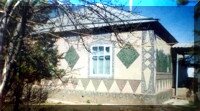
The main building material was wood. Three methods where used for making walls: Pise (pahsa); Clay rolls (guvalyak); and Bricks (kish). (Today, most Kyrgyz live in modern, brick, buildings, though the clay brick homes are still to be found in rural areas and city suburbs.)
Likewise, three types of roof were used, (perhaps depending on the size of the dwelling): Flat; Flat with one pitch; and High with two pitches.
The design of the house depended on the number of rooms. The plainest was a one-room house with one small window and door located near the corner of the wall. An open fireplace was put at the entrance. In this part of the room, food was usually prepared. A two-room house was built according to the same principle: the rooms were separated by a wall in which a doorframe was inserted and a door was hung. The first room at the entrance was called ashkona (or kitchen). The second room – meimanhana – served as a guest-room, a dining room and a bedroom. Such a house design met the needs of accommodating a single family – and bore some resemblance to the arrangements in a yurt.
The most typical feature of Kyrgyz houses was an open terrace – aivan. The roof of the aivan was a continuation of the house’s roof and was supported by the columns from the open side. The columns were often decorated with carving.
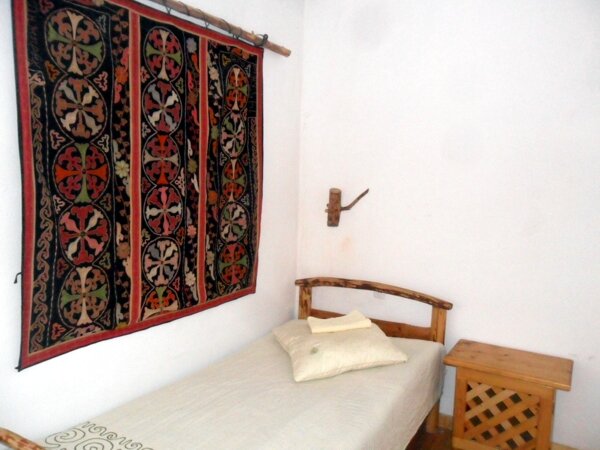
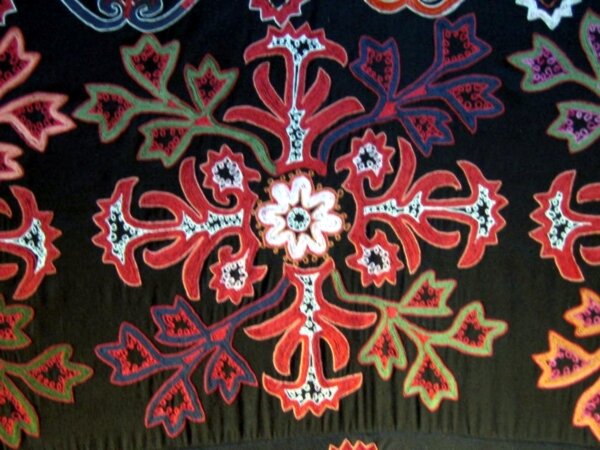
Wall niches were often to be found in house, and were multi-functional – serving as cabinets, cupboards and drawers, (although decorated trunks were also to be found). For example, clothes might be piled up in niches. Walls were covered by decorative panels – such as tush kiyiz.
Most of the modern day cities were established in 19th and early 20th centuries – on the site of ancient towns and fortresses. Often the old buildings would be gutted to provide building materials for the new – and photographs showing this can be seen in the museum at Burana. The new settlements went through periods of expansion, such as in the 1930’s, the 1950’s and 1970’s.
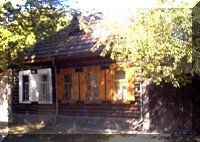
In many places the small one storey domestic dwelling, typical of the early period, can still be seen throughout the country. In Bishkek, on Moskovskaya, there is still an example with the wooden façade which characterized the Russian settler influence. The building preserved in the Frunze Museum in Bishkek may also give a feel of what the houses were like. In the south-western suburbs of Bishkek is Robochiye Gorodok – a “workers town” built in the 1920s by Interhelper – a group of Czech socialists who came in answer to Lenin’s call to help build Socialism in the new lands.
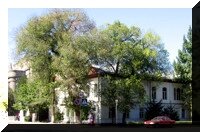
There were also some large mansions, however, and a rare surviving example is the rundown wooden villa in Dietsky park on Sovietskaya which was the home of IlyaTerentiev, Bishkek’s first Mayor. Another of his mansions can be seen in the Old Central Square.
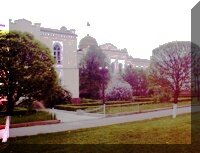
In the 1930’s, the many government and public buildings were constructed in a classic and monumental style. There are several examples of projects completed by Interhelper – Dom Druzhba in Ala Too Square (the original Government House); the AKB Kyrgyzstan Bank building on the corner of Frunze and Prospekt Erkindik. The tendency to build such “people’s palaces” was not implemented just in the capital – but was also carried out in the regional administrative centers as well. In central Bishkek there are several examples – ranging from the Opera and Ballet theatre, Dom Soyuzov on Prospekt Chui and the Marie, (Bishkek City Hall – also on Prospect Chui).
The Second World War saw many enterprises being moved away from the Western front and a range of large factories were constructed. Buildings of “Stalinsky” style were characterized by large rooms and high ceilings with ornate facades – reminiscent of the ornate facades on the ancient monuments to be found throughout the republic.
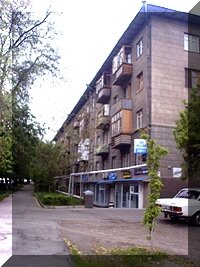
Later in the 1960’s many industrial centers were significantly enlarged and apartment blocks (four or five storeys high) were constructed in the larger towns from red brick or concrete in a “faceless” style often referred to as “Khruschevka” – after the Soviet leader who championed the cause of erecting mass and cheap accommodation.
The 1970s and 1980s saw a number of major construction projects throughout the republic – especially in the capital, Frunze – now Bishkek, and a trend to redevelop city centers with modern office buildings, department stores, and cinemas – making use of materials such as marble, concrete and glass. The Communist Party First Secretary, Turdakan Usunbaev, was known for being able to extract funding from the central authorities in Moscow for constructing such grand projects as the new “White House”, the Lenin Museum (now the Historical Museum), the Museum of Fine Arts, the Russian and Kyrgyz drama theatres, the Circus, the Wedding Palace and the Central library. The ambitious projects included the monumental marble edifices of the White House, the Historical Museum, the National Library, the Philharmonia concert hall, the facade of the Ala Too Square all belong to this period.
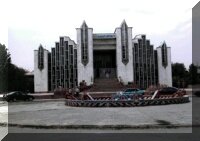
Such grandiose projects, however, provided little residential accommodation – and, by 1990, the housing situation was reaching crisis proportions – especially in the capital, Frunze, (Bishkek), and the densely populated areas of the Ferghana valley. In Frunze rumours spread that homeless refugees from an earthquake in Armenia were to be allocated housing. In response, people took to the streets to protest. The mood of the crowds in the mass demonstrations was angry, and there were calls for the government to resign, but order was maintained.
In Frunze rumours spread that homeless refugees from an earthquake in Armenia were to be allocated housing. In response, people took to the streets to protest. The mood of the crowds in the mass demonstrations was angry, and there were calls for the government to resign, but order was maintained.
In the south, however, and the quarrels between Uzbeks and Kyrgyz over building land erupted into violence which led to many deaths – reports vary but early estimates of 116 were later revised to 300, and some unofficial figures put it as high as 1000 (48 people died in the first four days of rioting in Osh, itself). The riots of June 1990 were sparked after local Kyrgyz had been granted building plots on an Uzbek dominated state-farm. A crowd of Uzbeks attacked a police station and the situation deteriorated. There was a wave of bloody revenge killings as inter ethnic rioting spread to other towns. Troops were drafted in from Uzbekistan and Turkmenistan to restore order, the border with Uzbekistan was closed to prevent the unrest spreading and a curfew imposed in several cities – but the unrest lasted for several weeks and many residents fled to escape the violence: Uzbeks to Uzbekistan, Kyrgyz to the North.
Towards the end of the Soviet period Bishkek was growing – but not fast enough. Even large apartment blocks constructed in the ever sprawling suburbs was not sufficient for the rapidly growing population.
Following the collapse of the Soviet Union, the infrastructure of all the main urban areas exhibited decay – and many building projects were abandoned, leaving half finished buildings littering the townscape. Most of the towns, however, retained their greenery and a number of new projects – especially new housing projects – were started. The restriction on the size of apartments was removed … as was the planning restrictions on building two storey accommodation … and the emphasis was on “individual style” building – which a new “rich” middle class were happy to adopt.
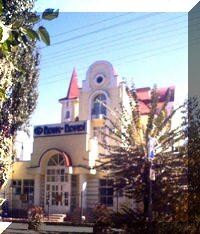
The individualistic approach has led to many interesting (if not strange) designs, involving towers and curves in an attempt to get away from the Soviet functional style of rectangular blocks. Some of the bank buildings show this most strikingly – such as the former Bishkek Bank on Toktogula, with it’s circular tower, or the “Toytown” fairy-tale palace opposite Bakai Bank on Isanovna.
The move has not been without controversy. There are many discussions about town planning – and the shape of Kyrgyz cities of the future.

Visitors to Bishkek today may be surprised by the number of building-sites that can be seen around the city which can be taken as a sign of the improving strength of the economy. There are also a number of “unfinished” buildings, some started long ago, even in some cases as long ago as during the Soviet period, where work has come to a standstill as a result of a cashflow crisis.
Amongst the many construction projects there are numerous trade centres (supermarkets) and business centres, but unfortunately, however, there are few factories being built, and the housing that is being constructed tends to be the “elite” (i.e. it is expensive) – and not suitable for “first time buyers”.
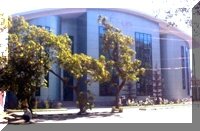
A considerable number of shopping centres have been built in Bishkek in recent years, including: Dordoi Plaza, SilkWay (now Detskiy Mir – Children’s World), Tash Rabat, the Vefa Centre (also known as Ramstore), and Caravan. Some have included office space and residential accommodation. There have also been several office developments in recent years and another modern trend that has exacerbated the housing shortage has been the conversion of apartments into offices – thus removing further units from the available housing stock – but as there is considerable demand for office space and demand exceeds supply which has led to considerable price increases.
It is not just in Bishkek that construction has seen a boom – the resort zone around Lake Issyk Kul, in particular, has also seen considerable development. Some of the resorts have been financed by the sale of cottages which have been as part of a complex together with the central facilities – enabling considerable improvements to be implemented. New projects have been also started on the less populated Southern shore of the lake. Other resorts have seen some renovations, but a large number of the facilities around the lake are still in dire need of improvements to reach international standards.
In other parts of Kyrgyzstan, the construction industry has been less active and there are fewer notable large scale projects. There are a few examples of Industrial construction projects, but these are generally limited to government funded projects with the involvement of foreign investment, such as the construction of electricity installations and cement works.
During the period since 2007, some areas of the country have experienced earthquakes which have damaged or destroyed buildings, especially self constructed, dried clay brick housing in rural areas. Towards the end of 2008, questions were being raised about the quality of such construction.
The construction industry in the republic has grown from about 6% of the GDP in 2002 to just over a quarter in 2006. There are about 80 companies operating in the capital, but many of them are relatively young in that they appeared following the Tulip Revolution of 2005. The ten largest, and longer established companies, have all built several large projects and have foreign investment. Most of these firms concentrate on building multistory elite apartment blocks, but the majority of the smaller firms specialize in construction of detached single houses. Apparently, many companies seem to be established for the simple purpose of constructing a single house.
Many people actually build their own homes. Some have plots of land allocated to them and build on these – others are simply squatters who move onto a plot of land, illegally, and begin construction. This has been a particular feature following both of the recent revolutions, in 2005 and this year. Some of the construction is made with modern materials, others using traditional methods such clay bricks.
The housing shortage is still a problem, even to this day. This is one reason why, following the events in Osh and Djalal Abad during the summer, when many houses were destroyed, a massive effort was made to rebuild the destroyed homes.
Even where there are houses, the conditions may well seem to be less than satisfactory – especially to more well-off Western eyes.
In the Soviet period, housing was a community property – there was no privately owned property until after the privatization that followed the collapse of the Soviet Union. It would allocated to families by a local commission, and it seems as if members of the commission had much power and influence in the community. The housing units were defined by area with a certain allocation of square meters per person in the household.
Much of the housing provision is small – one or two roomed apartments. A single room in a one roomed apartment serves as a bedsitting room, but there is usually a separate bathroom (and possibly a separate toilet) and kitchen, A two room apartment typically comprises a bedroom, a lounge or Living Room, bathroom (and possibly a separate toilet) and a kitchen. There is usually a hallway or corridor and there may also be a small balcony – in some cases the balcony has been windowed in to create an additional space for storage – and sometimes people even sleep in them.
Many families live in what Westerners might consider “crowded” conditions. Four people may well live in a two roomed apartment – the parents sleeping in one room with the children sleeping in the other. In most homes, the divan converts into a bed. The family of “Baseball Kids”, for example, (that’s the mother and eight children), live in such a two room house.
There may utility services provided, especially in the cities, but in many rural areas these may be lacking. Not every settlement, for example, has supplies of potable water, (i.e. drinking water or tap water). Very remote settlements might not be connected to the electricity grid. Gas supplies may be available only in “bottles” – or canisters. In the larger towns and cities there may hot water and central heating provided by special heating plants. Hot water is piped from the plant to the apartment blocks etc. This has a number of problems, for example, every year the supply is turned off for one month for system maintenance – usually in May, if the weather is unduly inclement during spring and autumn, the system may not be in operation, and it is difficult to control individual room temperatures. In many settlements, individuals have to provide their own heating (for example by some form of coal or gas burning stove) and hot water, (by boiling kettles).
Much more noticeable to Westerners is the lack of modern sewerage and toilet facilities. Indeed, there has been a lot of comment and controversy on this topic in recent years … Public toilets are “few and far between” … and in many cases, (especially outside the cities), will be of the “squat” variety. Even these come in different forms … some may simply be a hole in the ground. Almost all will smell unpleasant. Even where you find pedestal toilets, one shouldn’t be too surprised about the conditions – e.g. if there is no toilet seat – and the fact that there may not be a door to the cubicle.




 Bishkek