Dom Druzhba – Friendship House
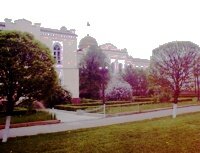
Dom Druzhba
One of my favourite buildings in Bishkek is Dom Druzhba, or Friendship House.
It is a two storey building with a central dome to the East of the main Ala Too Square. It is not only a fine example of classical architecture, but it has an interesting history to go with it.
Built in 1926 by the workers of the Czech Interhelpa organization as the Soviet House, it was originally intended to house the Central Executive Committee (the government of the day).
Construction began on May Day – May 1st, 1926 – and the foundation stone was laid in a solemn ceremony. Apparently, there was a time capsule built into the foundations, (or into a cornerstone – accounts seem to vary), in the form of a metal box containing documents – a message to future generations – in a concrete casing … but the exact location has long since been forgotten and it is lost in the mists of time.
It was completed in just one year, at a cost of 608000 rubles. At the time it was the only two storey building in the city centre, apart from the house of Terentiev, the city’s for mayor. just North of the junction of Sovietskaya and Jibek Jolu, which is now a ruin.
The floor plan of the building resembles a large letter “H” – the Cyrillic equivalent of “N” – which, apparently, got the architect Andrei Zenkov into trouble. Zenkov was a well established architect in the Central Asian region, having designed the all wooden cathedral in Almaty’s Central Park in 1904, (which, incidentally, is still called “Zenkov’s Cathedral”). He ran into trouble, however, because somebody happened to notice the shape of the building on the plans, and suggested that was in homage to the deposed Tsar Nicholas II, rather than to the glories of the new Soviet regime! Zenkov was almost imprisoned as a result.
That wasn’t the only problem associated with the design as far as the Soviets were concerned. Zenkov had intended to combine a number of elements of characteristic Central Asian architectural styles: the dome on the roof, lancet windows, and stylized decorations and although the building has undergone several restorations in its history and various incarnations, these basic elements are still evident today. These elements, however, were criticized as being “remnants of archaism and eclectism”.
Incidentally, Zenkov built five buildings here in Bishkek, but only three of them are still standing: Dom Druzhba; the branch of the Kyrgyzstan Bank on Erkindik between Frunze and Jibek Jolu and the Surgery Corpus of the National Hospital. The other two, a bank and a crenellated hotel on Vasilievskaya, (South of the Big Chui canal), have long since disappeared.
The basement of the building apparently once housed a dungeon that was used to hold dissidents during Stalin’s Great Purge. A recent newspaper account about the Chon Tash Massacre in 1936 describes how vehicles would drive up in the evening to deposit their political detainees.
When the second Government house, (currently the parliament building), was built – the Academy of Sciences occupied it for a while before it became the Historical Museum. For the convenience of visitors to the museum, the rooms were connected in such a way that it was possible to walk round in circuitous route. When the marble faced cube in Ala Too Square was constructed, the museum was re-housed there, and Dom Druzhba housed a number of cultural organizations, the Zoological Museum, a bookshop and an art gallery. It now houses the Ministry of Culture.
Like most buildings of its generation, the rooms inside are graced with high ceilings – 4.5m high and this, coupled with the thick brick walls, means that the building maintains a cool climate throughout the heat of summer. Indeed, underneath the central dome is a hall – once the scene of assemblies and meetings of the government – which has always seemed distinctly cool, (if not chilly), every time I have sat in it.
The floors of the building are wooden parquet, (which is quite popular here), and although they were still in reasonable condition, to ease the maintenance they were painted over. (There are plans to restore the floors to their original glory.)
The exterior of the building was repaired and repainted to mark the 125th anniversary of the founding of Bishkek. In 2007 the building was earmarked for further renovations – although the fabric of the building is basically sound, some of the utilities, (heating and water systems) were showing signs of their age and in need of replacement.
It is possible to stand on the corner of Ala Too Square and see the three seats of Republican government, (Dom Druzhba, the Parliament building and the White House), in one sweeping glance. The view of Dom Druzhba, however is somewhat hindered by the row of flagpoles that were erected in front of the building to match those on the other side of the square in front of Friendship Square and the Friendship Monument.
Perhaps my favourite story associated with Dom Druzhba tells of a nomad visiting the city from his high mountain pastures, (jailoo), shortly after it had been built. When he went back home, he told all his family and acquaintances what a wonderful city Frunze was, (as Bishkek was called in those days), with such a tall building that if you bent over backwards looking upwards – with the top of your head on the ground behind you – then you still could not see the top of the building. Apparently, the building he was describing is now known as Dom Druzhba.




 Bishkek