“Wow, no one saw this coming.”
The reporter over at Forbes was obviously in a state of shock when he wrote the article: ”University of Florida Eliminates Computer Science Department, Increases Athletic Budgets. Hmm.”
Apparently the University administrators have decided to effect savings of 1.7 million dollars by eliminating the funding for teaching assistants in computer science, cutting the graduate and research programs entirely, and moving the what remains of the department into other departments. To make matters worse, at the same time, the university has decided to increase the budget for its sports programme by two million dollars. Despite the fact that the two decisions are reported together, there is no suggestion that the two are linked in anyway; that it was a choice of “one or the other” – even the author of the article claims that he is not saying that the university “has chosen football over science.”
The article opens with the cry of amazement: “Wow, no one saw this coming”. Maybe I am just being pedantic, but I beg to differ. Someone MUST have seen it coming, even if only those actually involved in the decision making process. After all, decisions like this aren’t taken in a vacuum. They must have had more than just some inkling of what was in the pipeline. Is it really too much to assume that there had been at least some debate about the decision?, or that there must have been some reasoning behind the decision that was taken?
Although there were many people who were caught out by the events in 2005 and 2010, (including me for that matter), it would be too much to say that “no one saw the two revolutions coming”. We were caught out in that they developed in ways, at a speed and to an extent that we didn’t anticipate. Once again there have been claims made this week about those events on April 7th two years ago … about the presence of foreign mercenaries and snipers. These claims aren’t new but they help to emphasize the sheer confusion that existed at the time, and which persists even to the present day. 
I feel a bit more sympathy for the Kazakhs who presumably didn’t see the phenomenon known as Borat coming, or the effect that it would have on their country and in particular on their tourism industry. When the film was released in 2006, it was much criticized in Kazakhstan, (and even here in Kyrgyzstan, many of the locals were offended by the film and saw it as a great insult). The most recent and well publicized embarrassments have involved Kazakh sportsmen have won Gold Medals in international competitions … only for the loudspeakers to blurt out the wrong tune when they receive their medals in the official ceremonies, (not the official Kazakh National Anthem, but a version by Sacha Cohen – aka Borat. Apparently, some didn’t notice the mistake and the coaches of national teams have now been given special instructions to check the music before it is played in any future medal ceremony.) It seems that now, however, the Kazakh Foreign Minister has diplomatically “forgotten”, (put to one side), all this unpleasantness and has recognised that Borat has provided a real boost to the country’s tourism industry.
We are not sure what sort of season our tourism industry is likely to experience this year. There has been a host of meetings designed to iron out all the possible problems that can be foreseen … the trouble is that no matter how much we try to predict the future, no-one really know what is going to happen. All sorts of things can happen and have a significant impact, (both good and bad), and not all of them need be dramatic or revolutionary: changes in procedures or formalities, (e.g. the introduction of a visa free regime – or a tightening of the interpretation of the rules for issuing visas), a change in the weather pattern, or even something as simple as access to the airport for busloads of tourists.
Making predictions can be a pretty precarious business at the best of times … but someone in government felt sufficiently confident to predict that the average salary will rise by something like 60% over the next two years. That might sound pretty impressive, (especially if we consider where the money is going to come from), but it will still be just 15000 som, (about USD325 or just over GBP200).
The question about “where the money is going to come from” is actually quite an important one. According to the Vice Prime Minister the economy of Kyrgyzstan “can’t survive” without remittances from Kyrgyz citizens working abroad. These cash transfers account for more than 60% of the national budget and play a huge role in maintaining the macroeconomic balance of the country and help the National Bank to maintain the exchange rate and currency reserves.
Kyrgyz also relies heavily on the international donor community, so the same Vice Prime Minister has surprised quite a few people with his recent comments directed towards that community. Last week he criticized the World Bank for the time taken to implement projects … and this week he the press have been having a field day reporting his observation that Kyrgyzstan “doesn’t need money from the West”. As in the story about the Computer Science department at Florida University, the headlines don’t tell the whole story and it’s easy to get a mistaken idea. Last week, for example, one of the donors who had been approached for help in a particular issue that is actually quite “a hot potato”, regulating the mining industry, had replied that it would take them six months, or a year, to consider the suggestion. So the erstwhile member of the government pointed out that the issue was a bit more urgent than that and if the donors didn’t want to help, then they didn’t have to. Although Kyrgyzstan would have welcomed the contribution from specialized “experts” in the field, it would just have to go ahead without their input … and I suppose there was also the unspoken implication that if you don’t like the results – don’t complain … you were asked to help!
In this week’s comments he was saying we don’t need money – we need knowledge and experience in order to avoid making mistakes when implementing reforms. As it happens, this knowledge and experience could be far more valuable in the long run than the cash input, provided it is relevant, acted upon, is effective and does exactly what it is supposed to do.
One of the main issues in the news has been “energy”. The continuing saga of power cuts throughout the country continues. The question over the supply of petroleum and diesel fuel from Russia is still subject to some discussion, as the Russians to reimpose tax and duties on supplies. There was a lot of concern about gas supplies in the early part of the week as, (as I have mentioned before), Kazakhstan has threatened to cut off supplies if Kyrgyzstan doesn’t settle it’s outstanding bills. Apparently the biggest debtors are government institutions – including the Bishkek municipal authority. Anyway, alternative supplies have, apparently, been arranged … from Uzbekistan which is pretty ironic because Uzbekistan used to supply our gas and we only recently switched to supplies from Kazakhstan. What’s more, it will be at a higher cost so tarifs may have to rise.
Anyway, the issue came to an embarrassing head this week when the “eternal flame” at the war memorial was extinguished … because … yes, the bill hadn’t been paid. This has not only hit the headlines here, but has been featured on a number of news wires around the world, especially as it has happened just before the May holidays, which culminate in the Victory Day celebrations on May 9th … someone, somewhere, somehow managed to find a solution so that the flame has been relit and a really embarrassing moment has been averted. At least, we hope it has.
May is a busy month with 3 big holidays: May Day, (the 1st), Constitution Day, (May 5th) and Victory Day, (May 9th). March is the other “holiday month”, also with 3 big holidays: International Women’s Day, (March 8th), Norus, (March 21st) and People’s Revolution Day, (March 24th). The decision has been taken, however, to drop that last one, so March will go back to having just two holidays. What might also cause a little confusion is that President Atambaev has now signed a decree establishing the commemoration of Mothers’ Day here in Kyrgyzstan – which will be marked on the the third Sunday in May. No, it’s not going to be a fourth holiday in May, and it is not intended to replace International Women’s Day, but will be a chance to commemorate and enhance the role of motherhood and the family in society.
The embarrassment over the “eternal flame” isn’t the only one to hit the Bishkek municipality this week. The city councilors were somewhat agitated to learn that some nine thousand stray dogs and cats were shot in 2011. This is not exactly news in that it is not a “new story” but what made it newsworthy was that it sparked off a debate about alternative measures and even elicited a comment from the Mayor that shooting the animals was “inhumane”. Apparently the councilors considered the budget for this activity, in some detail, learning that there were twelve people employed in the programme, (earning between one and two hundred dollars a month), each bullet costs about one dollar and so on … and even if the total cost turns out to be in the region of two million soms, the cost of sterilization is much higher and the municipality has a shortfall of funding for the maintenance of schools and roads … both of which have been in the news recently.
There seems to have been an interesting shift in official attitudes towards our large, powerful and influential neighbor, China. The Chinese are major trading partners for Kyrgyzstan – according to some statistics “THE major trading partner” – although that was before the creation of the Customs Union, (CU), which curtailed the amount of transit trade between China and countries of the CU which travelled through Kyrgyzstan. There has been a lot of news of Chinese interest in investing in projects in Kyrgyzstan – most notably in the new “Silk Road Railway” linking Kashgar to Uzbekistan; the Chinese are apparently going to prepare the feasibility paperwork free of charge. Although Bishkek has always maintained fairly good relations with Beijing, every now and again a little “problem” emerges. Anyway, one minister spoke enthusiastically about making “every effort to establish a more fruitful cooperation with China”. I wonder if people have considered where this might be leading?
It is not just China with whom Kyrgyzstan is eager to cooperate. There have items about working with Interpol, especially in trying to curb the transit of narcotics through the country, and with other countries in the SCO, (Shanghai Cooperation Organization), which is to set up a special “cyber police” which will target the use of the internet to spread the ideologies of terrorism, separatism as well as providing logistical support for a range of illegal activities. I am sure that many activists and libertarians will have worked out where this measure may be going … and won’t be caught out in the same way as the Computer Science department at the University of Florida.
When it comes to the future of the Manas Transit base, Prime Minister Babanov was asked by a deputy what he thought about statements made by President Atambaev about the base having to close in 2014. His reply was basically that we have an agreement that lasts until 2014, but after that it’s future “should be decided within the framework of the Collective Security Treaty Organization”, (the CSTO). This won’t have come as a surprise to anyone … but I wonder what Moscow will make of it.
Postcard from Bishkek: the weekly postcard that I send out as an email also gets posted on the website ianbek.kg each week – and there are other postcards which don’t get sent out. This week, for example, there were postcards about:
- A good way to see wildlife? - last Sunday was International Zoo Awareness Day … designed to draw attention to the conditions of animals kept in zoos, and I took a look at the Nabu Wildlife Protection Center in Karakol – Kyrgyzstan’s one and only zoo.
- St George’s Day – As a true Englishman, I decided to mark the saint’s day of our national patron saint.
- Toi Talkan – a new form of “energy bar” made to an old traditional nomadic recipe;
- Da da da da da da da da … – On the anniversary of Batman’s first appearance in Detective Comics No. 27 back in 1939, I take a look at a Kyrgyz comic book: Tumar;
- Islam – according to some traditions, the Prophet Mohammed was born on April 26th in 570 AD … so I decided to take the opportunity to have a quick look at Islam in Kyrgyzstan;
- A Guimbarde by any other name … - yes, well “guimbarde” is French name for that traditional Kyrgyz musical instrument, the Temir Kopmuz … otherwise known as the Jews’ Harp.
It is now possible to follow me on Facebook, (where I have specific pages for Celestial Mountains and ianbek … and also links.kg and Kyrgyz Diary), and on twitter, (@Bishkekpostcard and @celestialMTC ).
We have also posted a couple of new spherical 3D panoramas on www.see.kg – click on the “Latest” button.
If you decide that you don’t want to receive these weekly postcards in your email anymore, please drop me a line to and I will take you off the distribution list. Alternatively, if you know someone who might be interested in being added to the mailing list, then get them to drop me a line and I’ll be happy to do so.


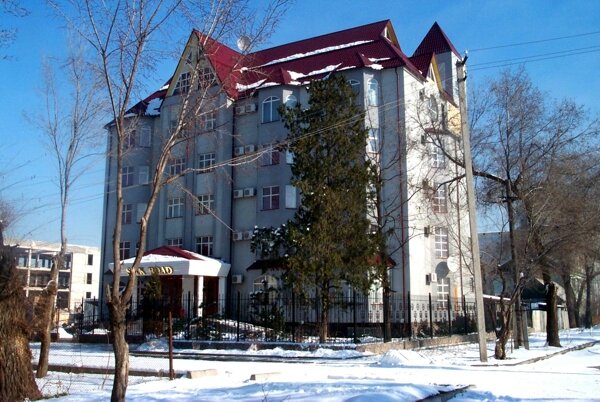


 Bishkek