A Guimbarde by any other name …
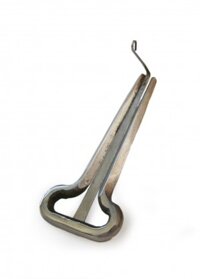
The Temir Komuz
Although I learned French at school, I wouldn’t claim to be speak French. I can read and the “get the gist” of a passage written in French and provided someone speaks slowly and uses a basic vocabulary, then I can follow a simple conversation, but I find it very difficult to think fast enough to be able to say anything in reply.
I don’t think “guimbarde” counts as one of those words that you might count as part of a “basic vocabulary” … but apparently it is the name for a traditional Kyrgyz musical instrument: the Temir komuz. Although generally referred to in Kyrgyzstan by this name, it is also known as the ooz komuz, (oral komuz), … as well as several other names.
In English we tend to refer to it, erroneously, as a “Jew’s harp”, but it is also known as a ”jaws harp” which is probably a more accurate description.

Playing the Temir komuz
In fact the origins of the guimbarde are lost in obscurity, but it is found across a wide range of cultures and historical contexts. There is no doubt, however, that it has an ancient lineage (it appears, for example, in a Chinese drawing dating from the 4th century BC), and it is thought to be one of the most ancient forms of musical instrument. Oddly enough, the first European mention of the instrument, (apparently in a Dutch customs document), and this seems to clearly identify it as a “jews harp” although it is not clear where the name came from. (The designation as “jaws harp” came much later.)
The first part of the name, ‘temir’, refers to the material from which it is made – metal, and the second, ‘komuz‘, to the resonator which generates the sound – the mouth.
The shape and form of the temir komuz is basically the same throughout Kyrgyzstan and, for that matter, abroad. The fundamental part of the design is a circle, (three quarters of a circle to be precise), which the temir komuzists call the “chara”, (or “bowl”). It can look like an elipse rather than a circle. The maximum diameter of the major axis of the bowl is about 45 or 65 mm, and the minor axis 20-30 mm. The arms of the semi-circle are extended parallel to one another for about 45-70 mm with a flexible membrane between them. The arms are called the “jaak”, (cheeks), and the membrane, which is the source of the sound of the instrument, is called the til, (tongue).
The temir komuz can be made from iron, copper, brass or bronze. In Kyrgyz legends there are mentions of them being made from silver and gold. For the til, steel is usually used. Copper and brass instruments are usually encountered in the south of the country, elsewhere iron is more commonly used. The instrument is usually stored in special wooden cases, often made from walnut or apricot wood.
The method of extracting a sound from the temir komuz involves the following: the chara is held in the left hand and the performer presses the jaak against their teeth. The distance between the top and bottom layers of the teeth depends on the width of the til, plus 1 or 2 mm, and they compress their lips preventing the unproductive exhalation of breath. Breathing and pinching the bent end of the til with the fingers of the right hand, the musician creates a vibration which is the source of the sound. The mouth acts as a “sound box” – the shape of the mouth and placing of the tongue changes the and timbre of the notes which be produced: to produce a lower note the tongue is placed at the bottom of the mouth and to produce a higher note it is placed to the top of the mouth.
It has been suggested that the metal version we are now so familar with, evolved from wooden or bamboo instruments developed in Asia, (perhaps Indonesia) – similar to the Kyrgyz Jygach ooz komuz. The instrument then made its way to Europe either along the trading routes of the Silk Road sometime around the thirteenth century.
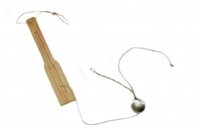
The Jygach ooz komuz
The jygach ooz koomuz is similar to the temir komuz, except in that it is made from wood, and the sound produced from it can be louder than that of its metallic ‘relative’.
A single piece of wood, (usually barberry, Abelia corymbosa or honeysuckle), is cut to size- between 13 and 20cm long and about 2cm wide, and a slits are cut into it lengthwise so that the central portion can serve as a vibrating reed. At the end of the reed is a small hole which has a lace threaded through it. In order to play the instrument, the musician presses it against the lips and pulls on the lace.
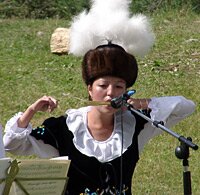
Playing the Jygach ooz komuz
In order to play the Jygach ooz komuz, the narrow end is held in the left hand, placed between the lips, and movement of the lips regulates the sounds that are generated. The right hand then pulls a string which is attached to the tongue of the instrument. Although, as a rule, the instrument is usually played by women, there are currently a number of male performers.
Although it is possible to vary the pitch and can produce a melodious sound, it is difficult to play smooth melodies on it, (mainly because of the stiffness of the reed), and so it is mainly used to provide rhythmic accompaniment in ensembles – however, it often features as a solo instrument as well.
Both of these instruments are used in national folklore and also by professional musicians and although men sometimes play them it is more usual to see them played by women.
Tradition has it that the sound of a temir komuz being played near the cradle of a new born infant, then the baby will grow up clever, gifted and eloquent.
There is an International Association for Jew’s Harp Music based in Iowa which, in 2004, published an article written by the Director of one of the Music school ensembles in Kyrgyzstan that called upon Kyrgyz businessmen to display patriotism, and provide aid to temir-komuzists.





 Bishkek