St George’s Day
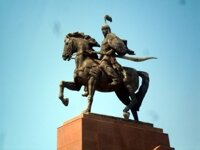
The new statue of the Benevolent Manas
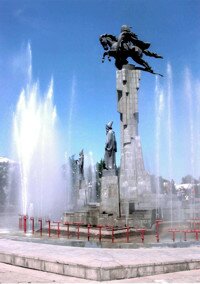
The Manas Complex
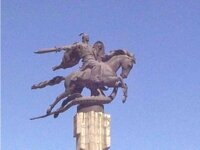
Manas and the "dragon"
There are two monuments the Legedary Kyrgyz hero, Manas, here in Bishkek, within a couple of blocks of one another.
The most recent one, (which is known as Manas the Benevolent), is in the main Ala Too Square, and was erected in 2011. It replaced the somewhat controversial statue of Erkindik, (the Kyrgyz statue of Liberty), which was supposed to represent the spirit of freedom holding aloft traditional Kyrgyz symbols. Erkindik had, in turn, had been erected in the place of a the obligatory statue of Lenin, pointing symbolically and optimistically forward to the promising future that Socialism offered the masses – although I often joke that, perhaps, he was simply saying “Look at those beautiful mountains!”
Probably, because of the location, it appears to be the more staid, traditional and ceremonial of the two. Like many statues of leaders on horseback, it is possible to imagine him inspecting his troops arrayed in front of him in serried ranks, or at some other ceremonial function … or just possibly leading those same troops towards a battle; but not yet into battle – although he has a sword in his hand but it is still sheathed and not yet drawn for conflict. The image is of a resolute leader, hoping for the best but prepared to face the worst if needs be.
The earlier monument is outside the concert hall of the Philharmonic Society at the intersection of Prospects Chui and Manas. Erected in 1982, it was designed at an integral part of a much bigger complex with fountains, supplementary statues of two of the main characters from the epic saga, (the counselor Bakia and Kanakei, Manas’ wife), flower beds flanked by busts of some of the most famous raconteurs of the epic and the concert hall providing an impressive background.
There’s nothing staid, ceremonial or traditional in this image of this statue. Manas is portrayed as a man of action in what is supposed to be a episode from the epic: siting astride his horse, Akula, engaged in battle with a serpent – a dragon? Some of Kyrgyz, however, are, apparently, not happy about the image of Manas presented in this monument. As it was explained to me: Yes, Manas was a warrior, but this was because of necessity not a case of the glorification of combat as in many other cultures. Having united them, he fought to defend his people from a multitude of enemies. They are not sure that a large, mythical serpent, (a dragon?), was one of those enemies, but the image of someone holding his sword down and behind him carries bad symbolism.
My first view of the statue and the complex came as a fleeting glance when I first came here in 1994. The statue was pointed out to me as we drove past it one day as we turned the corner and drove off to somewhere or other … I forget where. It all happened so quickly that I didn’t really have the chance to have a good look and take it all in, so when, a few days later I looked at a statue and asked my guide: “Is that a statue of St. George and the Dragon?”. He wasn’t too impressed that my apparent all too short memory.
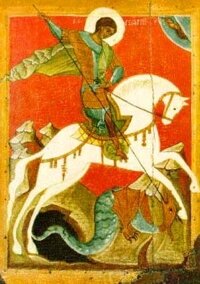
An icon of the traditional image of St George and the Dragon
I still think that, in a way, it was an easy mistake to make and understandable given the circumstances.
Coming from England, one of the countries which claims St George as its patron saint, the image of St. George and the dragon is part of our culture and background – although I can’t say that I remember learning the story in any great detail.
Although historians seem to accept that George actually existed, many of the fanciful and fantastic details of his life story has been the subject of much controversy, (especially his encounter in what is now Lybia with a dragon – a mythical creature; a creature of legend – which he defeats in order to rescue a local princess who has been dressed as a bride and left as tribute in order to appease the marauding beast – and which seems to be a compilation of many elements from different ancient legends myths and traditions).
Tradition has it that St. George was a Roman soldier had managed to find service in the Imperial Guard of the Emperor Diocletian. When Diocletian issued an edict that every Christian soldier in the army had to be arrested and had to decide between making a sacrifice to the traditional gods of Rome, or be executed. As a Christian, George was also arrested, and despite appeals addressed to him personally by the emperor, held steadfast in his beliefs and refused. Diocletian had no choice but the sanction the execution.
Traditional also has it that George died on April 23rd in 303AD, hence April 23rd is designated as his Saint’s Day: St. George’s Day – at least, in the West, according to the Gregorian calendar. In the Eastern Orthodox tradition, (which uses the Julian calendar), it falls on May 6th. However, because this often coincides with the Easter holidays, (or Holy Days), it is often moved so that the church commemorates the Saint on a different day.
In Russia, St George had a particular importance in Russia. The Order of St. George, for example, was an order of chivalry in Imperial Russia and the striped orange and black ribbon is used as a symbol for remembrance in the same way as we use a poppy in Britain.
Now, one of the Russian forms of the name George is Yuri, and there are two days days which were known as Yuriev Dehn … George’s Day. One was April 23rd, (even if it was celebrated, according to the Gregorian calendar, on May 6th), and was sometimes referred to as George’s Spring Day, as opposed George’s Autumn Daywhich fell on November 26th, (and so is celebrated on December 9th according to the Gregorian calendar). This second St. George’s Day commemorated the anniversary of the consecration of the Church of St George in Kiev by Yaroslav I the Wise in 1051. As it was celebrated at the time of year when the harvest is in and the agricultural year is over, it gained a special significance for peasants during the centuries when serfdom was the established order in Russian rural society. The Sudebnik of 1497, (a law code introduced by the Tsar, Ivan III – Father of Ivan the Terrible), had established the two week period, (one week before and one week after), of the holiday as the only time of the year when the peasants were free to move from one landowner to another. However, a century later the government of Boris Godunov prohibited the movement of peasants on Yuri’s day, leading to an expression to refer to a broken promise that is still used today survives today and which, roughly translates as: ”there you have it, Granny, Yuri’s Day”.
It’s not only the English which claim George as their Patron Saint – he is also the patron Saint of Georgia as well as Malta and Gozo and an important figure in Portugal. In fact, he is one of the most revered saints in the Christian tradition … and the day is commemorated in many different countries, cities, regions and institutions which claim affinity with him.
In the Spanish region of Catalonia, for example, on St. George’s Day it is traditional for sweethearts to present each other with a rose and a book. It was from this practice that Spain adopted the day as it’s nation Book Day, and this in turn proved to be the inspiration for UNESCO’s special designation of today as the World Book and Copyright Day. (As a pure coincidence, and another literary connection – it also happens to be Shakespeare’s birthday – and the day on which died).
Despite being a Christian saint, George is also known and venerated by Muslims – especially in the Middle East from Egypt to Asia Minor. This may be party due to the fact that he hailed from this area, Syria, and the fact that the stories and legends associated with this name appear to be a composite combining elements from both the Biblical and Quranic traditions as well as from folklore. There is even a story of him killing a dragon, (this time near the sea around Beirut).
On the other hand, St. George is not really known here in Bishkek and there are no special arrangements for commemorating the occasion, (apart the cake that I order from the local cake shop), topped with the flag of St. George in icing.






 Bishkek