A good way to see wildlife?
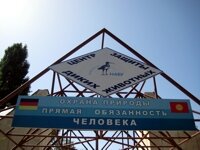
NABU Wildife Protection Center in Karakol
When people come to the office and see the cats for the first time, there are two typical reactions:
It is said that the British love animals. Someone actually posted a question on Yahoo asking if it was true that the British love their pets more than their children. It got pretty short shrift with most of the almost 70 replies deriding the suggestion … although one person mischievously asked: “have you ever met a British child?”
Another comment, however, mentioned the odd between the RSPCA, (the ROYAL society for the protection of animals which was established as early as in 1836), as opposed to the NSPCC, (the NATIONAL society for the protection of children founded almost sixty years later in 1895).
As it happens, the same sort of parallel can probably be drawn in the States. The ASPCA, (the American Society for the Protection of Animals), was set up in 1866, some thirty years before the NSPCC was established. Its founder, Henry Burgh, had been sent by President Abraham Lincoln to the court of Tsar Alexander II, and he was horrified by the way the Russian peasants treated their horses. It just so happens that on his return to the States, he passed through London and visited the RSPCA which inspired him to create a similar institution when he got back to America. Once again, the ASPCA proved to be a forerunner and model for those working to protect abused children, (prompting for example the foundation of the New York Society for the Prevention of Cruelty to Children).
Despite that, there are survey results which suggest that it is true the UK residents are more concerned about animal welfare than their North American counterparts, outscoring both Americans and Canadians on questions about support for banning all types of hunting, medical research or commercial product testing on animals, and “fur farming” as well as banning animal acts in circuses. Most of those, especially the first and last ones, wouldn’t go down well here in Kyrgyzstan.
One of the few issues where the results for the three countries were similar was on the question of whether animals held in captivity in zoos should be freed, (20% in Canada and 17% in the US compared to 22% in the UK).
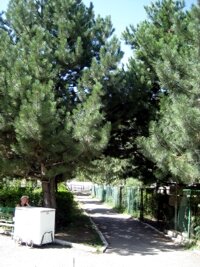
The park at the NABU Wildlife Protection Center
As it happens, today, (April 22nd), is Zoo Awareness Day, (ZAD), although the date seems to change from year to year and Wikipedia seems to suggest that it on April 17th whilst the Times Educational Supplement lists it as occurring on either August 31st or September 1st. The first such day was commemorated in the early 1990’s and it was apparently conceived by a British group called CAPS – the Captive Animals’ Protection Society, which should make it clear that the aim wasn’t to popularize and increase the number of people going to the zoo). They say that zoos are primarily about tourism and providing a ‘day out’ rather than having anything to do with education, conservation and research.
This is not really an issue here in Kyrgyzstan – where we don’t really have a zoo, (although there is an animal sanctuary in Karakol, and there is a proposal to build one at some point in the future here in Bishkek). There is a zoological museum here in Bishkek and many of the local museums have a display of stuffed animals to illustrate the wildlife that is found in the region.
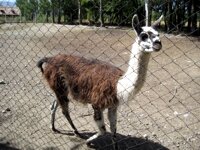
Llamas are one of the "exotic" animals to be found in NABU
The NABU Wildlife Protection Center was opened as the Karakol zoo on August 31, 1987. It basically has bears, wolves, bobcats, red and black foxes, mongoose, llamas, deer, antelopes, mountain goats, a camel, yaks, birds of prey, (griffon vulture, golden eagles, hawks, eagles and falcons), ducks, decorative hens, guinea-fowls, Japanese quails. In other words it is mainly populated with examples of local wildlife rather than “exotic” animals, although there are some, (llamas for example).
Until 2002, the zoo received its funds from the city budget, but due to financial problems, the zoo was transferred to the Kyrgyz-German public organization NABU, which is involved in environment protection and the protection of rare species of fauna.
NABU, (Nature and Biodiversity Conservation Union), was established in 1899 and is the oldest and largest environmental association in Germany with almost half a million members and sponsors. Its main objectives are the preservation of habitats and biodiversity, the promotion of sustainability in agriculture, forest management and water supply and distribution, as well as enhancing the significance of nature conservation in society. It has been active in Kyrgyzstan sin the beginning of the 1990s where it has concentrated on protecting endangered species, establishing protected areas, developing environmental education and supporting non-governmental organizations.
The remodelled zoo offers visitors a fascinating insight into the endangered wildlife of Central Asia and aims to win over children and young people, (the potential poachers or animal protectors of tomorrow), to develop a love for nature and animal conservation.
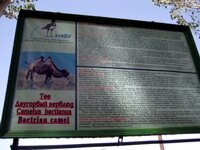
Information Board at the center in two languages
The centre primarily cares for injured animals that have been saved by their “anti-poaching squad” or which have been brought in by members of the public. Visitors to the center can get a the chance to see close up some of the endangered species of Kyrgyzstan, such as Marco Polo sheep, Siberian ibex and many birds of prey. Specimens are being protected in their new home and receiving the care that they urgently need. One year alone, for example, over 120 Saker falcons were saved by the anti-poaching squad. All the confiscated animals that, after careful checks, are deemed fit enough, are re-released into the wild after a recovery period.
As well as the center which is located in Karakol, NAU has also piloted a scheme of privately owned protection areas combined with an environmental protection programme amongst the local population.
One of the main projects that they are involved with concerns Snow Leopards. These large cats are threatened with extinction, especially from hunting, (for its fur and bones), but particularly as a result of poaching and illegal trade. NABU, in cooperation with the Kyrgyz government, is implementing a programme which includes a special anti-poaching squad, (Gruppa Bars – Bars is the Russian name for the Snow Leopard), that tracks dealers and hunters, seizing any snow leopards that are still alive. Three of the saved snow leopards now live in an outdoor enclosure in Kyrgyzstan that is the largest of its type in the world and is jointly supported by NABU and an organization called “Care for the Wild International”. Due to the severe damage they received to their paws from the foothold traps laid out by the poachers, the three, (Alcu, Kunak and Bagira) cannot be released into the wild. A female snow leopard, Another, called Djamilja, was taken to Germany due to her severe injuries and now lives in Zurich Zoo. (She has been included in the European Endangered Species Programme for breeding and thus helps to ensure the survival of her species outside of her native habitat.) It has recently been arranged for two cubs which have a genetic problem causing eye problems which means that they would not survive if released into the wild to be relocated to Almaty zoo which has the facilities to perform the necessary treatment to alleviate their problem.
Currently, reconstruction work at the center is underway, (for example, open air cages are being enlarged, and more natural and humane conditions are being created). According to the Karakol city authorities, about 10,000 people visit the zoo annually, including many school groups.






 Bishkek