Sinking ships
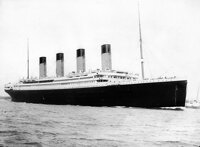
The Titanic - one of the world's most famous sunken ships
I remember being on a cruise ship in the Caribbean and one evening, when we were in the dining room eating dinner, the ship’s klaxon horn sounded: awooga awooga awooga awooga awooga awooga awooga awooga awooga awooga.
I turned to my fellow diners and said, “I wonder what that’s all about … at least it’s not a fire … they said they would ring it seven times for a fire … and that was ten.” No sooner had I closed my mouth than the captain came on the tannoy to announce that a fire had indeed broken out in the laundry and so he had sounded the fire alarm and we were to make our way to our muster stations by the life boats.
I like to think that my traveling companion and I showed the classic British “stiff upper lip”, refusing to panic and calmly finishing our glass of wine and making our way back to our cabin to get something warm to wear in the cool evening air on the upper decks. To be honest, we weren’t all that worried; there was no obvious sign of the fire on the cabin decks, the crew were seriously going through their, presumably, well practiced procedures and showing no signs of panic, (although some of our fellow passengers were frantic), and once we did emerge onto the boat deck we could see lots of other sips on the horizon who could come to our aid.
Of course, we thought about various shipwrecks throughout history, but there seemed to be little cause for concern. In what seemed to be a relatively short time, maybe less than an hour, the captain came back on the tannoy to announce that the fire had been extinguished and a special buffet had been arranged for everyone on the sun deck. That was a welcome move … remember, we hadn’t finished our dinner. Apart from the “excitement” of the evening’s events, the worst we suffered was that there was no laundry, (no clean sheets), for two days until we got to our next port of call and repairs could be effected.
I suppose that it is possible that there are some people who don’t know what happened 100 years ago today, but it is hard to imagine that there are many of them, given the amount of coverage in the media to the events in the middle of the Atlantic on that fateful Sunday evening.
The Titanic set sail from Southampton on April 10th, 1912, and after calling into the ports of Cherbourg in France and Queenstown, (which is now called Cobh), in Ireland, she headed out across the Ocean towards her destination, New York. Four days into the crossing, at 23:40 on April 14th), she hit an iceberg which carved a gash in her side through which the seawater flooded in and in less than three hours she was resting in pieces on the ocean floor. Two thirds of the passengers and crew that were on board, (a total of 1514 people, out of 2224), perished in the disaster.
So much is known about, and has been written about, the incident in the intervening 100 years it has become part of our popular culture and so, originally, I wasn’t going to write about it … but the amount of coverage in the media has made it virtually impossible to ignore. The intensity of public interest and the multitude of personal stories have had a remarkable impact on our collective consciousness, especially in the English speaking world. It’s been described as “one of the most fascinating events in human history”. I remember the effect of reading survivors accounts had on the most truculent pupils, both when I was a child myself and later when I was a teacher.
Although we know a tremendous amount of detail about what happened that night, it has been surrounded by controversy and the subject of much speculation, especially about events unfolded as they did, whether they could have been avoided, and how to apportion blame.
When the wreck of the Titanic was discovered, I remember that there was a lot of controversy about the ethics of the divers descending to what was effectively a grave site, and the debate continued when the artifacts they recovered were put on display in a traveling exhibition. I wonder what the people who criticized those events would make of the cruise that is retracing the route of the doomed ship. Shortly after the revolutions, both in 2005 and 2010, there were “tongue in cheek” suggestions that we should organize “Revolution Tours” and although I recognize that there may be some interest in
I was particular taken by three points … how quickly things can change, one moment all was calm and peaceful and people were “having fun”, but there were less than three hours between hitting the iceberg and the ocean floor, (so perhaps I should have been more concerned that night than I was); that the nearest ships were only 50 or 60 miles away, (just like those ships we could see on the horizon – so near and yet so far); and the report in the Salvation Army’s newspaper, The War Cry, describing the eventual arrival of the survivors in New York, which commented: “none but a heart of stone would be unmoved in the presence of such anguish. Night and day that crowd of pale, anxious faces had been waiting patiently for the news that did not come. Nearly everyone in the crowd had lost a relative.” Fortunately, we, (and our nearest and dearest), were spared that particular experience.
Here in Kyrgyzstan, two years ago, we went through a number of experiences that have had a similar sort of effect in the collective consciousness of the nation. The tragic loss of life loss in both revolution and the aftermath, (especially the events in Osh and Djalal Abad), have had a profound effect on people here.
The impact of those events, however, were not a unique experience and there have been many other events which have helped to shape the collective consciousness. These include, of course, the events in Osh in 1990 which preceded those of 2010, but also Urkun, (the events of 1916 when the local population and Russian settlers fought which resulted in something like 120,000 Kyrgyz fleeing across the border to China to seek refuge – many of them to perish in the hiugh mountain passes in extreme weather conditions).
Then there was the Great Famine in the 1930’s, when millions died. People still find ways to use stale bread, for example, rather than throw it away.
As it happens, today also marks the anniversary of the Soviet withdrawal from Afghanistan. Afghanistan was a traumatic experience for the Soviet Union and many of the generation who lived through it, and those who fought over there, still recall it with a mix of horror and sadness.
The discovery in 1991 of a mass grave at Chong Tash, (just outside Bishkek), where 137 people were buried after being executed as part of the Stalinist Purges, including most of the leadership of the Supreme Soviet of the day and several figures such as Kasym Tynystanov – the linguist whose portrait appears on the 10 som banknote, and Torokul Aitmatov – father of the famous Kyrgyz author and diplomat, Chinghiz Aitmatov. (Sadly, it appears that this is only one of several mass graves that are known to exist as a result of the repressions.) There is now a memorial complex to mark the spot and commemorate those who found their end in the events – called “Ata Beyit” – “cemetery of the fathers”, and many of those who fell during the events of April 7th, 2010, are also buried there. As an illustration of the importance of this site to the Kyrgyz, a new law has just been passed that will make laying a wreath at the site will be an obligatory part of any official diplomatic visit to Kyrgyzstan.
And there have been other events in living memory: the incursions by Muslim extremists into Batken in 1999 and 2000; the shooting of a lorry driver by an American soldier at the Manas air base, and others.
If that sounds a little depressing, it shouldn’t. The situation is not that bad, (the “ship of state” isn’t sinking), but all of this does help to explain why, sometimes, feelings run high. Indeed, it could well be argued that “none but a heart of stone would be unmoved in the presence of such anguish …”.
And feelings are, indeed, still running high in many communities around the country, as the mining community will tell anyone who listen. They are facing local opposition to many projects which should, in theory, help to bring prosperity to the local community as well as the country as a whole, and having to reach special deals with the local population before they can actually implement their plans. Although a review of mining companies approved many of the works that are currently underway, some were held back for further study and a moratorium on the issuance of licenses is to be introduced.
As another example, there have been a number of rallies during the week: in Djalal Abad, in Talas and even here in Bishkek. The meetings in the south, (which, according to varying reports, attracted between four and ten thousand people), went smoothly but a rally of about 2000 people in Talas was apparently “broken up” by members of a counter demonstration. There were even reports of one demonstration here in Bishkek, (apparently attended by just three people), demanding that the Russians leave Kyrgyzstan.
The Russians and the mining industry, of course, represent two of those ships on the horizon … let’s hope that it’s not another case of ”so near yet so far”.
There’s been lots of other news throughout the week, some of it, unfortunately not all that welcome. It seems, for example, that whereas exports from Kyrgyzstan have more than doubled since the turn of the century, (actually 252%), imports have risen by far more in the same period – a whopping 678%.
Amongst those exports, it appears are torpedoes manufactured by the Dastan company. That seems quite impressive, torpedoes manufactured in a land locked country but that’s a hangover from the Soviet days. I assumed that most of the production would be sold to Russia, but I was surprised that in fat this only accounts for something like a quarter of their production; most of the rest are apparently sold to India.
A new sales tax imposed on mobile telephone use is causing problems and may, according to some estimate,. Lead to price increases of as much as 20% – although companies working in this extremely competitive market may face problems if they do decide that they have to increase their tariffs. (Interestingly, a hike in these tariffs is supposed to have been one of the factors that helped to rile population and led to the downfall of the Bakiev regime.)
There has been a spate of bomb hoaxes, with “telephone terrorists” phoning warnings into schools, shopping centers and other places. The police seem to have been pretty effective and have caught quite a few of the hoaxers; some of whom have turned out, (surprise surprise), to be no more than teenagers. Others, however, are considerably older and are facing serious charges.
On the other hand, however, there has been other, less depressing, news … For example:
Two of the Snow Leopards in the NABU Rehabilitation Center in Karakol have been transferred to the Almaty Zoo so that they can receive specialist treatment for a congenital defect which affects their vision and means that they cannot be released into the wild – they wouldn’t be able to survive – but now at least they will be able to get treatment that will improve their condition.
Today has been declared a Subbotnik … a day of “community action” when people These are fairly common in former Soviet countries, and usually take place on Saturday, (in Russian “Subbotnik” means Saturday).
The first such subbotnik was organized by the local Bolsheviks at a railway depot in Moscow in April, 1919, as part of a response to Lenin’s call to improve the Russian railway. The idea took off and the first all-Russian subbotnik was held on May 1, 1920 when even Lenin took part, (removing building rubble in the Kremlin). This was the subject of a famous painting by Vladimir Krikhatsky, (“Lenin at the First Subbotnik”), which portrays him carrying a log – which was to become a common subject painted by several Soviet artists. Over the course of time subbotniks became “compulsory” with “Lenin’s Subbotnik” being held sometime near to his birthday (22nd April).
Perhaps inspired by this tradition of community action, the son of Former President Roza Otunbaeva has started a campaign to repair the many potholes in the capital city’s roads. Somewhat horrified by the swerving that many drivers execute in order to avoid them, and the fact that the city authorities didn’t seem to do anything about them, he started taking photographs of them and posting them on Facebook. Eventually he decided that “enough was enough” and to take matters into his own hands and organized crews to start filling them in and asphalting over them.
Perhaps the best news for me, (working in tourism – another ship on the horizon?), is that the government has decided on a new slogan and brand for the country: the Heart of Asia. At last we do seem to be seeing some action from the government on this front – we’ve seen very little progress, (although not for the lack of trying), since the last plan for the development of tourism expired in 2010 because of the atmosphere of uncertainty that has reigned in the country … If some events happen rapidly, bureaucracy takes time to run it’s full course.
I do hope it turns out to be a case of action and not just be a case of words and good intentions.
 Personally, I quite like the choice – it’s a great improvement on the Country of Tourism or the Land of Santa Clause, (two of the country’s previous slogans), although it does seem to be a bit ambitious. Asia is a big continent and saying that we are the heart of the continent doesn’t just mean that we are in the center of it, (which technically, at least according to the geographers, we are not; the center is actually a little bit further North, in the Russian Republic of Tuva – some 320km North of Urumqi). It is, however, hard to think of Kyrgyzstan as the organ that pumps the lifeblood through the rest of the continent, or being the core, “vital centre and source of one’s being, emotions and sensibilities” for the whole of the continent. On the other hand there are many positive aspects to the image which it would be good to develop: representing love and affection, courage, resolution and fortitude … and, also, if you look at a map of the country and turn it clockwise through 90 degrees, then it does indeed resemble the traditional image of a heart.
As I said last week, tomorrow happens to be the Orthodox Easter, and the shops are already full of eggs and the special dyes used to paint them, (although, apparently onion peel works just as well), stickers, or transfers with patterns and pictures of icons, and the special Kulich cakes, (tall cakes made from a sort of “short-pastry”). A friend from the country bought me twenty eggs, (ten duck’s eggs and ten hen’s eggs), so that the kids could decorate them. I think I am going to be pretty busy this weekend.
Postcard from Bishkek: the weekly postcard that I send out as an email also gets posted on the website ianbek.kg each week – and there are other postcards which don’t get sent out. This week, for example, there were postcards about:
- Kurmanbek Bakiev – Kyrgyzstan’s second President – ousted two years ago in the Easter Revolution
- A time to weep – Saturday, last week, was a pretty distressing day
- A newsletter arrives in the mail – a newsletter from Healthprom, a British based charity that works with disabled children here in Kyrgyzstan, prompted a look at autism in Kyrgyzstan
- Posting a letter – the cost of [posting a letter in the UK has just been increased, so I took a look at the Post Office and the process of posting a letter here in Kyrgyzstan
- Legendary origins of Lake Issyk Kul – Legends about the world’s second largest mountain lake – just where did those waters come from?
- Flora in Kyrgyzstan – on PAD, (Plant Appreciation Day), I take a brief look at the diversity of flora here in Kyrgyzstan
For the record, we’ve also put some new panoramas onto www.see.kg … click the “latest” to see the last two of the monuments here in Bishkek: that to the 2010 Revolution and of The Friendship monument, both of which are just to the East of the White House … to see some of the other more recent ones you need to click on Bishkek and scroll down to the bottom of the list.
It is now possible to follow me on Facebook, (where I have specific pages for Celestial Mountains and ianbek … and also links.kg and Kyrgyz Diary), and on twitter, (@Bishkekpostcard and @celestialMTC ). On the Celestial page we’ve posted some interesting views of Bishkek based on Victor’s 3D Spherical Panoramas in an album called Planet Bishkek.
If you decide that you don’t want to receive these weekly postcards in your email anymore, please drop me a line to and I will take you off the distribution list. Alternatively, if you know someone who might be interested in being added to the mailing list, then get them to drop me a line and I’ll be happy to do so.


 Bishkek