Kurmanbek Bakiev – Kyrgyzstan’s Second President
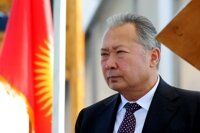
Kurmanbek Bakiev - Kyrgyzstan's second President
Kurmanbek Bakiev served as Kyrgyzstan’s second President, following the ouster of Askar Akaev from the post in the Tulip Revolution of 2005.
Having served in a number of official positions before this, including serving as Prime Minister, one might be forgiven for thinking that he was well equipped to fill the post. However, he drew most of his support from the South of the country and frequently faced popular opposition which grew with the mounting perception of corruption, nepotism and authoritarianism.
This came to a head in March 2010 when another round of unrest in March forced him to flee the White House, and eventually to seek asylum in Byelorus, where he still lives and works running a factory.
Kurmanbek Sali uluu Bakiev was born in 1949 in the village of Masadan (in the Djalal Abad oblast). It was a small village consisting of only about 70 families. Later his parents moved closer to the regional center of Djalal Abad, where his father was appointed as Chairman of a local collective farm. Bakiev attended a local “Russian” school – before attending a boarding school.
He graduated from a Polytechnic institute in Russia and worked for some time as an electronics engineer in Russia – and then joining the Soviet army. He moved back to Kyrgyzstan and held various positions in a plant in Djalal Abad before becoming manager of a factory in Kok Jangak (in Osh).
From 1991 he held various administrative posts in the Djalal Abad oblast, the State Property Fund, and the Chui oblast, before being appointed Prime Minister in 1999.
There was a problem when he was accused by some activists from the South of signing a “secret” agreement with the Uzbek government which would have handed tracts of Kyrgyz territory over to Uzbekistan in order to solve some of the contentious border disputes between the two countries.
He was forced to resign from the post of Prime Minister in 2002 as a result of the Aksu incident. A protest rally in the south had been called to protest at the arrest of another prominent politician, Becknazarov, on corruption charges. The police fired shots into the crowd and several protesters were killed. In the face of pressure arising out of this incident, the whole government offered their resignations to President Akaev, who accepted them, and the proceeded to reappoint some of the ministers to their old jobs. Bakiev, however was not so lucky.
He stood for Parliament and was elected a deputy to the Jogorku Kenesh and became one of the most influential politicians in the country. He was even considered as one of the few potential candidates who could oppose President Akaev. He became one of the leading figures in the opposition to the government and announced that he would stand as a candidate in the 2005 Presidential election.
Coming from the South, he tended to draw support from that region, but his party base was small. Despite that, in the 2005 parliamentary elections he was nominated by 13 different parties. It didn’t help, because he was elected according to the declared results from the Election Commission. He wasn’t alone – out of the 75 contested seats only7 seats were won by candidates who weren’t government supporters. The conduct of the election attracted a lot of criticism from international observers who said that it fell below internationally accepted standards. There were protests in the South, with calls for the election to be annulled, a re-run to be organized, and for the resignation of President Akaev.
The protesters sieved government buildings in Osh and Djalal Abad, and a rally was planned in Bishkek. The rally started peacefully, but after some skirmishes, the guard around the Presidential Palace turned aside and “melted away”. The protesters stormed the building – and the reign of President Akaev came to an end. He fled the country denouncing the “illegal usurpation” of power and claiming that he would be back.
In the meantime, the Supreme Court met and annulled the results of the disputed election. The old parliament met an appointed Bakiev as interim President and Prime Minister.
In July 2005, new presidential elections were held and Bakiev won an overwhelming majority. This may have been helped by an alliance with Feliks Kulov, who many commentators felt provided the only real competition to him, under which Kulov agreed not to stand in the election in return for being appointed Prime Minister.
Despite an overwhelming victory in the elections, trouble, protests and calls for his resignation dogged his first two years in office. A number of protests in 2006 brought about a new constitution which curbed his powers but was rapidly revised. The government resigned, although Kulov continued for a while as Acting Prime Minister, but although Bakiev nominated him for the post twice, the parliament refused to accept the nomination and Kulov left to join the opposition. A replacement Azim Isabekov, was appointed, but shortly afterwards also resigned. Bakiev appointed an opposition member, Almazbek Atambaev, to the post.
Atambaev was to serve for several months, but there was an uneasy truce between the main political figures. After he allegedly poisoned, Atambaev went to Turkey for medical treatment. A rumbling dispute over the privatization of the Crystal Silicon Factory in Maili Suu erupted and eventually Bakiev announced the resignation of the government.
In the subsequent Parliamentary elections, (which was highly criticized by international observers for falling below internationally accepted standards), the Ak Jol party which he had been instrumental in founding won the vast majority of the seats – in fact they won all the seats but in a “magnanimous gesture” a court decision enabled one of the oppostition parties to win some seats.
There were problems with power supply during the harsh winter of 2008/9, connected with the low levels of water in the Toktogul Reservoir. Many people thought that water had been sold by Maxim and the levels deliberately allowed to fall.
In February 2009, on a visit to Moscow, Bakiev suddenly announced that the US Air Base at Manas airport to the North of Bishkek would be closed when the current contract expired, taking almost everybody by surprise … the Kyrgyz and the Americans alike, but perhaps not the Russians. The announcement came immediately after a meeting with Russian President Dmitri Medvedev, during which Russia had promised a two billion dollar investment in a Hydro electric project and other financial grants. After a long period of insisting that the base would indeed close, it was suddenly announced, almost at the last moment, that the countries had negotiated an agreement and that the base would remain, albeit with some important changes in the arrangements: Payments for the rent of the base were substantially increased; the status was changed from an Air Force Base into a Transit Centre; and certain other conditions. A contract was signed to provide fuel for the base with a company that was thought to have connections with his son, Maxim, which supplied fuel basically imported from Russia and was to be the source of much criticism in both Kyrgyzstan and Russia.
Bakiev returned to Bishkek and in the summer was re-elected in a presidential election, which was highly criticized by international observers as falling below international standards. After the re-election he was, technically, in a strong political position, but lacked resources and, possibly the will, to implement economic reform and opposition to his reign was increasing. A new government was installed headed by an old ally, Daniyar Usenov.
There was growing concern about the possibility of further power restrictions; the announced increase in tarifs, (electricity tarifs were to rise by 170% and heating bills would rise by 400%), caused considerable discontent, particularly amongst the poor rural population.
Russia continued to back his government until March 2010, when the Russian media seemed to start a concerted campaign against him, which appeared to be supported by the Russian authorities. This campaign coincided with Bakiev’s volte farce on closing the Manas air force base. Convinced that fuel which had been provided free of duties was being supplied to the Americans and exported to third countries, especially Afghanistan, led to Russia imposing duties on energy exports to Kyrgyzstan which seriously fuel and transport prices.
A protest meeting in Naryn demanded the repeal of the hikes in energy tarifs and demanded that Maxim leave the country. Another protest in Talas on April 6th. The following day, at yet another protest in Bishkek, the White house was stormed by the protestors. Over 80 people were killed and Bakiev fled to his home in Djalal Abad. A few days later he was flown out and took asylum in Byelorus, where he remains to this day.
He faxed a resignation to the interim government, but later said that it wasn’t valid because his opponents had not kept their side of the bargain and were harassing his family. Most of close relatives, however, had, in fact, also left the country.
Although he no longer claims to be President, he does make the occasional into Kyrgyz politics by issuing statements about events in the country. There are some people who claim that he has made other attempts to influence affairs in the country, including the events in Osh and Djalal Abad during June 2010.
There are many activists who still demand that he be extradited to be tried for various excesses of his regime, especially those related to the events of April, 2011. Byelorus, however, has so far turned down every extradition request made by the Kyrgyz authorities.
Bakiev met his wife, Tatiana Vasilievna, an ethnic Russian, whilst studying at the Polytechnic Institute in Kuybyshev. They have two sons, Marat, who was a civil servant, and Maksim – a businessman.
After he arrived in Byel0rus, it was leaked that he had been joined by a “second wife” with whom he had another family.
For the record: It can be argued that Bakiev is the third person to hold the office of President. Wwhen Askar Akaev was de facto deposed on 24th March 2005, Ishenbay Dujshonbievich Kadyrbekov technically, under the constitution, became the acting president, for one day until Bakiev was appointed Acting President by the Jogorku Kenesh – the Paliament, but Kadybekov was never elected to the post and was only “Acting” President.)




 Bishkek