Posting a letter
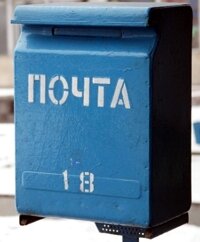
Postbox
Recently, the Post Office in the United Kingdom has raised its prices for posting a letter.
They offer two standard services, First Class and Second Class Post, as well as a special, premium, Same Day Delivery service. I’m not sure that the names are helpful but the main difference between the two standard services is that First Class post aims to deliver the letter or packet on the next working day, (although only about 85% of letters actually make this target), whereas Second Class Post is for letters and parcels are delivered to their destination within three working days, (including Saturdays).
The surprising thing to me when I read the news was that the cost of a “First class” stamp rose in April from 46p (pence) to 60p, (an increase of about 30%) whilst the cost of a “Second Class” stamp rose a whopping 40%, from 36p to 50p.
Even so, the Royal Mail claim that it offers the cheapest service in Europe … but there appear to be some qualifications … as the BBC put it: if you post “a heavy letter, weighing between 50g (1.76oz) and 100g (3.53oz)”, and “if you post it second class.”
Apparently, the Royal Mail also did some other adjustments in its calculations, taking into account the purchasing power of money in different countries … which sounds a little fishy to me.
The Maths and Statistics programme, More or Less, did a quick analysis and found all sorts of qualifications, converting local postal rates into US dollars. The most expensive place in Europe to post a letter appears to be Norway, where they have small remote rural communities geographically spread throughout the country, thus increasing the cost of delivering a letter. Jamaica had the most expensive service in the world, but the same stamp on a letter posted there would enable delivery in most of the Caribbean and parts of both North and South America – which must be a fairly good deal in comparison.
The cheapest place to post a letter, they found, was in Bangladesh, where it costs just about five US cents, closely followed by Thailand, Pakistan, Vietnam and India.
Here in Kyrgyzstan, posting a 100g letter within the country will cost about 13 som, (although a commercial enterprise will pay more – about double). That is just under 20p, or 30 US cents. Sp, for the standard postal service, airmail for letters and postcards, are not very expensive, by Western standards.
Parcels tend to be more expensive … but if they are not sent airmail they are still very cheap – however, the parcel may take some considerable time to arrive. That is actually a bit of a problem with using the postal service here … even within the country it takes two or three day sfor letters to reach their destination, (and to some remote regions – four days). When sending mail abroad, it can take anything between two weeks and several months to arrive. Plenty of clients have discovered that they arrive back home well before the postcards that they have sent.
Talking of postcards, (the traditional “Wish you were here type of postcard, that is), although they can be posted without an envelope – it is usual for them to put in one. Stamped envelopes can be purchased in post offices.
As it happens, you basically have to go to the post office to post a letter, (they tend to open from 09:00 to 18:00, Monday to Friday … although some may also be open on Saturdays). I remember, when I first arrived here, having already bought lots of stamps, trying to post a letter in one of the neat blue post boxes you still see around the place – only for it to drop right through and land at my feet.
The envelope should have your name address in the top left hand corner. The recipient’s name and address is then written in the main part of the envelope. (Remember to leave space for the stamps.)
Addresses on letters sent to local addresses should be in Russian (or Kyrgyz) in the format
- Country
- Postcode
- City/Town/Village
- Street address
- Recipient
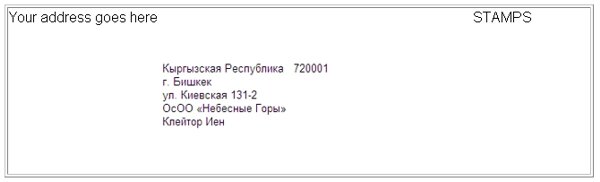
Layout for the address on an envelope
Some addresses may seem surprising. For example.:
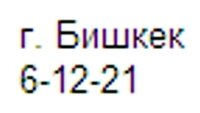
Yes, it is an address!
… which means :
Bishkek,
Sixth Microdistrict,
House No. 12,
Apartment 21.
If you are sending letters or postcards home then the first line of the address should be the name of the destination country written in Cyrillic. The rest can be in English, French, German, Latin, Japanese … or whatever.
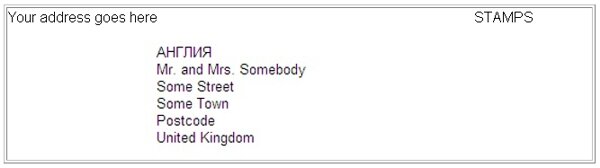
Addressing an envelope abroad
Here is a list of some Country names in Cyrillic:
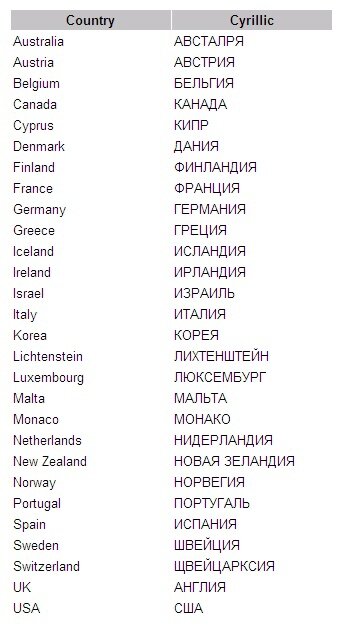
A selection of country names in Cyrillic
Mail can be sent under the normal mode, or recorded deliver (zakasnoy – where the recipient has to sign to acknowledge delivery), or insured.
Parcels have to be specially packed – the post office staff will do it for you for a small fee. You have to fill in a customs form and there is a charge for insurance based on the declared value. They can be sent by ordinary post – or by airmail … before deciding on the cheapest option, it’s a good idea to ask how long it will take for the parcels to arrive … but don’t rely on the answer being accurate.
The Post Office also operates an Express Post Service (EPS), which is similar in cost and service to a courier service – several of which are available, at least here in Bishkek and some shipping companies for transporting bulky or heavy items.
As in the West, the post office actually offers many additional services … many people, for example, pay their utility bills at the post office, collect their pensions, the postal carrier accepts subscriptions and delivers newspapers and journal, and it is possible to order air, rail and bus tickets as well as theater tickets, Some Post offices have facilities for internet access. The Post Office claims to offer some 55 different services is also looking at introducing financial and other services. Postage stamps are produced by a separate company, (and, for the record, I wrote a postcard a couple of years ago about Kyrgyz stamps).




 Bishkek