Flora
Today, April 13th, is another one of those special nominated days: Plant Appreciation Day – or PAD, for short.

I have absolutely no idea who originally conceived of the idea for this day … but it is supposed to be an occasion when we can appreciate just how important plants are to us.
Let’s face it, few of us ever stop to think just how vital plants are to our survival. Without them, we wouldn’t be here. Plants change the Carbon dioxide in the air into oxygen: so, no plants – no oxygen. That’s not to mention their value in providing us with food, medicines, fibres (for example, our clothing), fuel, building materials, paper, chemicals, dyes and many other products.
As one website puts it: “Imagine a world with no toilet paper”.
They also make an important contribution to our quality of life, even if only for their decorative value, but also, most of us have a plant (or many plants) that we look after. Some people even talk to their plants – Prince Charles took a lot of ribbing when it became known that he was in the habit doing this. Of course, talking to plants may be just as much about our personal psychological health well being as it is to the well being of the plants, (but there is some scientific evidence to suggest that plants do actually communicate – by releasing chemicals signals.)
So, it seemed to me that today would be an ideal day to take a brief look at the wide variety of flora here in Kyrgyzstan.
Let me be frank about this, I am not a botanist, so I may be a bit out of my depth, but I hope that I will fare better than the tour guide who when asked “What’s this little flower?”, apparently replied, “It’s a yellow flower.” I know that this is almost certainly a mythical story, but I had to admit that there have been lots of occasions when I have been asked that same question and hav had to reply, “Sorry, I don’t know.”
One of the reasons for this is simply my ignorance, but in addition:
- a plant may be known by different, local, names wherever it is found – even in one location/country it may be known by several names;
- in some cases – especially for plants which grow in foreign climes, there is no English name … in some cases of the plants listed in the literature here I can find the common Russian and Kyrgyz names – but often there is no English equivalent;
- the same “common” name can be given to several different plants – a commonly cited example is the bluebell … which in England is used for a woodland bulb of the hyacinth family, whereas in neighbouring Scotland it refers to a delicate flower which grows in dry open ground; and
- some common names came be misleading – an example that is often quoted is the plant known in English as “Spanish Moss” – which is not native to Spain, and is not a moss.
One way round this is to use their their Latin, or scientific, names. The system for designating these names is based on the work of the Swedish botanist, Carolus Linnaeus, (who lived between 1707 and 1779) formalised the system of naming plants which is widely used, based on Latin. He drew on the work of ancient scholars such as Pliny the Elder who wrote descriptions of plants in the first century AD.
Under this system, every plant has a name which is divided into three parts. Consider an example: Tulipa anadroma Z.Botsch. This contains:
-
A genus name (e.g. Tulipa) – similar to a surname
-
A species name (e.g. anadroma) – similar to a given name
These two should uniquely identify the plant. In addition, the complete complete name would also include:
-
The name, or an abbreviation of the name, of the person who first published a description of the plant, (in our example: Z.Botsch). In some cases the abbreciation is a single letter … L. for example refers to the ancient scholar Linneaus.
Another feature of scientific names expressed in Latin, is that they often describe some features of the plant – and to those who understand the system and use it frequently the names can be helpful when encountering a plant for the first time.
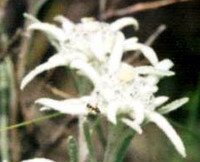
Edelweiss
The wide variety of flora which can be found in Kyrgyzstan is due to the different landscapes: the soils, altitudes, mountain ridges and the hollows formed between them, which in many cases form isolated micro-environments.
In the low-lying valleys and in the low foothills, steppes prevail. In the middle mountainous zone are widely spread meadows, forests, and shrubs, whilst in the high mountainous zones alpine meadows, “kriofill”-cushion areas and mountain tundra can be found. “Thorny-cushion” vegetation covers the stone-detritus mountain areas.
About 4000 species of plants have been catalogued in Kyrgyzstan.
The most widely spread trees are spruce, juniper (archa), and forests of nut (especially walnut) and fruit (apple, pear, cherry-plum, cherry, currant, and raspberry canes). There are also maple, poplar-willow, and birch forests and Tien-Shan rowan-trees grow almost everywhere. The walnut forests in the South-East of Kyrgyzstan in the Ferghana and Chatkal ranges at altitudes between 1000 and 2200 meters a.s.l. – featuring walnut-trees occupy an area of over 600,000 hectares, (the largest walnut forests in the world).
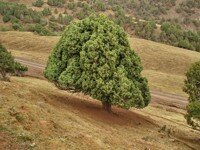
Archa
The forests in the south of the country are currently facing serious problems of deforestation. As well as trees being cut down to provide valuable wood both for export and domestic use (for building, and firewood), areas of woodland are being turned into arable land by farmers looking for additional land resources. Livestock often trample underfoot young plants. Also, pests such as the Gypsy Moth are taking their toll on denuding the forested areas. Kyrgyzstan has reduced, or eliminated the use of chemical agents in line with treaties that it has signed, and the sheer economic cost of such measures. Steps such as the introduction of new species of insects to help control pests are being introduced. Disease also takes a toll on the number of trees. There are also a number of international projects aimed at preserving and expanding the forest resources within the country.
Shrub thickets such as “karaghun”, cherry, rosary, pistachio, almond, cherry-plum, sea-buckthorn, barberry, willow are widely spread throughout the countryside. Sea-buckthorn, dog-rose, and willow grow in the flood-lands of several rivers.
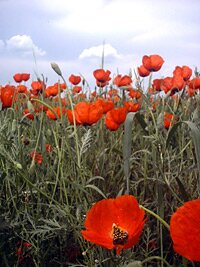
Poppies
In alpine meadows (at an altitude of 3000 meters a.s.l.) edelweiss, dandelion, Alpine Aster, Semyenov onion and primroses grow. Edelweiss is not as rare as it is in Europe – and dandelions are not thought of as weeds in the same way as they are in the West. At certain times of the year the mountain sides may be covered with poppies or tulips. About 5 km south of the Djety Oguz sanatoria, is Dolina Svetov (Valley of the flowers) a valley opens out which is ablaze with colour from May – when there are multitudes of poppies – throughout early summer.
In the forests, steppes, and meadows it is possible to find many different species of fungi. “Mushroom gathering” used to be a very common activity.
A large number of the plant species to be found in Kyrgyzstan are endangered and listed in the Red Data Book of endangered species. This was first published in 1997 and listed 65 plant species that were considered to be at risk, or endangered. These were also included in the 1985 version of the list, but when it was revised some twenty years later, in 2005, although fourteen species were removed for one reason or another, and additional forty four species were added, (mainly mushrooms and other fungi). When a new version of the list was issued in 2009, another twelve species were removed from the list, but four more were added.
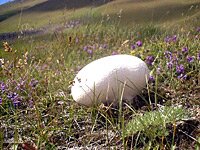
Fungi
There are various schemes which aim to help preserve species of endangered plants operated by Botanical Gardens around the world, including the Botanical Gardens here in Bishkek. For example, in Britain, Kew Gardens maintains a stock of seeds from such plants and members of the Royal Horticultural Society can obtain seeds so that they can grow the plants at home and thus help to preserve the species. Seeds of some of the endangered species are available as part of this scheme.
In a way, it’s important to maintain the diversity of the plant world here in Kyrgyzstan because many of the plants which are known throughout the world actually originated in Central Asia: from the apple to rhubarb and the tulip. The preservation of the stock could well be important for maintaining the genetic pool of the plant kingdom in years to come.





 Bishkek