A bet on Kochkor
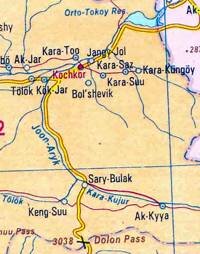
Kochkor
I’ve been up to Naryn for the weekend. I wish it had been for a few days off, but it was work connected with our guesthouse there. I go up nearly every month just to keep an eye on things, do the accounts and so forth. This time I had to take with me some materials as we are redecorating some of the rooms during the “low season”, whilst there are few guests to disturb.
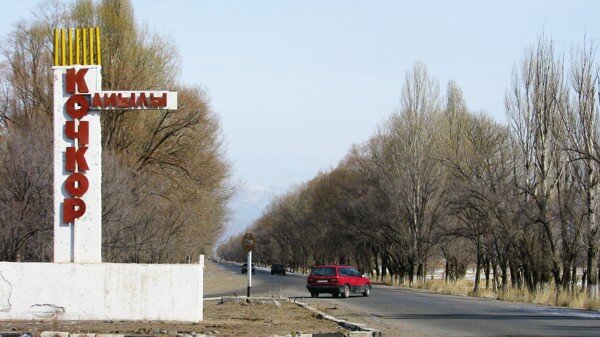
On the way we passed through the market town of Kochkor.
Despite the claimes that zima ne budet, (there’s be no winter), the temperatures have been bitterly cold and we have had a lot of snow here in Bishkek this year. There was still some lying on the ground as we set off early on Saturday morning. I wasn’t expecting, however, to see any snow in Kochkor. You see, even if it snows in Kochkor, it hardly ever settles.
Now, a lot of tourists to Kyrgyzstan know Kochkor. Most people used to simply pass through Kochkor (or Kochkorka, as it used to be known in Russian), on their way to, or from, Torugart and the Chinese border. Nowadays, however, more people are stopping and spending some time in the region.
One reason for this is probably the development of the “Shepherd’s Life” project – a local initiative inspired by the Swiss development program “Helvetas”. A network of shepherd’s families offers home-stays and can organize transport, and other services (horse riding, trekking, guides, talks and demonstrations of local crafts, concerts of traditional Kyrgyz music …) in the region.
Home-stays and Farm-stays are popular all over the world – and for those who are willing to spend the time getting acquainted with the host families and their way of life – it can be a most rewarding experience (as well as offering the shepherds and farmers a way to supplement their income). The program has been very successful: it has been featured in travel books, and has adopted as a model, not just to other parts of the Naryn region – but also in other parts of Kyrgyzstan – it was the forerunner of the CBT, (Community Based Tourism), project – as well being used as a model in other Central Asian countries. (At one point the village actually boasted four such groups).
The region is actually quite well suited for tourists. It has a mild climate, (snow, for example, rarely ever settles in Kochkor – even when the surrounding mountains are covered in it), and the village is a good place for “soaking up the atmosphere”, for example: by walking along the main street that runs through the town; spending some time in the main square; perhaps visiting the market and visiting the cemetery with it’s eclectic collection of memorials – a visit to the Regional Museum could prove interesting. (There are said to be over 5000 exhibits in its nine rooms. A fine yurt is on display, along with a collection of traditional Kyrgyz crafts and exhibits about local ‘soviet heroes’.) In the club of the Son Kul sovhoz , (collective farm), there is a mosaic by the famous artist Theodore Hertzen.
For those that have the time and are interested, there are a couple of enterprises here which manufacture and sell traditional Kyrgyz crafts – and are likely to be cheaper than in Bishkek shops. (One shouldn’t be surprised to see shyrdaks hanging out over the fence – or lying in the road … it is possible the shyrdaks are for sale … but it more likely to be a family ‘spring cleaning’).
There is lots to see and do in the surrounding area as well; because of its position on the main road from Bishkek/Issyk Kul to Naryn (and hence onto China) and from Issyk Kul to Osh and the South, Kochkor offers a fine base from which to make trips into the surrounding countryside.
Traveling from Bishkek/Issyk Kul the road pass the Orto Tokoi reservoir. It was the first reservoir built in Kyrgyzstan, in 1956. The water level fluctuates considerably throughout the year, but the turquoise colour can be quite striking – and in winter, when it is frozen over it has a mystical, desolateness. Incidentally, the reservoir is on the same River Chu that flows down to Bishkek via Boom Gorge … although one might get the impression that it must flow via Issyk Kul – it doesn’t … it swings around the end of the Kyrgyz Ala-Too range.
There are two roads to Suusamyr from Kochkor. The Southern route passes through a number of villages – the largest is Chaek. A detour off this road to Min Kush is possible. The Northern route follows a river gorge – but is virtually deserted as no one lives there. The road conditions can be very poor.
Just off this road, to the North of Kochkor, there used to be a road over the Kyrgyz Ala-Too mountain range to the Kegety Gorge, and down to the Chui valley. It is featured in one travel book as a spectacular route for mountain biking – but it is not possible to travel along it by car now, not even in an off-road 4WD vehicle (we’ve tried it! – but some time ago, not on this trip), because of landslips and avalanches and, in fact, it is closed by snow until well into the summer.
Although tourism has become important in the local economy, the land between the mountain ridges is ideal for agriculture and that is the mainstay for most of the population. In Soviet times there were several large collective farms in the valley and Kochkor was well known for its crops – especially potatoes, which are still sought after. The main activity, however, is the rearing of sheep, (as it is throughout the whole of the country). There are several mountain pastures (Jailoo) in the region where it is possible to trek, ride horses, and stay overnight in a yurt with a shepherd’s family.
From Kochkor, for example, it is possible to visit Son Kul; either by driving up towards Naryn as far as Sary Bulak and then turning off … or by taking the Suusamyr road and turning off to Kara Keche before Chaek.
As well as sheep, there are lots of horses. The Kyrgyz pride themselves on their horsemanship … it is often said that Kyrgyz boys learn to ride before they can walk. The horses are valuable animals – and provide the Kyrgyz with meat and Kumys as well as a mode of transport. However, any animal that is going to be slaughtered for meat will never be ridden – as it affects the quality of the meat.
About 25 km from Kochkor is the Chong Tuz complex. There is a mountain of rock salt and in Soviet times a mine was established to extract the mineral. The mine still works and salt is produced not just for use in Kyrgyzstan – but is also exported. You won’t find it on the table, however, as the rock salt is usually given to farm animals as a food supplement. Also, during the Soviet period many people would come here for treatment for Asthma and allergies. Apparently, spending time in the atmosphere inside the salt mine is thought to be very beneficial. A course of treatment involves staying in the mine for 10 hours a day for 16 days. In recent years a development program has been underway to turn the mine into a health resort including providing accommodation and facilities. Tourists – assuming that it isn’t full of patients at the time, can also use the center. They have their own jailoo, about a three hours trek away, above the center.
The presence of the salt in the are is often quoted as the reason why snow does not settle in the area. The theory is that the salt lowers the freezing point of water so that even when the temperature is well below zero, it still melts on contact with the ground. Personally, I find that hard to credit, but it is the way that it was explained to me.
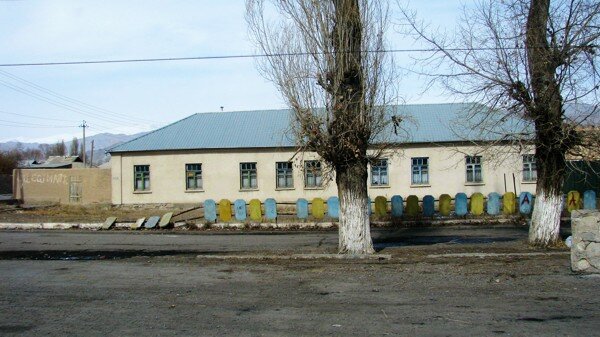
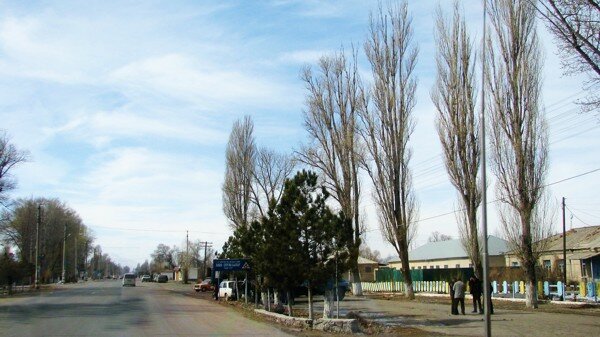
The town is actually the conurbation of two villages. One guide book calls if a “sleepy little Kyrgyz village” – although it is a little hard to imagine it a “sleepy” when you consider the number of people in the main square almost every day. Another travel writer was reminded of “the paintings in Bishkek’s Fine Arts Museum of traditional Kyrgyz life enhanced by enlightened Soviet settlement policies.” This probably something to do with things like the metal cutouts on the lampposts along the length of the main street – a hammer and sickle; a rocket blasting into space and an atom representing science; a cog wheel representing industry and technology; corn representing the agriculture of the region … and so on. There are also the painted wooden fences with slats of wood held together by an elongated diamond shape – typical of villages everywhere in the former Soviet Union.
Actually, the history of Kochkor does represent this in some ways. It is supposed to be the site of the first settlement in the valley. There are some ancient barrows to the to South – between the villages of Kara Suu and Bolshevik. Situated on the main road from Balykchi to Naryn, at a point where the road to Suusamyr, (and on to Osh), forks off from the main road to China from Issyk-Kul and the Chui valley, it marked a natural stopping point for a camp for nomads and travelers. A mosque and an inn (Chaihana) were established. As such it has always attracted a wide variety of nationalities. As well as the Kyrgyz – Uzbeks, Uighurs, Dungans and later Russian and German settlers were attracted to the plain. (Since independence – many of the other nationalities have, in fact, moved out.)
In 1909 the village was named Stolypin, after the Russian Prime Minister who was a major advocate and proponent of Russian expansion into, and the settlement (colonization?) of Central Asia. Stolypin and the Bolsheviks, under Lenin, were violently opposed to each other’s ideas and after the revolution, in 1917, the town was renamed Kochkorka – and as with many towns which have been renamed since independence – the Kyrgyz version of the name Kochkor was adopted.
As is often the case, there are a number of legends associated with how the village of Kochkor got its name.
One legend tells of an old widow, who was very poor, who sent a sheep to market. She couldn’t go herself – so she entrusted it to a couple of her friends. The sheep was already very skinny and looked very sickly and the friends did not look after it very well on the journey. As a result, when they arrived at the market, no-one wanted to buy the animal. There was an organized “sheep-fight” and the men decided to enter the animal. Because it was thin it was able to fun around a lot more than its rivals around which it literally rang rings … until the opponent dropped from fatigue. Having done so well, it was entered for another, bout … and another. As well as earning a lot of prize money – and from bets, it became famous and the village was named in it’s honour – Kochkor.
Perhaps the most romantic, however, tells of a poor, well educated, young man – a traveler. On one of his journeys he stopped at the camp of the local Khan. The Khan had a daughter who was very beautiful – and many of the local princes had already tried to woo her – all of them unsuccessfully. In short, the traveler met her and fell in love – asking the father to allow her to marry him. Although the Khan laughed at the poor traveler, he was not amused and decided to teach him a lesson. He decided to set the would be son-in-law an impossible task. He offered the young man a chance to breed camels for 10 years (!) and if in that time his stock increased by a hundredfold, then he could marry the princess. The young man was so in love with the girl that he set about his task. The first winter was unusually harsh. One day there was an eclipse of the sun and a chill fell across the face of the earth and a storm blew in. The wind was so strong that the man could not even open his eyes. Exhausted, using the last of his strength, the young man cried allowed “Kach kar, Kach kar!” (which roughly translates as “Go away snow, Go away snow!”) Nature heard his cry and took pity on him – the storm abated, the wind died down and the snow stopped falling. From that day, so the legend has it – it rarely ever snows in Kochkor.
Once, that fact actually won me a bottle of Cognac. As we were approaching Kochkor on one of my monthly visits, the fields on either side of the road were lying deep in snow and my driver was taking great pleasure in explaining to me that we wouldn’t see any snow in Kochkor. “You’ll never see snow in Kochkor!”, he proclaimed. Feeling a little mischievous, I asked if he would like to bet on, (say a bottle of Cognac), that and he took up the challenge. As we drove through the village he proudly pointed left and right at the streets free of the white stuff and asked me when I would present him with his bottle. I pointed out that the bet was that I would “never” see snow in Kochkor, and it was true that on this visit there was no snow … but this was just one visit – and was not “never” … but, I pointed out, “never is a long time”, I told him. In fact, I couldn’t loose the bet, because all I had to was sit it out and wait … but I could win if I ever did see snow on the streets of Kochkor. He wasn’t exactly happy, calling me heetriy, (crafty), but accepted the logic … and we forgot about it. For a while, anyway; until a few years later when we did actually see snow in the village. As we drove through the market square I pointed out of the window and asked “What’s that white stuff on the ground over there?” He understand straight away and when we got to Naryn, he went out and bought me my Cognac.
Incidentally, the young man was successful: he prospered and his herd of camels increased by the required amount and so he eventually married his princess and together they had a son who became a great warrior.
On this occasion, I am not sure that I would have one my bet or not. On the way up to Naryn, as we approached Kochkor the signs were not good. Although the Orto Tokoi reservior was frozen over, there was only a little snow to be seen and I felt that, on the basis of previous experience, there was unlikely to be any in Kochkor itself. It was quite mild; the sun was shining and the temperatures not particularly low.
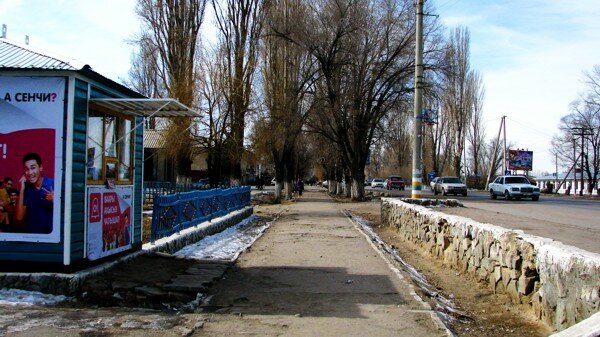
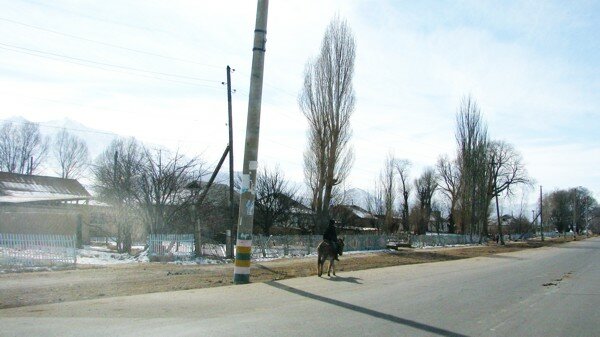
When we go to the town, however, there was a little snow to be seen, which suggested that a few days earlier I would definitely have won.
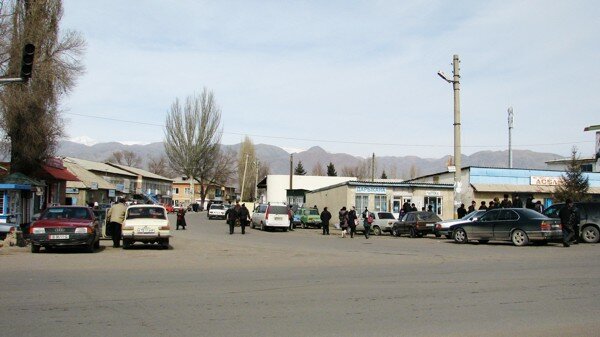
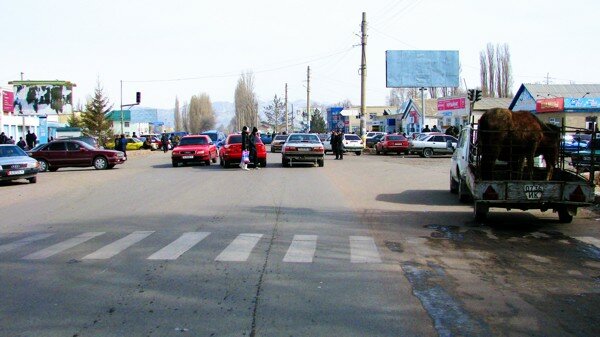
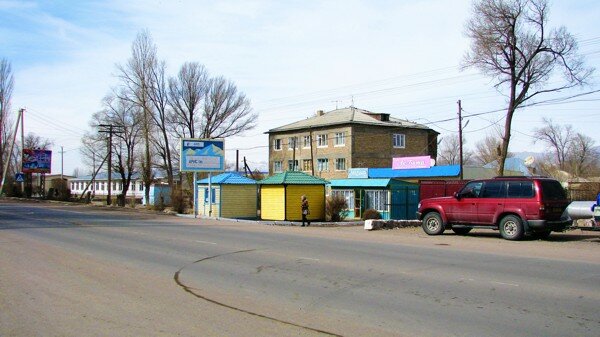
The market square was crowded as usual, but once you left that behind, the road was remarkably clear of any traffic.
As we carried on up to Naryn, the river was frozen over in places. Where the running water had created a gap, there was still ice stretchin out from the river banks over a meter above the rushing diver water that coarsed its way down the valley, leaving incredible images of coloured strata.
Up to and over the Dolon pass we hit the snow which, although not particularly deep, looked as if it might hang around for sometime yet. Naryn was cold: minus 12 when we arrived in mid afternoon but falling into the 20′s overnight. In the morning, it was still minus 22.
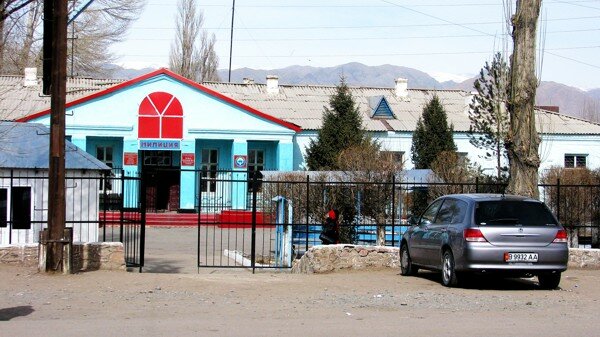
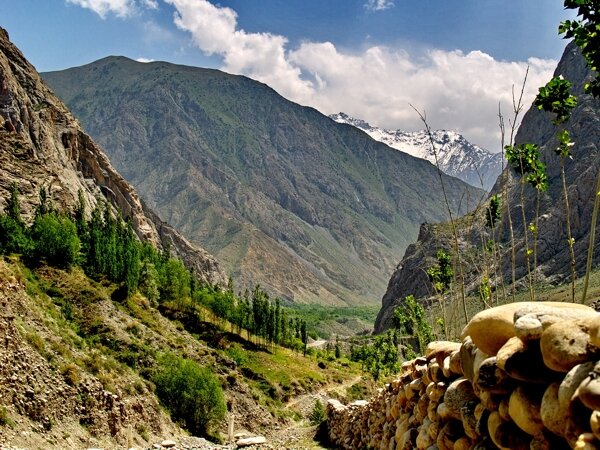
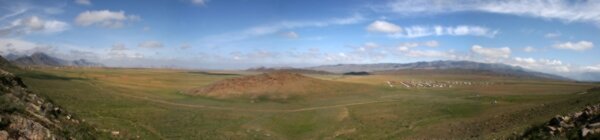
Maxim had come with us and took some photos – a lot of photos, but here is just a selection:












 Bishkek