Go East young man!
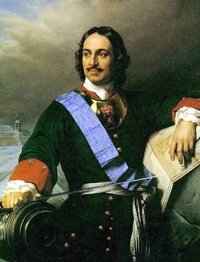
Peter the Great
Looking at the history of Russia, it is easy to think that since the reign of Peter I, (Peter the Great, 1672-1725), Russian interest laid mainly in the direction of Europe. Impressed by the culture and civilization of Europe and comparing it to what he saw as the backwardness of his native land, he set about a process of reforms, even moving the capital from Moscow to St. Petersburg. Despite this, in Britain there was for a long time a commonly held suspicion, fermented by rumour, that he left a secret “Last Will and Testament”, which ultimately involved frustrating Britain’s interests in India and elsewhere.
Russians had, in fact, long been involved to both the East, in Siberia, and the South, towards Central Asia. Ever since the invasion of the Mongols and the “Golden Horde”, Russians kept a wary eye on their Eastern borders. Some commentators even suggest that their experience under the Golden Horde helps to explain much of Russia’s foreign policy ever since … especially the desire to create stable and secure borders with “client states” providing a buffer zone to protect the territory of the “mother country”.
The Novgordians, (a Russian Republic to the East of Moscow), had ventured into the nearer reaches of Siberia since as early as the 11th Century. In the sixteenth century groups of Cossacks advanced into Siberia, only to leave after their leader drowned in a river, but expansion to the East continued led mainly by bands of hunters and adventurers. To avoid the populated areas where they might encounter resistance, they travelled further North and Moscow established forts in their wake. In the space of just eighty years, Russian suzerainty had stretched all the way to the Pacific Ocean.
The first Russian traders and soldiers began to appear on the northwestern edge of what is now Kazakhstan in the early 17th century, when Cossacks established the forts that later became the cities of Oral and Atyrau (Gur’yev). The Russian imperial authorities followed and were able to establish their authority over stretches Kazakh territory because the local khanates were preoccupied by a war with Kalmyks (the Oirats and Dzungars).
Whenever a new group was assimilated in the Empire, it was seen in St. Petersburg as a case of the local population “accepting” Russian “protection”. Generally the Russians allowed the local culture and authority to continue as before, but they established new towns with imported Russian architecture, tree lined streets and rectangular street layouts with trees and open spaces (as in the case of Bishkek). They brought with them social and cultural facilities, education and religion, (Christianity spread into the predominantly Muslim region together with Russian colonists. The Russian Orthodox Church established a Central Asian bishopric in 1871 with its bishop first residing in Verney and after 1916 in Tashkent). When, later on, some of the locals decided to rebel, they would be stripped of their autonomy and direct rule established.
In a world where colonization seemed to be “the norm”, the United States were expanding and absorbing territories in the Central and Western parts of their continent, and with a suspicious eye on Britain’s expansion in the Middle East and the Indian sub-continent, they began to turn their attention to their Southern borders – and beyond. Coupled with a rash boldness among the officers, there was almost an irresistible impulse to push the borders further and further to the South.
By the turn of the nineteenth century, the situation to their South, (towards Central Asia – and Kyrgyzstan), the Russians saw an anarchic collection of unstable states – living in a state of isolation (Bukhara practically denying the existence of anything beyond their boundaries) and constantly fighting amongst each other and anyone who dared to enter their loosely defined territory.
One by one the different khanates fell to the encroaching forces. Khiva, Bukhara, Kokand. In the 1850s, the Russian army increased their activities in the Southern regions. The construction of Russian forts began in southern Kazakhstan including Fort Shevchenko (Fort Alexandrovsky), Kyzylorda (Fort Petrovsky), Kazaly (Kazalinsk) and Almaty (Verney). In 1863, the Russian Empire created a number of new administrative districts in Central Asia, including the Governor-Generalship of Russian Turkestan (which consisted of the oasis region to the South of the Kazakh steppes and Zhetysu (Semirechye) region). Verney was to provide military support for the capture of the Kokand fort of Pishpek in the 1860′s – Kokand fell in 1876. The last to fall were the Tekke, (Turkmen) in 1874.
In just over twenty years they had assimilated a vast stretch of land, half the size of the USA.
It wasn’t, however, just a case of military conquest. There were explorers such as Semyenov and Prezhervalsk, Chokan Valikhanov, (a Kazakh serving as an officer in the Tsarist military who made several expeditions into Kyrgyzstan and wrote extensively about the people, customs and traditions, political and economic developments in the region), who did much to open the country and bring back information and scientific specimens.
As well as the soldiers, such as the Cossacks who built garrison towns such as Karakol, there were also many settlers … mainly peasant farmers who were encouraged to settle in the new lands This was to provide new tensions and problems, once again drawing parallels with the history of the “How The West Was Won”.
.
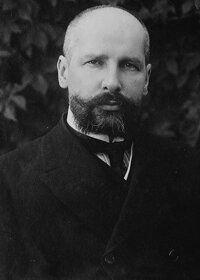
Pyotr Stolupin
In the 1890s, many non-Cossack Russian settlers migrated into the fertile lands of northern and eastern Kazakhstan. In 1906 the Trans-Aral Railway between Orenburg and Tashkent was completed, further facilitating Russian and Ukrainian migration to Central Asia. B etween 1906 and 1912, more than half a million Russian farms were started in Kazakhstan alone as part of the reforms of Pyotr Stolypin, who was Prime Minster under Tsar Nicholas II from 1906 until 1912. (By 1917 there were close to a million Russians in Kazakhstan, about 30 % of the total population.)
The village of Kochkor in the Naryn oblast of Kyrgyzstan was named in Stolypin’s honour … only to be renamed when the Bolsheviks came to power after the October Revolution in 1917.
Arstanbek Bunlash uluu was a Kyrgyz akyn who was concerned about the influence of the Russian colonists of his day upon his native people and their culture. He composed poems about the “dark times” that were coming and the need for the Kyrgyz to preserve their traditions and their lifestyle.
The rural areas of Central Russia were overcrowded, while the East was still lightly populated despite having fertile lands. In, 1906 the Tsar issued a decree giving peasant farmers the right to transfer, (without any restrictions), to the Asian territories of the empire, and to obtain land cheap, or free. A large advertising campaign was conducted: six million copies of brochures and banners entitled “What the resettlement gives to peasants, and How the peasants in Siberia live” were printed and distributed in rural areas. Special propaganda trains were sent throughout the countryside, and trains were provided to transport migrants. The state also gave loans to the settlers for farm construction.
It was a mixed success, however as not all the settlers decided to stay; 17.8% migrated back. All in all, more than three million people officially resettled in Siberia and between 1897 and 1914 the Siberian population increased 73%, and the area of land under cultivation doubled.
.
Stolypin was a reforming Prime Minister. His aim at developing the lands to the East of Russia one of his reform policies aimed at attempting to limit the rise of extreme radicalism in the empire. Other elements of reforms included: the development of large-scale individual farming (khutors); the introduction of agricultural cooperatives; the development of agricultural education; the dissemination of new methods of land improvement and introducing affordable lines of credit for peasants.
Although he had been warned of plots by radicals against him in September 1911, Stolypin travelled to Kiev and on September 14th he attended a performance in the Opera House. He refused to take any form of special protection. The Tsar and two of his daughters were also present. During the performance he was shot twice, (once in the arm and once in the chest), by a radical who also happened to be an agent working for the secret police. Stolypin is reported to have coolly risen from his chair, removed his gloves and unbuttoned his jacket, (exposing a blood-soaked waistcoat) before sinking into his chair and shouting, ‘I am happy to die for the Tsar’, then motioning to the Tsar in his imperial box to withdraw to safety. The Tsar, however, remained in his position and in one last theatrical gesture Stolypin blessed him with a sign of the cross. The next morning the distressed Tsar is supposed to have knelt at Stolypin’s hospital bedside and repeated the words ‘Forgive me’. Stolypin died four days later, on September 18th. Bogrov, his assassin, was hanged a few days later, the judicial investigation having been halted on orders of than the Tsar himself.
The “double identity” of his assailant, coupled with the suggestions of the Tsar’s role in subsequent events, has led to some doubt as to whether the assassination was the work of radicals or part of a plot by conservatives who were concerned about the effects of his policies. Anyway, the radicals took the blame.
As a measure of his importance, in 2008 a television poll was conducted in Russia to find the Greatest Russian of all time. Stolypin came in second place, behind Alexander Nevsky, with Josef Stalin in third.
.





 Bishkek