Dord

The definition of Dord
We all make mistakes … and I admit to several in my postcards.
When some eagle eyed person spots a mistake and writes to tell me, I don’t edit the postcard, but add the fact in the comments section below. Usually the mistake is just a typographical error, I have hit the wrong key and my spell checker, (they are not perfect), didn’t signal the fact. Although I am British, and tend to use British spelling, my spell checker is American and often flags words which are correct in English-English but wrong in American-English, (for example: programme or favour), and I am used to overlooking these.
Last Saturday, however, the weekly postcard where I review the week’s news was supposed to be called Personality cults but, because I was going up to Naryn, I was in a hurry mistyped the title … and the email went out with the title Personaly cults. Oddly enough, no-one seems to have spotted this particular mistake … or, at least, no-one has written in to take me to task for it … yet.
Today happens to be the anniversary of the discovery of one of the most well known examples of a typographical error: Dord, which was listed in the 1934 edition of the New International Dictionary, which was published by Merriam-Websters . It wasn’t until 1939 that an eagle eyed editor noticed that the entry didn’t have any supporting citations; a history of the word’s etymology or examples of its usage. An investigation launched and it was discovered that the index card, or slip, which read “D or d, cont./density.” The layout was ambiguous and was taken to be an entry for the four letter word Dord, whereas it was really mean as an annotation to show that the letter “d”, (either as a capital or lower case letter), could be an abbreviation for Density. Once the error had been discovered, although no official announcement was made, arrangements were made for the error to be excised from future printings of the dictionary.
Now, compiling a dictionary is quite a complex business … far more complex than might be imagined. I was fascinated a few years ago to read a history of the first Oxford English Dictionary with an account of how a small house in Summertown, Oxford, was turned over to the project and how the Oxford University Press almost despaired that it would ever get published. Having read it, I am more surprised that, in fact, there aren’t far more mistakes.
At least it was an honest mistake – not something mischievous as in the television comedy series, Blackadder, the erstwhile Dr Johnson arrives at the palace, having completed his life’s work. His dictionary contains every single known word in the English language except the rather dubious ones uttered by Blackadder …
http://www.youtube.com/watch?v=hOSYiT2iG08
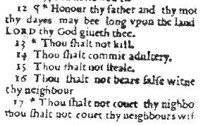
Exodus 20:14 from the Wicked Bible
Perhaps the most infamous example of a typographical error is the Wicked Bible, published by Robert Baker and Martin Lucas in 1631.
It’s called the Wicked Bible, because it omitted one word out of the Ten Commandments – yes, it was the word “not” and it was the seventh commandment … yes, the one about adultery. It cost the two publishers dearly … a fine of three hundred pounds, (which was no small sum in those days), the loss of their license and a place in infamy.
All the copies of the notorious publication were supposed to be collected and burned, but a few managed to escape this fate and are extremely valuable as collectors items – apparently one being offered for sale in 2010 for the princely sum of almost ninety thousand dollars.
I don’t expect my typographical errors to become so famous or valuable … but I will definitely resist the temptation to see if I can emulate them …





 Bishkek