Horses in Kyrgyz nomadic culture
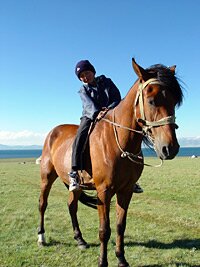
Kyrgyz boys are said to learn to ride before they can walk
“Horses are a man’s wings”
“If you are given only one day’s life, spend half of it in the saddle”
“Only a horse and an agreeable conversation can shorten a long journey”
Domestication of the horse made a huge difference to the development of mankind – as they provided a means of transportation enabling fast large scale movements of peoples over great distances and a source of power. It is thought that there were many centers of domestication on the Eurasian steppes – although recent ‘Soviet’ research suggests that it first occurred in the Ukraine around 4000 BC – and that the culture of the horse then spread Eastwards.
The horse occupies a major role in many traditional cultures. They have a special place in the traditional lifestyle and culture of the Kyrgyz people as a symbol of wealth and for their practical use to a nomadic people. They are valued for their physical strength, their endurance and their stamina. Whilst the number of sheep herds exceeded that of other domesticated animals, it was the number of horses which it owned that determined the status of a household.
Famous Central Asian breeds include the Akhal Teke of Turkmenistan, (the forerunner of the modern Arabian steed) which could cross desserts, the Prezhevalsk (or Wild Asiatic Horse – the world’s last remaining species of Wild horse) and the Kyrgyz pony, which could cross over stony ground without metal hooves and the mares of the Ferghana valley famous for their speed.
At Aravan, near Osh in the South of Kyrgyzstan, ancient petroglyphs have been found representing the “Celestial Horses”. On a couple of rocks the drawings have remarkably small heads; long, graceful swan like necks; lean bodies and long, tapering legs. The Ferghana valley was the home of the famous “Dragon Horses” which were the subject of many legends across Asia and India for the size, speed and endurance. It was thought that there were descended from dragons and divine steeds, hence the name. The earliest Chinese expeditions to the area, (in the second century BC), came looking for both allies and horses. Chang Ch’ien was the commander of the guards of the imperial palace gates and volunteered to lead an expedition of 100 men to form an alliance with the Yueh-chih against the Xiongnu, (a Turkic speaking nomadic tribe which, at the height of it power, dominated an area that extended all the way from Eastern Mongolia to the Aral Sea). After a trip lasting thirteen years he returned, with a solitary survivor from the 100 men that had originally left with him. He is often regarded as the founder of the Silk Road. The new emperor We-ti sent him back (this time with three hundred warriors), and after a lifetime of travel and danger his health gave out and he died after his return from his second trip. Wu-ti then sent another, far larger, expedition which after a four year campaign returned with some 3000 of the Celestial Horses.
These horses were famous for “sweating blood” – something noted by Silk Road travellers right up until the 19th and 20th centuries. The reason for this phenomenon remained a secret right up until the twentieth century when it was discovered that it was due to parasite infections. The parasite burrowed under the skin in the region of the shoulder and back and produced little swellings which burst and bled. Not only were these horses highly prized by the Chinese army and served in many campaigns, (and later by the nomadic tribes which inhabited the region, they were traded for silk – much of which found its way to Europe – and served as models for sculptures across China.
The troops of Genghis’ Khan were able to conquer vast tracks of land, from Austria in the West to the Sea of Japan in the East, and from Siberia in the North to the Arabian Gulf in the South. They “conquered and ruled from the saddle”. Genghis Khan’s first demand when he entered Bukhara in 1220 was for fodder for the horses.
For centuries horses and sheep formed the currency of exchange – used to buy goods, a wife or a weapon.
Kyrgyz horses tend to be small, hardy animals, able to travel over bare rocks and up steep slopes. They are ideal for travelling over the mountainous countryside and enduring the extreme climatic conditions. Their endurance was noticed during the Russian expedition to Khiva when fewer Kyrgyz horses died than other breeds. In fact the Kyrgyz highly prize sturdy animals and would “test” their horses by not feeding them for several days, leaving the saddles on and not feeding them until they showed signs of exhaustion.
Kyrgyz horses tend to be light brown in colour with black manes – but there are also grey, black and red horses. Horses are often named according to their colour.
Horses were classified into three main types – fast riding horses; slower riding horses and pack animals. Fast horses, “gallopers” were relatively rare, highly valued and received special training. Riding horses would be hobbled and kept close to home, but others would have been kept in herds – with several owners co-operating together.
A herd would consist of between 15 and 30 horses, one dominant stallion with about 15 mares and a number of younger animals. Stallions would protect their mares but if they were over zealous a wooden hammer might be tied into the main that knocked the neck if it moved too rapidly – hence slowing it down and making it more docile, less violent.
From ancient times, Chinese records reveal that horses were used as compensation for serious injuries and that the death penalty was imposed for stealing a hobbled horse. Archeological finds show that horses featured in religious cults and were often chosen as sacrificial animals. Horses were often buried with their owners – and apparently this custom survived from the 4th century right up to the end of the 19th Century. The warrior, inseparable from his horse in life, could not imagine life after death without his trusty steed. In the Manas epic the death of the warhorse was mourned as much as the death of a hero – and as he approaches his own death, Manas mourns his fallen “brothers in arms and war-horses”.
Horses featured in many Kyrgyz rituals associated with birth, upbringing, marriage and death. For a long time – even upto the twentieth century – many of the Kyrgyz continued to practice shamanism, calling on the spirits of nature for help and support. Amongst these spirits was the horse spirit: Kambar Ata. A horse with big pale eyes was thought to assist with an easy birth and so would be brought to a woman giving birth. Children were given the name of a horse as a nickname because it was thought that evil spirits were afraid of horses. The bridegroom when riding to meet his bride would dismount and send on the horse in front of him to announce his arrival – and was later given to the sister or closest female relative of the fiancé – an important act of trust and friendship because no-one sold their saddle horses. (It was considered a sign of subservience to offer a horse as a gift.) It was considered rude to arrive at a trot or a gallop – which was usually reserved as a sign of those bringing bad news.
Horse races and games were common features of major festivals, “tois”, weddings, funerals. Nowadays, however, the emphasis is more on entertainment than the spiritual or ritual elements.
There are many legends which feature horses – such as how At Bashi got it’s name, and horses feature prominently in the epic “Manas”. Chinghiz Aitmatov’s novel Farewell Gul’sary! (1966) – centres on a man tending his dying horse and musing over his past, (on how he was excluded from the party under Stalin and on whether he should rejoin it) and conjures up many images of the special place the horse occupies in the affections of the Kyrgyz.
There is even a reference to “wandering Khirgizzes, who come on shaggy ponies from the Pamere” in Matthew Arnold’s description of Sohrab’s army in his poem “Sohab and Rustum” which was written in 1853.
Horses also provided a source of leather for the nomadic Kyrgyz and craftsmen still make a variety of beautiful leather objects.
Horsehair was also used. Although hair from the manes would be used domestically, tails would sometimes be sold.
Horse riding is also a popular activity amongst tourists who visit Kyrgyzstan. This can range from just a couple of hours whilst they visit one of the valleys near Bishkek or Lake Issyk Kul, Son Kul or Tash Rabat – to extended treks lasting anything from two days to two weeks.
Bishkek has a large hippodrome which is used for National Sports – especially on high holidays such as Independence Day or Norus, and there are others around the country, for example in Cholpon Ata and Chon Kemin … but it is Karakol that is home to the oldest Hippodrome, not just in Kyrgyzstan but in Central Asia.



 Bishkek